

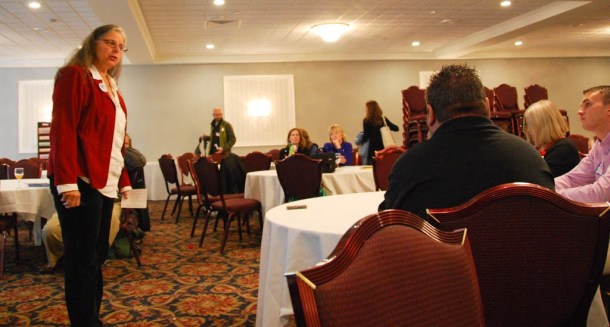
“[Marijuana] is with young people, and I would say with adults as well, one of the most misunderstood, rationalized drugs,” said Margo Austin, a counselor at Burlington High School, to an audience of about 20 people Monday in Montpelier.
“When this drug is present in [student] lives, school becomes so much more challenging,” Austin said, “because marijuana has a gripping impact on short-term memory and motivation.”
The event was hosted by Smart Approaches to Marijuana -Vermont (SAM-VT), a statewide chapter of a national movement aimed at keeping the use of recreational marijuana illegal. The group supports the use of medical marijuana and decriminalization of the drug, but believes making it more available will have dire consequences in the state.
But the group’s mission is not embraced by a majority of Vermonters, with recent data from the Castleton Polling Institute reporting 54 percent of Vermonters support marijuana legalization.
A number of prominent politicians in the state have also come out in support of legalization, including Senate Minority Leader Joe Benning, a Republican, and Democratic gubernatorial candidates Sue Minter and Shap Smith. Attorney General Bill Sorrell predicted at a retreat in September that the Legislature would legalize the drug in the next session, which begins in January.
“I’m a Vermonter, why is it inevitable? I thought I had a right to vote. I thought you had a right to vote,” said Debby Haskins, executive director of SAM-VT, at the kickoff event. “I thought we had a right to have a conversation with our representatives and senators.”
Haskins and others portrayed marijuana as a drug that would bring enormous societal costs to the state that would outweigh any benefits gained through tax revenue. Speakers said marijuana increased the risk of suicide, could spur schizophrenia and would act as a gateway to more serious substance abuse and pointed to the increased potency of modern marijuana.
“Let’s call it ‘crack weed,’ because if we are talking about THC levels of 90 to 95 percent that’s not ditch weed,” Austin said. “That’s not your grandma’s pot.”
Matt Simon, New England political director of the pro-legalization Marijuana Policy Project, said SAM-VT used hyperbolic rhetoric in their discussion of the dangers of cannabis.
“I think they are doing the entire debate a tremendous disservice by comparing marijuana to crack cocaine or any other drug that is known to kill people,” he said.
Simon said SAM’s decision to stop short of embracing recreational availability of marijuana meant the state was missing out on tax revenue and was supporting illicit activity through black market sales.
A report completed by the Rand Corp. on Vermont’s possible legalization of marijuana estimated the state could collect up to $75 million annually through taxes.
“We have seen this in Colorado and Washington,” Simon said. “Last year hundreds of thousands of dollars of marijuana products were sold and life went on, the sky didn’t fall.”
The Rand report said roughly 80,000 Vermonters use marijuana today, and Mariah Sanderson, director of the Burlington Partnership for a Healthy Community, said the number would rise to a dangerous level if legalization occured.
“Why do we want to increase marijuana-use issues that Vermont already has?” Sanderson asked. “And what kind of benefit could we possibly get from legalization that would justify that kind of public health risk?”
A number of New England states are debating legalization, including Massachusetts, Rhode Island and Maine. And Justin Trudeau, the recently elected prime minister of Canada, has promised to work toward legalization.
Several bills proposing the legalization of marijuana have been bee introduced in past legislative sessions but none gained traction. Lawmakers have said the issue is likely to receive a serious examination in the 2016 session.
While Simon said Vermont would eventually legalize the drug, he said he was not positive it will happen in 2016.
“I agree with Debby Haskins 100 percent on one thing: it’s not inevitable to be passed in the next session,” he said.

