

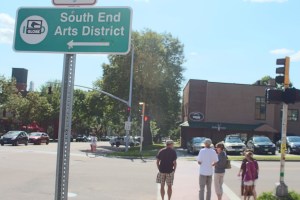
[B]URLINGTON — The City Council quashed plans to allow housing in a South End industrial district Monday after months of pushback from artists and business owners located there.
Councilors passed a resolution that “urges” planners “not to permit housing in the Enterprise Zone” and remove a recommendation in favor of housing from the draft PlanBTV South End — a planning document the city has worked on for more than a year.
Several members of the South End Alliance, a group giving voice to the artists and business owners in the Enterprise Zone, applauded the move, but said they believed the resolution’s language was disrespectful, because it referred to the controversy as a “distraction” from the planning efforts.
“The real distraction was the consultants’ push to change the zoning in the district,” said Genese Grill, a member of the South End Alliance. Grill and others took issue with the involvement of Boston consulting firm Goody Clancy and Associates, which has a $140,000 contract to help develop PlanBTV South End.
The Enterprise Zone covers only one-quarter of the South End, and only 4 percent of the city as a whole, yet it’s home to 92 percent of Burlington’s industrial space and 20 percent of its workforce, according to Diane Gayer of the Vermont Design Institute on Pine Street and the South End Alliance.
Residents also said they believed that, compared to past public planning initiatives, there wasn’t sufficient opportunity for meaningful community input.
Councilor Joan Shannon, D-Southern District, where the Enterprise Zone is located, was a sponsor of the resolution. She acknowledged that three draft versions of the plan all included housing in the Enterprise Zone limiting opportunities to weigh in against housing. Still, the process has included a “tremendous amount” of public engagement, she said.
Maggie Standley, an artist who for years had a studio in the Enterprise Zone, said presenting draft plans that all included housing was an “unfortunate waste of time and taxpayer money.” City officials say they appropriated $355,000 for the planning effort over two years.
Shannon and her co-sponsor Councilor Chip Mason, D-Ward 5, doubled down on their characterization of opposition to housing in the Enterprise Zone as a distraction from planning the future of the whole South End.
Mason said the opposition has been “loud” and “sustained” drowning out discussion of other aspects of the plan such as brownfield remediation, stormwater management, preserving open spaces and fostering economic development.
Addressing Burlington’s lack of housing is a pressing need, Mason said, lamenting that “any place we propose putting housing it meets with resistance.” He said he hopes the resolution will pave the way for a broader planning discussion.
Shannon said South End stakeholders are not uniformly opposed to housing in the Enterprise Zone, but her thinking has changed through the planning process. Burlington needs to “preserve some area for jobs” and when housing is an option, it tends to take over, she said.
Mayor Miro Weinberger came out in opposition to the proposed rezoning that would allow housing in the Enterprise Zone, in a Burlington Free Press op-ed last month. His reasoning echoed that of the City Council resolution that taking housing off the table makes sense because it’s become a “distraction,” not because it’s a bad idea. In the op-ed, Weinberger acknowledged residents’ fear that housing in the Enterprise Zone will push out businesses and spur gentrification.
However, the mayor wrote that he’s long been “open to the idea” of housing in the Enterprise Zone to meet the city’s desperate need for it and the potential for mixed-use development to make the area more “vibrant, pedestrian and bike-oriented.”
Shannon said the resolution passed Monday night does not preclude housing in the Enterprise Zone from being a part of future discussions on the neighborhood’s development.
Correction: An earlier version of this story misstated what percentage of Burlington’s workforce is in the Enterprise Zone according to Diane Gayer and the South End Alliance.

