


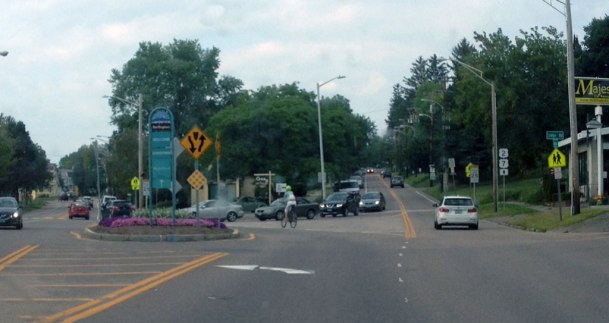
[T]he construction of Burlington’s first traffic roundabout is now scheduled for a section of Route 7 – a high-crash area – where a dangerous junction of five roads is mitigated currently by a rotary.
The Shelburne Street roundabout will be located where South Willard Street, St. Paul Street, Shelburne Street, Locust Street and Ledge Road converge.
The city and state met on Wednesday to coordinate work efforts and to plan outreach for the project, so the project can “advance as quickly as possible,” according to Chapin Spencer, the city’s director of the Department of Public Works.
Though the city is helping to coordinate the two-phase construction project, it is being managed by the Vermont Agency of Transportation, or VTrans.
Spencer said in an email that the roundabout “will be a great improvement for this intersection” and will accommodate all modes of transportation.
If everything goes according to plan, Spencer said construction will begin in 2019. Completion would be expected in late 2020 or 2021.
VTrans has budgeted the roundabout at $2.83 million, and the city will not be liable for any of the cost. Federal funds fully cover upgrades such as roundabouts for high-need locations, Spencer told residents on Aug. 21 at a South End neighborhood meeting.
Karen Paul, the Ward 6 city councilor whose district the project falls in, said the roundabout has been on the back burner a long time.
“I’ve been trying to move this forward because it is one of the top accident sites in the state, and it’s languished,” she said.
The City Council approved the project in 2008.
“Projects move forward when you have a champion. If you don’t have a champion who has muscle behind them, like [Department of Public Works] officials, it languishes,” she said.
Other factors have delayed the project, she said. “It’s such an interesting intersection, there are many utility lines underneath the rotary. Because of stormwater you can’t just pave over this,” said Paul.
Michele Boomhower, the state director of policy planning and intermodal transportation, said it has been difficult for the city to make arrangements for the complicated project.
“My understanding is that there were delays in getting agreement from the city a few years back as to how to address the utility elements of the project – and in arriving at a signed agreement,” Boomhower said by email. “In the past few years, there has been enhanced communication and collaboration which has aided in advancing the project to the point we are at now.”
Sitting atop an axis of criss-crossing utility lines, Paul explained, the roundabout’s construction requires the utilities to each agree to work within and share a common duct that’s going to be built for the project, Boomhower and Paul said.
Then each utility needs to sign a legal agreement. Boomhower said that after “a lot of discussion and debate” the state persuaded all of the involved utilities to share a common duct underneath the roadway.
Still, legal agreements haven’t all been signed, and the city needs to get rights of way for properties it will need to dig in or near.
After that, the city’s new proposed water and sewer lines will need to be designed.
Rights of way – or access to underground utilities and adjacent lots for storing machinery or digging – are currently being obtained across 32 different properties, said Boomhower.
Half of those properties would be directly impacted by the construction, and three would require takings – including part of the property at Christ the King School on Locust Street.
In spite of the complexities, public support, and even demand, based on recent comments at VTDigger – appears to be high.
“Now if only the City could act as quickly for the Shelburne Street Rotary – a far busier, and far more dangerous, intersection … with no progress in sight,” wrote Dave Smith, responding to a recent story about a traffic light on Pine Street.
Tony Redington, who sits on the Ward 2 Neighborhood Planning Assembly in the Old North End, called the rotary an “‘intersection of death’ on Shelburne Street [that] remains unaddressed for seven years though 100 percent federally funded.”
After a March 30 tour and seminar on the roundabout trend, an article in the Burlington Free Press mapped the city’s worst intersections and gauged them on their roundabout-worthiness.
Burlington’s Shelburne Street roundabout would be one of 12 that have been built in the state. Four others are in the design phase.
Paul said she’s only seen interest grow as the years have passed.
“There’s always been support for the roundabout, especially now lately I’ve been hearing for one reason or another from a lot of people,” she said. “Some who have children they walk to school, a lot of elderly people are very concerned about how safe that intersection is, you have the church, you have the school, Callahan Park,” she said.
Chapin Spencer noted that while roundabouts were included in the recently released planBTV South End, the Shelburne Street roundabout in discussion wasn’t part of that, or prompted by the plan, though it does fit into the multimodal goals for the neighborhood.
“It will be Burlington’s first full roundabout and I’m pleased that there is such public support for getting it constructed,” said Spencer, who said the state and city would have a public meeting about the project in the next month or two.
For information from the Chittenden County Regional Planning Commission on roundabouts visit this page.
