



[A] study on school lunches published last month by a University of Vermont research team won time in the national media spotlight — and prompted some some debate in Vermont.
Sarah Amin, who recently completed her PhD at UVM, lead the research in 2012 and 2013 that used digital imaging to track students’ eating habits around the time new federal school lunch guidelines were enacted.
During the 2012-13 school year, a change in federal policy about school lunches went into effect, mandating that students select one fruit or vegetable as part of every school meal.
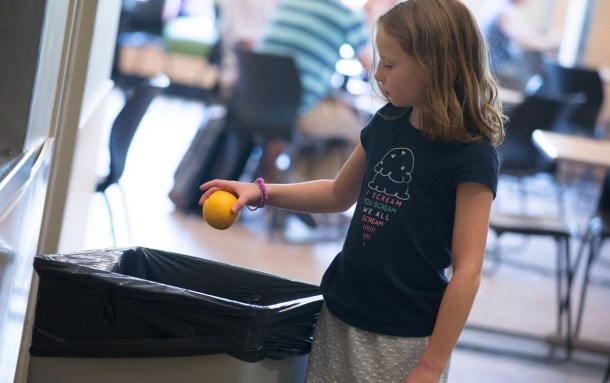
But, in studying two elementary schools in the northeast, Amin found that instead of increasing consumption of fresh fruits and veggies, the new guidelines resulted in higher rates of food waste as well as a slight decrease in consumption from when they were allowed free choice.
The study, published last month in Public Health Reports, found that after the new guidelines were implemented, kids picked up fruits and vegetables at a higher rate. But kids also threw away more fruits and vegetables — food waste increased by 56 percent under the new guidelines – and they were eating 13 percent less of those foods than they had before the mandate.
Published on the eve of a congressional vote that will determine whether to extend the national nutrition guidelines, Amin’s study garnered national media attention, earning headlines in the Washington Post, Consumer Affairs, CBS and others.
However, Marissa Parisi, executive director of Hunger Free Vermont, questions how representative the study’s findings are. The research was carried out when the guidelines were newly implemented, she said, and the program across the country was in a transition phase.
“It just does not paint an accurate picture of what is going on in schools now, or even what was going on in schools then,” Parisi said by phone earlier this week.
Parisi said that she agrees with what some of the research found — for instance that children with longer lunch breaks are more likely to eat fresh fruit and vegetables. “Kids just need time to sit and eat their meals,” Parisi said.
And Parisi said that anecdotes from food service directors and other recent research contradicts the UVM study.
At Barre Town Middle and Elementary School, Bob Hildebrand, the food services director, said children’s attitudes towards fruit and vegetables shift in the time since the guidelines were implemented.
“We’re not getting nearly the resistance we were a few years ago,” Hildebrand said, who is currently serving in his third year overseeing the cafeteria offerings for students from Kindergarten through eighth grade.
Hildebrand, who works for the Abbey Group, a food service provider that operates throughout the region, said that the lunch regulations have been a learning curve on both sides of the cafeteria line.
Hildebrand and other Abbey Group managers experiment with different tricks to make fruits and vegetables more enticing. While a whole apple may not attract a lunch line fan club, he said, a salad bar with a wide range of choices can prove to be a hit.
At first, when the guidelines came in, some kids fought the half-a-cup requirement, Hildebrand said. But it is now very rare that he finds himself in a stalemate with a student over fruit and vegetable portions. In fact, he said, he’s watched many kids expand their palates. He has even had to step in to stop kids taking too much pineapple.
“I think there’s always going to be some level of food waste,” Hildebrand said. “The trick is I think to encourage kids to take a healthy amount.”
In an interview Thursday, Amin said the study provides “one snapshot” of school lunches and noted that she would like to see more research from a broader geographical area, as well as over a longer period of time.
Amin said that she intended the study to be viewed in the context of other research on the implementation of the program. Some other research, like a study out of Harvard University, sheds a more positive light on the lunch guidelines, she said.
“We just want our study to serve as one piece of a very large and complex puzzle,” Amin said.
Ultimately, she said her team is supportive of the changes made to the school lunch program, and she points to ways that fruits and vegetables can be more enticing to children — cutting up an apple or serving vegetables with dip, for instance.
“We are strong school nutrition advocates and we’re very (in favor of) the guidelines being reauthorized next month,” Amin said.

