

[T]he city of Burlington is giving residents an opportunity to decide which water quality planning projects should be priorities for the city.
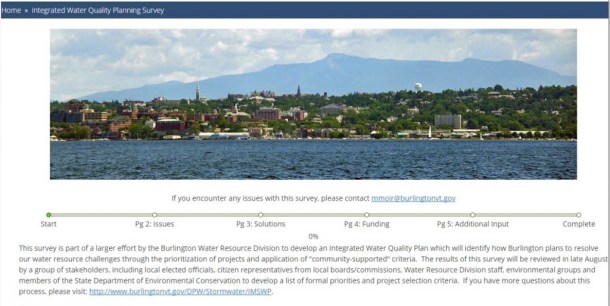
Until Aug. 25, a public survey created by staff from the Water Resource Division is open for all Burlington residents to weigh in on which water quality projects are the most important to implement.
Staff from Burlington’s Water Resource Division attended Neighborhood Planning Assembly meetings to share information on water quality in the city and to engage Burlington residents in a dialogue about how they would like to see their stormwater and wastewater utility fees spent to improve water quality. The result is the survey, which became public on July 29, according to a news release.
“Like other cities, Burlington has a wide variety of water quality challenges and there’s no real way for us to adjust them all at the same time,” said Megan Moir, stormwater program manager of the Burlington Public Works Department.
Input from the survey will be used to help inform Burlington’s water improvement program, which features a new, integrated planning approach for wastewater and stormwater management, according to the release. Moir said the agency will use the data provided by Burlington residents. She is particularly interested in finding out which of the city’s water resource challenges are of most concern to residents, and what planning criteria residents would like the city to use.
The online survey is six pages, including the start and finish pages. The second page lists a wide range of water quality issues, including general water quality of the streams, rivers and Lake Champlain, sediment runoff and beach closures, and then asks the participant to rate a level of concern for each issue, or specify that they need more information.
The next page asks which kind of stormwater management solution the participant would prefer out of green stormwater infrastructure, such as rain gardens, trees, permeable pavements and bioretention – and traditional gray stormwater infrastructure, such as subsurface tanks and pipes. The survey goes on to ask the participant to choose which criteria they see as most important when considering solutions to the water quality issues.
“Oftentimes in public projects, it’s only about cost, cost and cost,” Moir said. “But we would like to think that there may be other things that we would want to look at when we are prioritizing projects, such as ability to create more greenspace, improving the aesthetics of a neighborhood or a business district, the ability to treat multiple pollutants versus just one pollutant at a time and so on and so forth.”

Burlington is one of five recipients of a grant from the Environmental Protection Agency, according to a Sept. 23, 2014, letter from the agency. The $67,000 grant is from Tetra Tech, an Environmental Protection Agency contractor, Moir said.
Without the grant, Moir said she doesn’t know if the city would have started on this process quite so early. She also said she had originally proposed a different scope for the grant than what was given to the city.
“I had actually wanted them to help us with the financial capability assessment piece, but the EPA wasn’t able to help with that,” Moir said. “The main area that they’re helping us out with is the public outreach component and the survey.”
Tetra Tech is a company that supports both government and commercial clients. It gives consultation on solutions for water, energy, environment and infrastructure, according to its website. Previously, they have assisted the state with Lake Champlain phosphorus studies, according to the July 29 news release.
Tetra Tech is also going to lead stakeholder meetings Aug. 27 in which the results of the survey will be reviewed, Moir said. Stakeholders will include locally elected officials, citizen representatives from local boards and commissions, Water Resource Division staff, environmental groups and members of the State Department of Environmental Conservation, she said.
“Obviously we’re the technical experts,” Moir said. “We’re going to run any technical information through a screen to make sure it makes good scientific, logical sense, but we are interested in what people think we should be focusing on.”
Tetra Tech will also help Burlington with a more refined stakeholder meeting between the Environmental Protection Agency and the Vermont Department of Environmental Conservation as they determine what criteria Burlington will use for projects, Moir said.
“And the last part of the grant, I believe is going to be looking at some existing projects that we’ve already done the studies for, and run them through the prioritization matrix that we’ve developed and kind of show how this process will work in the future,” Moir said. “That, I believe, is going to be the extent of the EPA grant.”
Moir said the city also recently received a $100,000 grant from the Vermont Department of Environmental Conservation to “take it to the next step” and conduct citywide stormwater and combined sewer master planning, and look at where and how they would be treating stormwater throughout the city while also using the criteria being developed right now from the survey.
It could potentially be a “long time,” Moir said, before the projects are implemented. She anticipates having an integrated plan – a document that talks about the process and actually looks at the different types of projects that they would do, as well as the total price tag for all the things that they need do – in 2017. At that point city officials will look at the total cost, she said.
“A key piece of the financial capabilities assessment is making sure that how much we ask ratepayers to pay in any given year is not so much that it kind of breaks the bank,” Moir said.
“We have to look at our socioeconomic factors for Burlington, how much they’re paying for the wastewater rate, the water rate and the stormwater rate to make sure we come up with a sustainable rate plan that funds as much as we can do in a year but doesn’t put undue burden on our community [members] that are already paying taxes and already paying other rates.”
It could take up to 20 to 25 years before projects are in place. Moir anticipates seeing some early pilot projects, or small examples of the types of projects that they want to do, as soon as next year or shortly after 2017.
It takes six to 10 minutes to complete the survey. Moir would like to see 300 to 500 respondents.
To take the survey, visit this page.
