

Editor’s note: This commentary is by Tom Pelham, formerly finance commissioner in the Dean administration, tax commissioner in the Douglas administration, a state representative elected as an independent and who served on the Appropriations Committee, and now a co-founder of Campaign for Vermont.
[N]ear the end of the recent legislative session, Rep. Janet Ancel, chair of the House Ways and Means Committee, said, “We’re trying to get a revenue bill and trying to get out of here.”
And so they did.
At the beginning of the legislative session, legislative leaders struggled to fix a problem of their own creation, the legendary $113 million “budget gap” for fiscal 2016 attributable to budget growth at 5 percent in an economy growing less than 3 percent. Higher taxes would have to be part of the plan, they said, but protecting the middle class from tax increases was a priority.
But in the end, it’s the middle class that will pay the higher property taxes, sales taxes and income taxes. Let’s take a closer look at the income tax increases in this regard.
The Legislature and governor increased income taxes by eliminating the deduction for state and local income taxes, capping itemized deductions at 2.5 times the standard deduction (excluding medical expenses and charitable contributions) and placing a minimum 3 percent income tax on incomes over $150,000.
The manner by which the JFO profiles these tax increases makes them appear of relative minor impact, with .1 percent to .3 percent effective tax increases across “all taxpayers.”
Here the Legislature’s Joint Fiscal Office (JFO) profiles the plan (see page 3). The manner by which the JFO profiles these tax increases makes them appear of relative minor impact, with .1 percent to .3 percent effective tax increases across “all taxpayers.”
But here’s what the JFO profile doesn’t show. First, it doesn’t show these tax increases are retroactive to Jan. 1, 2015, causing the tax increases to apply to all of calendar 2015 plus the last six months of fiscal 2016, from Jan. 1 to July 31, 2016.
Secondly, the JFO profile doesn’t show the effective percentage increase specifically on those taxpayers directly affected by the increase, for example those who itemize deductions. Here’s that profile using the JFO data:
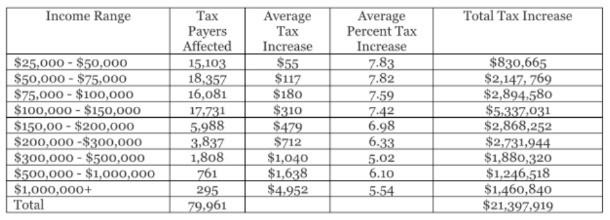
As can be seen, lower income filers will pay a relatively higher percentage tax increase. Cumulatively, tax filers with incomes below $150,000 (which in many instances are a married couple filing jointly) will pay 52 percent of the tax increase at $11.2 million while higher income taxpayers will cover the balance at $10.2 million.
And so it goes, the Legislature and governor cannot solve the fiscal mess they’ve created without whacking the middle class as there are too few higher income filers in Vermont upon whom to cost shift their overspending.

