

[R]esearch conducted by a University of Vermont biologist shows that decades of conservation efforts for marine wildlife have been successful, but now there’s another problem amid the resurgence: invasive species.

Joe Roman, a fellow at the Gund Institute for Ecological Economics at the University of Vermont, was the lead author on a study that discusses how the past few decades of conservation efforts, such as the 1973 Endangered Species Act, have led to an abundance of some marine species, according to the June 2 paper.
“This paper is intended to help wildlife managers do something unusual: make decisions when animals are abundant rather than when they are rare or endangered,” Roman said.
Roman said that there is still a need for increased protection of the oceans. Many coastal communities and maritime industries see the increase as a “surplus,” even though many of the species were at high levels already, according to the paper.
Roman attributes this surplus mindset to shifting baselines — when fisheries’ biologists see the abundance of fish stocks at the start of their careers as an ecological baseline, and then judge future changes against that baseline. His paper is about setting a new baseline and lifting the current baselines to accommodate the increase in marine species, Roman said.
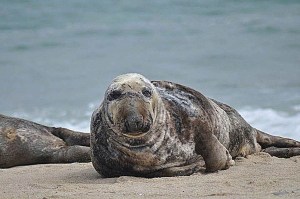
In particular, a rise in the number of gray seals has been blamed in parts of Canada and the East Coast for decreasing fishing stocks as well as increasing the number of great white sharks that migrate in toward Cape Cod, according to the paper. In 2012, Canada’s Senate Standing Committee on Fisheries and Oceans proposed to kill 70,000 gray seals over the course of four years in the Gulf of Saint Lawrence in order to recover fishing stocks, according to the paper.
Reducing and eliminating commercial hunting has been a huge factor in the population increase of some species, according to the paper. Roman said that the populations of some species have increased enough that environmental protections could be taken away.
“We can turn around the decline in species,” Roman said.
The National Oceanic and Atmospheric Association has already announced a proposal to reclassify the status of humpback whales under the Endangered Species Act, according to an April 20 press call. Donna Wieting, director of the NOAA Fisheries office of protected resources, said that humpback whales were first listed as endangered in 1970.
Since they were first placed on the Endangered Species List, there has been a significant increase in 10 of the 14 population segments of humpback whales, Wieting said. Of the other four population segments, two will be listed as threatened instead of endangered and two will continue to be listed as endangered, Wieting said.
“Over the last decade, there have been concerted efforts to make population estimates,” Angel Somma said, chief of National Oceanic and Atmospheric Association fisheries endangered species division.
The two species that will still be listed as “threatened” swim through U.S. waters, but the two that are continued to be listed as endangered do not, Wieting said.
The 90-day public comment period on the 10 species of humpback whale being “de-listed” ends July 20, said Jenny Lyons, spokesperson for NOAA. Lyons said that the agency aims to get out a final rule by April 21, 2016, or as soon as is practicable.
A year and a half ago, Roman went to a Duke University marine lab, which began his research for this paper, he said. He said he had worked with two of the three co-authors prior to this paper, and that all three co-authors are affiliates of Duke University.
