

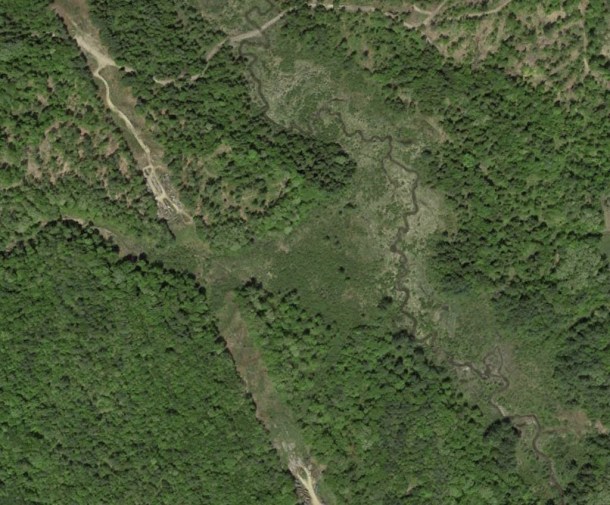
[P]art of a wetland Vermont Gas purchased with the intention of placing it into conservation to mitigate the environmental impacts of a proposed natural gas pipeline stretching through Addison County was damaged by its former owners, the company said.
Vermont Gas said it discovered this month that a wetland in Colchester was filled with clay soil and tree stumps by an excavation company on behalf of the trash collection company, Gauthier Trucking Inc., the former property owner. The incident allegedly occurred after Vermont Gas took ownership of the property, and the state is investigating who is responsible.
Vermont Gas purchased the 61-acre parcel for $250,000 as part of an agreement with the Agency of Natural Resources to conserve the land in exchange for building a 41-mile below-ground pipeline from Colchester to Middlebury.
The state and Vermont Gas believe the wetland can be restored. Vermont Gas is currently speaking with the former landowner and the agency is conducting an investigation to determine who is responsible and whether fines or remediation are necessary.
Vermont Gas discovered a bulldozer operated by Ormond Bushey & Sons, an excavation company in Essex Junction, filling the class two wetland May 1. The company says it then contacted Gauthier Trucking and the excavation company to have the activity halted.
Vermont Gas attorneys sent cease and desist letters that day to Gauthier Trucking and Ormond Bushey & Sons. Vermont Gas says it later discovered a second dumping area a few hundred feet away.
One of the owners for Gauthier Trucking Inc. declined to comment for this story.
Vermont Gas said it is stabilizing the area to mitigate further environmental impacts, including the installation of a silt fence at the toe of the filled area. It says it has also put up no trespassing signs and is working on a remediation plan.
“This activity was not conducted by or on behalf of Vermont Gas or any of our representatives. We are committed to making sure the damage is remediated and to preventing further unpermitted activities on the property,” said Beth Parent, a spokesperson for Vermont Gas.
Parent said the company believes that the parties responsible for the environmental damage will have to bear the cost.
Gary Kessler, compliance and enforcement director for the Department of Environmental Conservation, said less than one acre of the total parcel appears to be disturbed. He said it is likely the damage could be repaired.
The 61-acre parcel contains 15.8 acres of sandplain forest, several wetlands and streams. The wetland that was filled runs into an unnamed tributary of the Indian Brook, according to Vermont Gas.
Wetlands, also known as bogs or swamps, are considered a buffer between dry areas and waterways. Wetlands provide flood control, water quality protection and wildlife and plant habitat, among other functions.
The purchase was required as part of a memorandum of understanding with the Agency of Natural Resources. Compliance with the MOU is a condition of Vermont Gas’ state permit for construct the pipeline.
The Department of Public Service, which represents the public in utility permitting processes, said Vermont Gas did not violate the terms of its state permit.
“I don’t think it’s a violation of the [certificate of public good] at all,” Public Service Commissioner Chris Recchia said. “This is apparently trespass with an alleged violation of wetland rules that the landowner happened to discover. The [Public Service Board] is the ultimate decider.”
Opponents of the Vermont Gas pipeline say the company is responsible and violated a condition on their state permit.
“Since Vermont Gas owns this parcel they are responsible for the activities on that site,” said Sandra Levine, a senior attorney at the Conservation Law Foundation in Montpelier. “It calls into question their ability to manage this project where they seem unable to provide the protection that is required of the natural resources on their property.”
Recchia said the company discovered the activity and reported it immediately.
“An investigation needs to occur. I don’t not see any sloppiness here on the part of Vermont Gas,” he said.
Vermont Gas has agreed to acquire two conservation easements or purchases, according to Parent.
Construction of the pipeline is underway as the Public Service Board considers whether to revoke, change or approve the company’s state permit following a increase in the cost estimate to build the pipeline.
The company estimated the project would cost $86 million when it was approved in 2013. Late last year the company said it would cost $154 million, the second such increase the company announced. Most recent estimates indicate the project’s’ cost have held steady.

