

[T]here is little to remind visitors today at the Statehouse of what the House Chamber looked like 50 years ago on May 14, 1965. There now are only 150 desks for House members, not 246, one for each town in the state. There are no more spittoons. There is no longer a long table on the House floor where the press and media sat in the middle of the action. Today, visitors will observe House members busy with a vast array of technology at their fingertips.
In 1965 there was no technology in evidence. No iPads, no cellphones. No microphones. Then, as now, there is an army of eighth-graders serving as “legislative pages.” But even these young folks are now equipped with technology. This makes the old-fashioned practice of carrying handwritten notes no longer the principal way of communication inside the Statehouse.
1965 was a Vermont of a different time.
As a young reporter for the Vermont Press Bureau, I had a front row seat on the House floor. By that warm May afternoon in 1965, I had been reporting on the emotional events for months leading up to the crucial vote regarding reapportionment. The vote is an event seared in my memory.
Thanks to Rep. Tim Jerman, D-Essex Junction, who last Thursday used the time for daily devotionals to recall for his current House colleagues that 50 years before on that day the House voted 163-62 to reapportion. The vote brought to an end a system where each and every town in Vermont sent one person to the Statehouse. By 1965 Vermont had one of the most malapportioned legislative bodies in the nation.
The federal courts had declared Vermont’s method of electing Vermont House members unconstitutional. The state was under a federal court order to either fix the system by June 30, 1965, or the courts would impose a solution.
For many months, then House Speaker Franklin Billings Jr., R-Woodstock, was trying to convince the large majority of Republicans in the House — 173 of the 246 members — many from very small towns, that they needed to vote to commit political suicide.
It was a gut-wrenching and emotion-laden debate that lasted for months with no clear outcome until the very end.
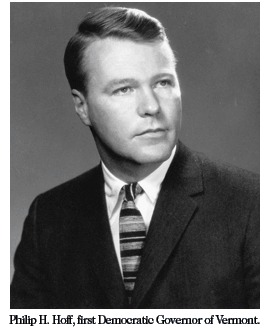
On one side was the then Democratic governor, Philip H. Hoff, who along with fellow House Democrats and a bloc of liberal Republicans, strongly favored reapportionment. On the other side were small-town conservative Republicans who deeply distrusted the “big cities” and feared that the “Vermont way of life” would be destroyed. But despite their angst they feared the federal government worse, and the thought of the proud and independent state of Vermont coming under federal control was unthinkable.
In the end, these conflicting forces resulted in a coalition of Republicans and Democrats putting aside their deep personal feelings for the good of the state and they voted to move ahead.
When the vote was announced there was weeping in the Statehouse. There were threats of civil disobedience. There were declarations that the larger towns in Vermont with more House votes would suck the life out of the very small towns. One prediction was that Democrats would take over the politics in Vermont and replace the Republicans as the leading party in Vermont.
By contrast, there was great joy and elation in the House, led by Gov. Hoff, who declared that Vermont was finally leaving the 19th century, and predicted that Vermont was on the verge of a new era of state government. In fact, Hoff was standing in the House balcony watching the vote (against all traditions) and gave a loud yell of approval at the result.
The prediction that Vermont would face major changes proved to be right on the mark. During the remainder of the 1960s, the Vermont Legislature moved rapidly to consolidate state agencies, revamped the state’s judicial system, began the drive for more environmental controls by banning billboards, and abolished the office of the local Overseer of the Poor, replacing it with a statewide system for social welfare programs, as a few examples. The politics of the state changed dramatically. Now Vermont is considered the most liberal state in the union.
Rep. Edward J. Conlon, R-Windsor, said it best when he stood up rather solemnly after the May 14, 1965, reapportionment vote was announced: “Time marches on.” Yet, Conlon might be amazed that 50 years later, despite the many changes, the historic tension between small and larger Vermont towns, especially as it relates to schools, and the authority of the towns versus state government, are still persistent themes of Statehouse debates in 2015.
Steve Terry was former managing editor of the Rutland Herald and is a founding member of the Vermont Journalism Trust Board. Terry, Tony Marro and the late Sam Hand are the authors of “Philip Hoff — How Red Turned Blue in the Green Mountain State,” published by Castleton College in 2011.

