

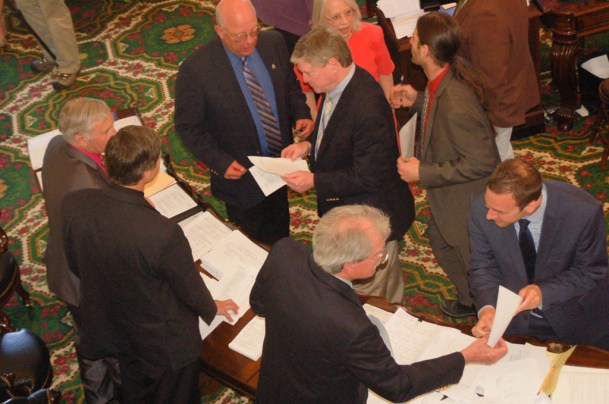
[T]he Vermont Senate gave preliminary approval Thursday to a bill aimed at improving educational quality and reducing school spending.
After four hours of debate, largely over the impact of the legislation on the state’s small schools, senators voted 27-3 to accept its version of H.361, setting up a showdown over significant differences with the House-passed bill.
Critics of the Senate legislation say the bill has no cost controls and will not result in lower property taxes in the near future. The House version includes a cap on school budgets that has been deemed unconstitutional. Suggestions for using average per pupil spending rates as a tool for limiting spending were not incorporated in the Senate bill.
The Senate legislation features incentives for school districts to create larger school systems that offer economies of scale and improve educational opportunities for students. It encourages school districts to consolidate school boards. It also preserves economic supports that keep small schools from feeling the full effect of declining enrollment.
The House version phases out those supports, known as small schools grants.
 Senators on the floor argued about preserving the grants, which go to about 100 schools that have 100 or fewer pupils.
The lawmakers voted to support an amendment from the Senate Appropriations Committee that restores the grants.
Lawmakers also argued whether the legislation — spawned by an outcry for tax relief from voters in the November election — delivered on that expectation.
At least one lawmaker, Sen. John Rodgers, D-Essex/Orleans, said he will propose from the floor Friday an amendment that would limit school spending.
Sen. Joe Benning, R-Caledonia, said he supported H.361 because many of the schools in the Northeast Kingdom, which he represents, are in trouble, and many are looking at ways to work together and share resources.
“I have witnessed several small schools go through the painful process of closing,” he said.
For schools that are operating efficiently and offering a quality education, “This bill leaves you alone,” Benning said.
But fears about the fate of small schools, in part, led Sens. Anthony Pollina, D/P-Washington, Richard McCormack, D-Windsor, and Dick Sears, D-Bennington, to vote against the bill.
“I know that this bill says it is not intended to close any small schools … but I’m simply not convinced that will not be the result of the bill,” Pollina said.
Pollina also said he was “not convinced that this proposal does anything to address the need for lower property taxes.”
McCormack said the purpose of the bill seemed to fluctuate during the session.
“Initially, this was a way to lower property taxes,” which resulted from taxpayer outcry, he said. But when hard savings weren’t identified, McCormack said, “Suddenly [the bill] was about quality. I see a major disruption of Vermont tradition with inadequate justification for doing it.”
Most senators, however, said the bill addresses the challenge lawmakers were given.
“I believe that this bill moves us in the right direction,” said Sen. Becca Balint, D-Windham. “I believe that if you keep children at the center of the conversation and their needs going forward, then changing the governance structure will help to give them what they need — not just educationally, but socially and emotionally, so I will be supporting this bill.”
 Both versions of the bill seek to move the state’s 277 school districts into larger school systems to compensate for the loss of more than 20,000 students since 1997. Meanwhile education spending and property taxes have continued to climb.
“Both the House and Senate have now passed legislation to enhance the quality of education in Vermont and bend the cost curve on education spending,” said Gov. Peter Shumlin in a statement late Thursday. “I feel confident we will emerge with legislation that makes meaningful reforms to promote quality education at a price Vermonters can afford.”
The bill offers tax breaks and grants to spur merger activity, and phases out the hold-harmless provision that, like the small schools grants, has cushioned tax rate increases for districts losing enrollment.
Sen. Ann Cummings, D-Washington, chair of the Senate Education Committee, said the committee took testimony about a high school with only two students in a class. She questioned whether those students were getting the kind of healthy social interaction they will need to be successful adults.
Sen. Philip Baruth, D-Chittenden, supported the bill because he believes the state needs to address the demographic crisis in Vermont’s schools, projected to continue to at least 2030.
The Senate version calls on the Secretary of the Agency of Education to propose a plan to the State Board of Education to restructure districts that have not taken any steps to consider consolidation of school district boards. The Legislature will ultimately decide whether to reassign school districts.
It also calls for two preferred governance structures — supervisory districts or supervisory unions of 900 students — but stresses that that will not work or be expected in all regions of Vermont.
“We felt that what we put forward in terms of incentives and abilities of districts to work together could bend the curve on property taxes, and could provide better opportunity for Vermont students,” said Sen. Dustin Degree, R-St. Albans.
Sen. Bobby Starr, D-Essex/Orleans, explained the changes made by the appropriations committee, and its decision to preserve the small schools grant program – which costs the state about $7 million a year. Starr said 77 schools that receive the grants would be affected.
“We would have a net savings of about $2 million to $3 million, and we felt that that was such a small savings … that for causing them that much grief, it really wasn’t worth the battle,” Starr said. “If you want to go to war with 77 towns, good luck to you.”
Cummings argued against keeping the small schools grant program as is, saying removing the assistance, except for geographically isolated schools, “… was one of the major incentives to start making changes.”
The Senate bill is up for final approval Friday and, if passed, would move to a conference committee to iron out the differences with the House version.

