


[B]ack when horses did the farm work and one-room schoolhouses dotted the Vermont landscape, our state had something else it doesn’t have much of any more: grain production.
In 1830, wheat-growing in Vermont peaked at approximately 40,000 acres – more than 60 square miles — according to the St. Albans-based Northern Grain Growers Association.
But as soils became exhausted and farmers sought more productive land on the nation’s western frontier, grain acreage in Vermont plummeted. By 1950, only 907 acres of wheat were planted, according to Jack Lazor, who with his wife, Anne, produces wheat, soybeans, other grains and dairy products on 450 acres in Westfield and Troy.
The decline continued after 1950, but grain-growing in Vermont never quite died out, and today it’s making something of a comeback.
Heather Darby, field-crops specialist with the University of Vermont Extension Service in St. Albans, sees “a very slow, steady increase” in the cultivation of food grain – meaning oats, soybeans, flint corn, millet, barley, spelt and flax, in addition to wheat. She estimates the total cultivation of food grains at 2,000 acres statewide and production is mostly organic.
The hurdles that Vermont grain-growers face involve more than the absence of the flat expanses, deep topsoil and economies of scale that make the Dakotas or Illinois ideal for many of the crops that struggle here.
Less obvious are the financial hurdles — the cost of energy and pricey machinery Vermont farmers need to dry harvested grains in a climate that is much wetter than the American grain belt. Outlays for harvesting combines also exceed what small farmers can afford.
In addition, Vermont has no off-farm flour mills to take grain from local farmers — the nearest such facilities are in Quebec and New York.
And, in Lazor’s words, “none of them want to pay that much” for grain produced, expensively, on a small scale. The competition, Midwestern wheat, can be brought in by the railroad car for milling. Such flour as is produced in Vermont thus comes from small mills on the growers’ own farms.
“The market’s there” for local grains, Darby said, “but it’s the middle piece, the processing piece” that inhibits production.
The relative ease of growing grain for animal feed poses another challenge. Feed grain does not have to meet as high a quality standard as food grain, and it commands as good a price, tempting growers away from the consumer market.
With soybeans grown for soy milk, for example, “You get a stone in there and it ruins your equipment, to say nothing of lawsuits,” Darby said.
Darby says a lot of farmers prefer to grow feed grain because they get paid about the same amount with fewer headaches.
The joy of soy
While oats, barley, wheat and rye have long histories in the Green Mountain State, Vermont’s organic farmers in particular have recently struck out in new directions, growing such crops as soybeans. Hardwick’s Vermont Soy Company, which produces organic tofu and soy puddings, uses beans almost exclusively from five Vermont growers, the remainder coming from just across the border in Quebec.
“There are more smaller growers that are getting into that crop,” business manager Michael Carr said.
“Soybeans are actually one of the easier [crops] to grow,” Darby said. “It’s easy to get soybeans to the right moisture and dryness, vis-a-vis corn,” with which soybeans are often grown in rotation.
Carr noted, however, that “getting the beans clean is a restriction for a lot of small growers. They don’t have that equipment and may have to contract that out.” Darby estimated that soybeans grown for food – much is grown for animal feed – accounted for only 500 acres around the state.
Darby spearheaded the growing of soybeans for food by bringing in seed beans from Quebec in 2007 for experimental cultivation.
The variety “was just really vigorous,” Lazor recalled. “I decided I was going to use that soybean. They get up to my waist. They’re really well adapted to Vermont.”
Rice is nice
In recent years, rice has also been grown in at least five Vermont locations – even in Cabot, where midsummer temperatures average only 66 degrees, below the 68-86 degrees ideal for the crop.
Rhapsody Natural Foods, which makes rice milk and other rice products, has been growing a relatively cold-tolerant rice in the Washington County town experimentally for seven years, but general manager Sjon Welters conceded that Cabot is at the climatic fringe for rice cultivation.
Climate change could change that, he said, but in the meantime, the Champlain Valley is “a very good area” for rice-growing.
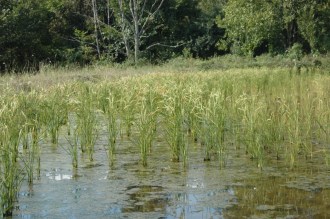
Champlain Valley rice growers include Erik and Erica Andrus, who plant one acre of the grain in Ferrisburgh, making them the state’s largest producers of the crop. Erik Andrus said they had no problem selling the 3,000 pounds of table rice they produced in 2013, their best year since getting into the crop in 2011. The rice retailed at about $4.50 a pound, he said. “I could charge more. I could be charging $10,” he said.
“We’re so far from reaching the demand out there for regional rice,” he said of the crop’s potential in Vermont. The couple are prepared to grow up to five-plus acres ultimately, but that may be as far as economies of scale can be stretched on a small, diversified farm such as theirs.
“I’m not even a flea in comparison” to big California growers, Andrus said. “Five acres is a lot for me, but a grower in California wouldn’t even get out of bed for that little.”
Like Welters, Andrus wants to see public investment in rice’s potential.
“If we (Vermont rice-growers) could have 1 percent of what large-scale dairies get in the way of support, that would be fantastic.”
Andrus said the state would need to help invest in water management systems and terracing to create rice paddies. But, he said, “the state of Vermont finds this so novel that they’re just going to sit on the sidelines for 10 years before they take it seriously. By that time I’ll either have succeeded or gone out of business.”
Grist for the mill
The Andrus farm also produces wheat, which the couple grinds for their bakery’s artisan breads. The Lazors do their own grinding, too, selling wheat and spelt flour and cornmeal in outlets around the state.
The local branding and niche appeal of such finished products would seem to broaden possibilities for profit when the growing itself is a losing proposition. But on-farm refinement of crops is far from being the universal recourse for Vermont grain-growers struggling to survive financially.
“Some of our best farmers just want to produce food,” Darby said, but “currently people in Vermont who are growing grains don’t have much choice. They’re meeting a market demand for flour by processing it on their farms.
“Some [farmers] find a niche. That’s the great thing about Vermont. You can come up with anything. It’s amazing sometimes.”
The Rogers farm in Berlin presents a case in point. Nate and Jessie Rogers and the Lazors, are the only people in the state growing oats for human consumption.
Labor concerns
The Rogers grew 12 acres of oats last year, in addition to their wheat and dairy operations, and are rolling the oats themselves. They grew a hull-less variety of the grain with seed from Quebec and got around the expense of a hulling machine. They utilize rolling equipment that’s simpler and less expensive than the machinery used for mass-market oatmeal. That means a shorter shelf life, and the finished product is not cheap. The Rogers say the standard processes “reduce flavor and take away nutrients.”
Vince Rooney, who uses the Rogers’ oats at his Falls General Store cafe in Northfield, calls them “some of the best I’ve ever tasted.”
Nate Rogers said grain-growing in Vermont is “a very viable business for farmers willing to invest in the infrastructure,” but added that “keeping it simple” — as in simplifying the oat-rolling – is “the whole thing.”
“It’s a scale discussion, too. You don’t start out growing 150 acres. You keep adding infrastructure as you go,” he said.
Whatever the success of the Rogers’ economy-conscious approach, the micro-level vertical integration of farm production with processing, distribution and marketing presents its own pitfalls. Adding value at the farm can mean that employees, even those who devote most of their working hours to producing the raw commodity, are no longer subject to an agricultural exemption for overtime pay.
As Lazor explained, “If I clean grain for seed and sell it to other farmers or grind wheat into flour and sell it to stores, I lose some of the tax advantages given to farmers because I am now considered a processor.”
The Lazors found this out in 2013, when the U.S. Department of Labor audited their operation and ordered them to pay $11,000 in overtime due to employees.
“We really got taken to the cleaners on it,” Lazor said. “We have to be very careful who does what and how. It takes the fun out of it.”
Vermont’s grain farmers must consider, above all, the prices they charge for products.
While the Andruses’ rice has fetched $4.50 a pound, not everyone is prepared to pay such a premium for a local alternative. As of mid-April, comparable rice from elsewhere in the United States was available for $2.49 a pound at Montpelier’s Hunger Mountain Co-op and $1.16 a pound at the Colchester Costco.
In Darby’s words, “The unfortunate piece is that most Vermonters can’t have access to these great [Vermont-grown] products, because they are more expensive. And they’re not available to everyone because there’s not enough. There’s limited supply.”
In an era of industrialized agriculture, she added, “we expect food to be really cheap. But what costs are in the cheap food? . . . Are [the farmers] even able to make a living? I don’t know what the right answer is, but I don’t see any grain farmers getting rich in Vermont.”
The price differential between local and non-local grain products may soon shrink, she said.
“It’s already happening,” Darby said, describing recent spikes in prices for organic grains, for example, as “reflective of what’s going on with climate.” She alluded to “really bad crop years in drought-stricken, big-producing states” in recent years. When that happens, she said, “what we have here becomes more affordable.”
Rhapsody’s Welters concurred, pointing out the perils of relying on California for our food – although his firm has does exactly that for the rice it processes.
“It just doesn’t make sense,” he said, pointing to the drought in California. “You wonder what that’s going to do to the price of rice.”
Ironically, farmers often qualify for food stamps because their incomes are so low, according to Anore Horton of Hunger Free Vermont.
And there lies the paradox of grain-growing in Vermont: In a state where farming is marginal to begin with, how can growers produce grain at an affordable price without sending themselves to the poorhouse?
“You have to be an absolute maniac to do this stuff — and I’ve been a maniac most of my career,” Lazor responded, looking back over his four decades as a grower. “It’s served me well.”
