

Editor’s note: This commentary is by Dan Jones, who is an energy activist in Montpelier, and former chair of the Montpelier Energy Advisory Committee. It was first published in the Barre-Montpelier Times Argus.
[F]or the past 100 years, Montpelier’s and central Vermont’s land use and economics have been determined by one overwhelming factor: the primacy of the automobile. When you include such items as road maintenance, plowing, traffic police, rainwater sewage control, lost property tax opportunities, etc., one might argue that every year a very large portion of our municipal budget is committed solely to the demands of the auto.
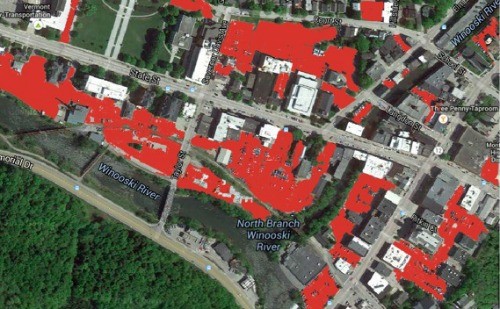
Even more astounding is the portion of our downtown real estate exclusively devoted to asphalt parking lots, yet another demand of the automobile. This hard fact is well hidden because Montpelier presents such a pretty face to the world, when seen from State and Main. But behind that postcard view, there is another reality: a town overrun with cars. As the graphic map makes clear, over half of Montpelier’s quaint downtown real estate is actually dedicated to off-street parking (in red). In fact, the only actual green space in downtown is the Statehouse lawn.
Over half of our state’s consumption of climate-changing fossil fuels goes to feeding autos and light trucks. For Montpelier commuters, these vehicles then spend their days baking in the summer sun, collecting ice in the winter storms while providing toxic runoff in the rain. Next, they demand a massive road network dedicated to their use, and their use alone. Such unquestioned allocation of our resources and real estate indicates an obedience to a force beyond our control. It’s almost like we have embraced a conquering alien army which now demands allegiance, constant care and feeding from all of us. We have allowed ourselves to become slaves to an empire of the automobile.
It sounded to me like this parking priority was in conflict with a palpable sense among the citizens, that what Montpelier really needed was some public green space by the river.
As small cities, such as Montpelier, struggle with their governing priorities, it is becoming evident that we can only see a future under continued domination by the demands of the personal car. This was highlighted recently in a report of the Montpelier city council’s deliberations as to the coming year’s priorities. The story clearly showed that Montpelier decision system is paralyzed by two factors: diminishing revenues and the absolute authority of the automobile. So, in response, the city will propose the massive construction of a downtown parking garage.
This strange turn of affairs least me to ask: How does Montpelier’s identity as the green capital of the greenest state and its commitment to become net zero by 2030 square with the continued enablement of carbon-spewing vehicles and the spread of more asphalt? Maybe it is time to seriously talk about our subjugation to the demands of the auto and perhaps even look at ways of fighting back?
Is this massive allocation of our city to the needs of the car really the best use of our limited downtown land? Do we need to authorize more debt to build a garage for even more cars? Is this really what the citizens of Montpelier want?
At the recent public discussion of the Taylor St. development, one theme was clear; for the developers the most important element in any new downtown building is the availability of parking. City zoning rules demand it, and investors won’t put up money unless there is excess parking available. However, it sounded to me like this parking priority was in conflict with a palpable sense among the citizens, that what Montpelier really needed was some public green space by the river. With this proposal for the planned garage leads me to ask if we really need to block off even more riverfront for the sake of more parking?
By now it should be evident to all of us that adaptation to the growing problems of global warming and oil dependence must move front and center in our public discourse. Concerning our dependence on the car, it’s time to recognize the size of the elephant in the room that no one wants to discuss. How can our city provide a model of energy efficiency to anyone if one of our top priorities is allocating even more resources to the ever growing demands of the car?
Some will argue that we will always have personal cars and trucks, but they will be electric. However GM may soon be ending production of the Volt, and a Tesla is merely a green status symbol only millionaires can afford. Moreover, thousands of public charging stations will, in turn, require a lot of rural real estate allocated to extra solar and wind generation. So perhaps this idea of a fleet swap shouldn’t be happening soon.
Rather, lets use our imaginations to come up with something better. We can create local transportation options that are cheaper and more in keeping with what the public wants and our identity as green Vermonters. I would like to create a fleet of vans that would offer the same convenience of the car but with less cost. Maybe we could replace all the second cars in town. Or, how about wider use of the state’s Go Vermont program so many commuters could get into town with much less parking demand. We could even envision a time when we close downtown to the automobile altogether and convert the present sea of hard surface parking to sustainable housing and business space, with a beautiful greenway system to walk, bike and shuttle folks 24 hours a day.
We need to be thoughtful and honest, and start to imagine smarter goals. Given all our reliance on the auto, this is an uncomfortable conversation, but its time to start it. Frankly, this could be a first step in organizing a revolution to overthrow the Empire of the Automobile.

