Editor’s note: This article is by Lisa McCormack, of the Stowe Reporter, in which it first appeared on April 23, 2015.
Vermont’s maple syrup industry did OK, despite below-normal temperatures in February and March, followed by an abrupt warm-up in April.
While that spring pattern can really hurt maple syrup production, most sugarmakers say that, on balance, they came through the weird weather in decent shape.
Even though production ran lower than a year ago, there will still be plenty of Vermont-made maple syrup on store shelves, and the quality of this year’s sap has been particularly good.
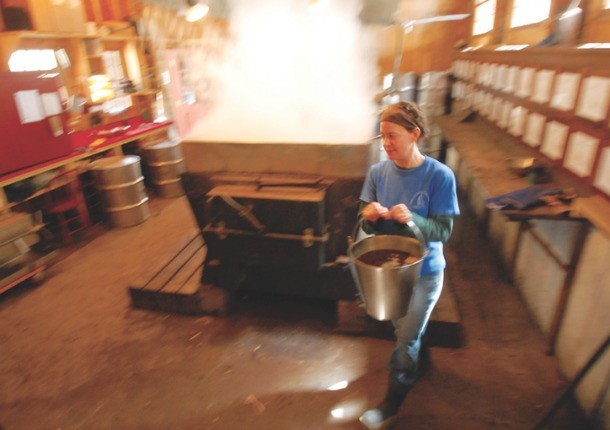
Lew and Audrey Coty tap 10,000 trees at their Nebraska Knoll Sugar Farm in Stowe. They got off to a late start, and boiled their last batch of sap last Thursday.
“It’s not quite as much as last year, but it’s been a good season,” Lew Coty said. “We made very little in March, but April came through for us. There were no spectacular runs, but it was slow and steady.”
Paul Percy taps 16,000 trees at his sugarbush in Stowe. He typically turns out between 3,000 and 5,000 gallons of syrup, but production is running behind this year.
A stretch of cold weather could keep the season going a while longer, he said.
“What we really need is a good snowstorm,” Percy said, while acknowledging that “not everyone thinks that.”
What does snow do? “It makes trees think winter is still here,” Percy said.
Maple sap flows best on warm, sunny days followed by nights that dip below freezing. The fluctuations are key: Cold nights contract air bubbles within the tree, producing suction that draws sap from the ground into the tree, where it mixes with sugar and freezes; warm days thaw the sap and expand the air bubbles, creating pressure that makes the sap flow into buckets or tubing.
When temperatures stop falling below freezing at night, sap stops flowing, bringing the sugaring season to an end. The warming weather also prompts sugar maple trees to bud, and once that happens, any sap that is collected will have a bitter taste.
Hard to predict
There’s tremendous variation when it comes to the start and end of sugaring season because it’s so weather-dependent, said Tim Perkins, director of the UVM Proctor Maple Research Center.
Generally, sap begins running in February and production peaks in March before sputtering out in April.
The past two years have started late, Perkins said, and this season is winding down in all but the coldest regions of Vermont.
“Southern Vermont is mostly done,” Perkins said. “The Champlain Valley is mostly done. The northeastern part of the state is variable.”
David Marvin, founder and owner of Butternut Farm, produces about 6,000 gallons of maple syrup from his sugarbush in Johnson and packages maple syrup and products from other suppliers at his facility in Morrisville.
He expects the yield at this sugarbush to be about 25 percent below normal this year, but says sugarmakers in other parts of the state have fared better.
“Southern Vermont and Franklin County have done well,” Marvin said. “Modern operations with clear vacuums can overcome some of the poor conditions.”
It’s still too early to predict where the overall Vermont production will end up, Perkins said.
“From what we have heard, it not going to be a record season, but it’s not going to be a bad season, especially if people are using good technology,” Perkins said.
In 2014, Vermont tipped the bucket at 1.32 million gallons — 40.6 percent of total national production, according to the U.S. Department of Agriculture.
Percy bought his sugar shack in 1961. His father began sugaring on the property in the 1930s. He’s not ready just yet to make any predictions about how the season might end.
“Call me around the first of May and I’ll tell you,” Percy said.
Same taste, new labels
In 2013, Vermont adopted a new grading system for maple syrup. As of Jan. 1, 2015, all syrup sold outside the state must be marked using the new system.
The former Vermont designations — fancy; grade A; light, medium or dark amber; and Grade B — have been replaced with four grades designed to convey information about the color and flavor profile of the syrup.
Now, all packaged maple syrup will be labeled Grade A, and will be classified as “Golden color/delicate taste,” “Amber color/rich taste,” “Dark color/robust taste” or “Very dark/strong taste.”
Maple syrup sold in Vermont may continue to be labeled with the previous designations until Jan. 1, 2017, although many producers have already made the switch.
The new system is designed to provide clear and universal descriptions of pure maple syrup in local and international markets.
The sap that’s been collected this season has been high quality, resulting in a good mix of light and dark maple syrup, according to Perkins and local sugarmakers.
“The sugar content is quite high, which helps people make lighter syrup,” Perkins said. “It’s also been very cold, which helps produce lighter syrup. The dark syrup has an excellent flavor.”
This season, the Rooney’s syrup started out light — or “fancy,” as Charlene calls it — before turning to medium then back to light. She predicts any syrup harvested during the remainder of the season will be dark.
“A lot of the younger generation like the darker syrup anyway,” Rooney said. “It’s got a stronger flavor.”
Percy is also pleased with the quality of his syrup.
“I’ve made a lot of good syrup,” Percy said. “Mostly fancy.”