

Editor’s note: This commentary is by Robert Feuerstein, who is president of Kennedy Brothers Inc. in Vergennes.
[R]eading Jack Hoffman’s commentary in VTDigger on April 8 raised some questions for me. I looked at the JFO data but didn’t really understand it since it doesn’t match spending numbers elsewhere. Also, I felt that it is important to look at total local and state government spending.
Collecting data for the years 2000-2015 from: usgovernmentspending.com and doing a few simple calculations show us all a very different picture. The years 2014 and 2015 are estimates. The data use nominal or inflation adjusted dollars.
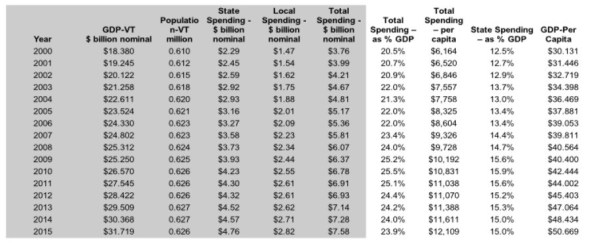
The data in gray comes from the website cited above. The last four columns are simple divisions of the other columns to get percentages and per capita numbers. We can see that from 2000 to 2013, state gross domestic product (GDP) per capita increased from $30,131 to $47,064, a 56.2 percent increase. However, looking at total Vermont state and local government per capita spending we see that it increased from $6,164 to $11,288, a whopping 84.7 percent increase. Now since revenues basically equal spending in Vermont, that means revenues and spending grew almost 85 percent while the state economy grew 56 percent. That sure sounds like a spending problem to me. Imagine if in your own household you increased spending 30 percent more than your income. It wouldn’t be a happy outcome for you. And it won’t be Vermont if this trend continues.
I strongly believe that economic growth with more and higher paying jobs is the answer.
We also can see that between 2000 and 2013 total spending grew from 20.5 percent of state GDP to 24.2 percent of state GDP. Please note this directly disproves Mr. Hoffman’s assertion that state revenues aren’t keeping up with Vermont economic growth. If that were true then spending as a percent of GDP would be decreasing, not increasing over time. Revenues and spending are still growing faster than the economy when comparing the years 2006 and 2013.
And if poverty and homelessness are increasing in Vermont as Mr. Hoffman mentions, then we must ask whether the large increases in spending are helping or hurting this problem.
I strongly believe that economic growth with more and higher paying jobs is the answer. Raising revenues as Mr. Hoffman suggests will only make this more difficult and hence increase poverty and homelessness even more. I certainly hope that the focus of Speaker Smith and the lieutenant governor on economic development, and the governor on workforce development are heeded by the Legislature, and not Mr. Hoffman’s misleading analysis.

