

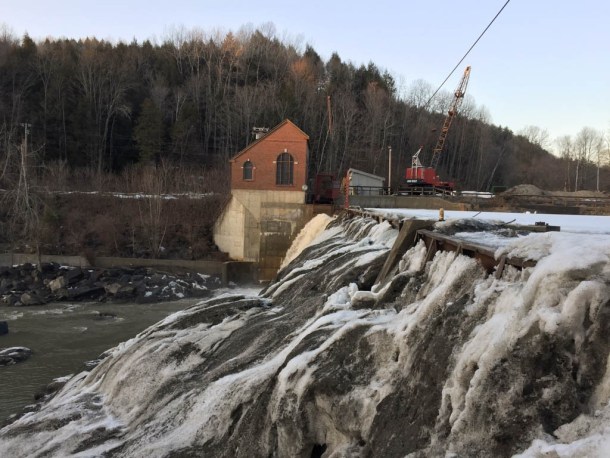
[L]awmakers are considering legislation aimed at removing poorly maintained dams from Vermont’s rivers and streams.
The bill, H.37, would require dam owners to register dams and pay an annual fee to fund the state dam inspection program.
Proponents of the measure say it will improve public safety and the environment. Towns that own dams cite cost as a concern. State officials worry workload would increase without additional resources.
Rep. David Deen, D-Putney, chair of the Fish, Wildlife and Water Resources Committee, introduced the bill. He said one purpose is to prompt dam owners to repair poorly maintained dams or remove those that do not serve a purpose. He hopes to pass a bill out of the House this year, but it would have to wait until next year for Senate approval.
 Dams that pose the greatest risk to human health and property, known as high hazard dams, are inspected annually, according to the Department of Environmental Conservation, which oversees the state’s dam safety program.
Low risk dams can go unchecked for more than a decade, according to a state engineer.
The registration fees would increase, based on the risk of the dam, from $200 to $1,000. (High hazard is not an indicator of the dam’s condition but the potential risk to human health and property.)
The state does not know how many dams are in Vermont, but estimates there are about 1,200. The state doesn’t know the exact number because registration has not been previously required.
Thirty-five percent of the state’s dams are in poor condition, according to a 2014 report by the Vermont Section of the American Society of Civil Engineers.
The report found Vermont’s dams to be in “fair” condition in part due to low staffing levels at the state’s dam safety program, which has two engineers responsible for inspecting 519 dams.
The state’s program includes voluntary regulations and a time-consuming process for correcting safety deficiencies, the report found.
The majority of dams are the responsibility of private landowners who are unwilling to invest in maintenance or repairs, the report found.
Municipalities own 78 dams, of which 20 are considered high hazard, according to the state.
Karen Horn, the director of public policy and advocacy for the Vermont League of Cities and Towns, said some dam owners are not sure they even own a dam. That’s why she wants the bill to require owners be notified of their liability.
“We are very concerned about what will be the eventual expense entailed and whether there would be an opportunity to provide good information to dam owners before the process goes into effect,” Horn said.
Private dam owners can seek financial support for repairs through a state revolving loan fund.
The bill would increase the number of dams the Department of Environmental Conservation must inspect. The state currently inspects about 500 dams and the bill would increase that number by about 800, according to a state engineer. Under the bill, dams are defined as located within a perennial stream, which could include private ponds, or ponds that impound at least 500,000 cubic feet of water.
Gov. Peter Shumlin’s proposed 2016 budget reduced funding for the state’s dam safety program by more than $120,000.
The $135,000 that the department estimates would be raised through new registration fees could backfill some of the cuts, according to David Mears, commissioner of the Department of Environmental Conservation.
This would keep the program together, but Mears is unsure it could expand.
“I am concerned that it may not be enough,” he said. “That’s basically enough to fund the existing program.”
Mears supports the governor’s budget proposal, but he said there may be a risk to public health and safety due to a lack of resources.
“I think that the risk is more than I’m comfortable with,” Mears said.
Under the bill, the state would designate certain dams as abandoned.
The state has discovered poorly maintained dams that have been abandoned. In one instance involving a dam on Curtis Pond in Calais, the state had to search land records back to the 18th century to find the owner.
According to Steve Bushman, one of the state’s two dam safety engineers, the state could be liable for more abandoned dams without the money to tear them down.
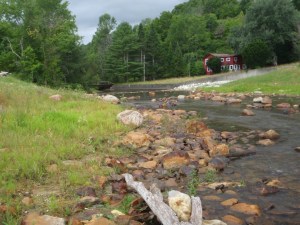
“I have owners come to us and say ‘we can’t afford to do anything, do you want it?’” he told the House Fish, Wildlife and Water Resources Committee on Friday. “We’re going to be getting these orphan dams and we’re not really going to know what to do with them.”
“Take them out,” Deen said. He said there is money in the capital budget to remove dams.
For decades, environmentalists have advocated for dam removal. The 8-foot-tall Swanton dam spanning the Missisquoi River is a recent target in Vermont. Lake Champlain International and the Fish and Wildlife Department want to remove the dam in order to allow fish in Lake Champlain access to spawning grounds upstream.
Brian Fitzgerald, a river ecologist with the Vermont Natural Resources Council, said dams in Vermont create barriers that alter river ecosystems.
“They fragment these systems,” Fitzgerald said. “It disrupts all these natural processes that are going on: fish up and down downstream, movement of sediment downstream, the temperature impacts are due to the fact that you impound a river and it becomes wider and shallower.”
He worked with the Agency of Natural Resources’ dam removal program. He said since 1996, 16 dams have been removed in Vermont. This includes the Dufresne Dam on the Batten Kill in Manchester, which the state removed in 2013 to improve fish passage. Fitzgerald said rivers and fish habitat can be restored after the dam is properly removed.
The Agency of Natural Resources regulates dams unless the owner of the dam has a federal license to generate electricity. The Public Service Board, Natural Resources Conservation Districts, and the federal Army Corps of Engineers, Forest Service, National Park Service and Fish and Wildlife Service also regulate dams.
