

[A]n official for the Shumlin administration is taking responsibility for inaccurate statements the governor made about the performance of the company primarily responsible for completing the Vermont Health Connect exchange.
Three weeks ago Gov. Peter Shumlin announced his contingency plan should Vermont Health Connect fail. He said the state would not have to abandon the exchange because Optum, which replaced CGI this summer, has completed work on time and under budget.
“Optum, so far, has not only delivered earlier on all the challenges they’ve been facing and tech they’ve been developing, but they’ve also done it for less money in every case than they’ve originally outlined,” Shumlin said.
Invoices from Optum covering the period from June to September, first acquired by the advocacy group Vermonters for Health Care Freedom, show that’s not the case.
The invoices show that only two of five completed task orders — contractually defined pieces of Optum’s work — were completed under budget in that period, for a combined $13,445 in savings. Optum is billing the state a total of $2.64 million for those five task orders. The state will not have to pay an additional $161,181 in cost overruns because they exceed the maximum amounts negotiated in the contract. No other invoices have been submitted by Optum to this point, according to state officials.
The state is slated to spend up to $57 million for Optum’s help in fixing the dysfunctional health care exchange. In all, Vermont Health Connect could cost $200 million. About $127 million was paid to CGI, the previous contractor.
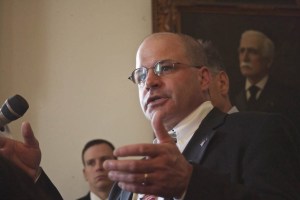
Shumlin did not address his prior comments in remarks at a Wednesday news conference. Instead, he deferred to Lawrence Miller, his chief of Health Care Reform.
Miller took responsibility for the inaccuracy of the governor’s statements, which he said were based on incomplete information he provided the governor. The governor’s comment was based on Miller’s review of Optum’s performance on task orders related to developing the exchange’s functionality, and did not account for Optum’s work maintaining and operating the exchange, he said.
“That’s me misspeaking to the governor, being focused on the development task orders and not including in my mind the operations’ ones,” he said.
Miller inspected a list of development task orders that had gone through the state’s vendor management review, and based on Optum’s performance, as reflected in those reports, the company’s development work has been on time and under budget, he said. VTDigger has requested documentation supporting that conclusion, which the state has yet to provide.
The May 30 deadline for an automated change of circumstance function is a development task, and that’s why the administration is confident Optum will deliver, Miller said. When the new capability is launched, it will only be visible for backend users. If it works smoothly, it will be made available to the public.
Automating the change of circumstance function will allow customers to update to their coverage or personal information online. It’s a function that has eluded Vermont Health Connect since its launch in October 2013. For the past year and a half, state workers and contractors have input changes manually.
Forty-five percent of the $6.6 million Optum billed the state for its first four months of work was for processing backlogged change requests. VHC and Optum shifted their focus to processing new customers and renewals during the recent open enrollment period that lasted from mid-November through mid-February. Two weeks later, the administration said the backlog had ballooned again, this time to 11,000.
If VHC and Optum can’t deliver an automated change function, it’s not clear Vermont can sustain the maintenance and operational costs of a system that relies so heavily on manual processes.
VHC cost $126.7 million as of the end of 2014. Federal grants covered most of the cost, but starting this year, states building their own exchanges are no longer allowed to bill the feds for maintenance and operational costs — which include processing backlogs.
The state has roughly $72 million in federal grants to help pay for the exchange’s completion, which includes making the system work for small businesses — an aspect of the exchange that VHC has suspended its work on.
The state appropriated an additional $9.7 million for VHC in its adjustment to last year’s budget, with $3.5 million coming from the general fund. This year preliminary versions of the budget include $26 million in general fund monies for VHC. It’s unclear if that budget anticipates a fully functional exchange.
An amendment to the Budget Adjustment Act will require the administration to report on VHC spending and prospective budgets in greater detail — a sign of lawmakers’ growing discomfort with VHC’s costs.
Many legislators, including House Speaker Shap Smith, are calling for Vermont to at least look at transitioning to some version of the federal exchange, which Shumlin has said he will do if Optum misses the May 30 deadline and an October deadline to automate the renewal process.
State Auditor Doug Hoffer is expected to release an audit of the exchange this month, which could provide greater detail on how VHC is using its resources, and what changes it has made to improve operations.
Internal VHC documents from January show that the feds are also auditing the exchange. A report issued after a federal audit of Maryland’s exchange found it had improperly billed the feds for $28.4 million.

