

[C]ASTLETON — Adam Tredwell didn’t like the taste of the first electronic cigarette he tried.
But when he started law school in 2007, the prospect of facing hours-long exams without a regular shot of nicotine was even more objectionable. Outside of the classroom, he still smoked tobacco, because the e-cigarettes that mostly came from China at that time lacked enough appeal to convince him to quit.
Two years later, when Tredwell’s mother dropped regular cigarettes cold turkey for the battery-powered version, they agreed that ex-smokers needed a better option. The law student, at Temple University in Philadelphia, spent his summer break at home in Rutland County concocting various formulations of nicotine-laced liquid to heat up and inhale with an e-cigarette.
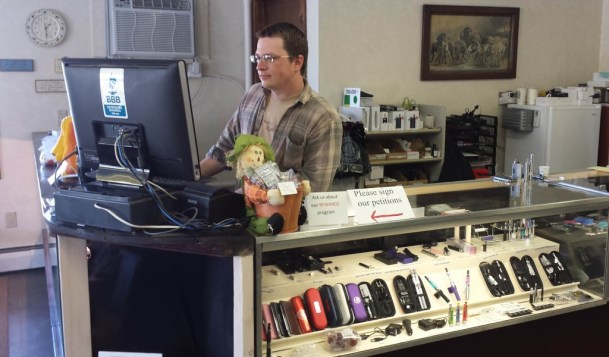
With a perfected mixture complete in June 2009, Tredwell launched Vermont Vapor Inc. as one of the first U.S. manufacturers and wholesalers of “juice” for e-cigarettes. His mother, Linda Barker, runs the Castleton company’s companion shop, selling the bottled liquid in two sizes and e-cigarette equipment displayed in glass-enclosed cases.
“I want people to stop smoking,” said Tredwell, 36, who started smoking cigarettes in his mid-teens and now is a single dad with a 13-year-old daughter.
Vermont Vapor had an initial boom in business as one of the earliest U.S. suppliers and East Coast shops and now tallies about $24,000 per month in sales. Nationwide, sales of e-cigarettes and vapor products in the mass market – including convenience, discount and drug store chains but not small independent retailers – reached $811 million in 2014, according to IRI, a consumer products market research firm based in Chicago.
Today, though, Vermont Vapor’s future hinges on the outcome of multiple state proposals to curb the use of e-cigarettes.
In Vermont, as in other states and across the nation, lawmakers are raising questions about e-cigarettes that science has yet to answer. That’s not stopping some from pushing for restrictions on the products.
“The more the industry expands, the more regulation,” Tredwell said earlier this month, as he sat at a table in his shop and puffed on an e-cig. “And the worse it’s getting for us.”
Vapor trail
E-cigarette users don’t smoke. They vape. They use a metal device with a rechargeable battery and a small coil that heats a bit of fabric, like a wick, which soaks up a liquid cocktail of nicotine and flavoring and turns it into a vapor for the user to inhale.
Manufacturer safety standards for the devices, most made in China, are one concern of state and federal legislators and regulators. But the greater sense of unease centers on the e-juice and its ingredients, the potential health risks of heating them up, and the addictiveness of the nicotine in vapor form.
Four bills that would impede vaping in the state have reached Vermont House committees: H.93 would raise the minimum age for buying tobacco products or substitutes from 18 to 21; H.233 would tax e-cigarettes, as other tobacco products are taxed, at a rate of 92 percent of the wholesale price; H.171 calls for the same bans on smoking in public places to apply to vaping and would prohibit e-cigarette displays on store counters; and H.59, would restrict e-cigarette flavors to menthol.

Rep. Patti Komline, R-Dorset, sponsored the latter legislation out of concern that fruity, sweet and candy-named flavors are aimed at children and could lure them to a nicotine habit when they otherwise wouldn’t choose to smoke.
“If you open it and you smell it, it smells like candy. It smells sweet,” Komline said of the watermelon-flavored version she bought and tasted. “They’re so gearing this towards young people to try to get them to smoke.”
Some adults have told her that blueberry and other e-cig essences helped them quit tobacco. She sympathizes with those people and remains open to discussion and possible compromise on the legislation, she said.
“It’s definitely better than smoking cigarettes,” she said. “But it’s not good. It’s addictive.”
The flavor-restriction bill would strike directly at companies like Vermont Vapor, which created a niche with its carefully crafted recipes. It offers 22 flavors – including ChocoMint, Café au Lait, Strawberry-Mango and Sugarhouse Blend – each in five nicotine strengths.
The law would leave the e-cigarettes sold by nation’s two largest tobacco companies – Vuse by Reynolds and MarkTen by Altria – which have the deepest distribution and dominate the market, as the only allowable products. Blu, the brand made by third-biggest U.S. tobacco company Lorillard, comes in a few fruit flavors.

“We’d go out of business,” Tredwell said flatly. “There aren’t enough menthol smokers, and that would be the only flavor we’d be able to sell.”
No vapers would buy liquid without flavor, other than the handful who like to add their own flavors at home, Tredwell said. “It would taste like unflavored Robitussin. Nobody would use that.”
The proposed tax on e-cigarettes also would hurt Vermont Vapor, forcing Tredwell to either lower his wholesale price or risk losing customers, he said. As the cost of the tax will likely pass to users, Tredwell added, it will cut into the cost benefit that gave cigarette smokers an incentive to switch to the healthier alternative. His price for a month’s supply of e-liquid to satisfy a pack-a-day smoker, about $20, is far less than those packs of cigarettes cost over 30 days.
“I’m a big believer in taxing the bads to finance prevention,” said Rep. Alison Clarkson, D-Woodstock, who sponsored H.233 to make the law consistent across all nicotine products.
Limited evidence of health risks hasn’t deterred her from concluding that they’re there. “I don’t think people should be smoking, vaping nicotine, a tobacco substitute, and think they’re vaping something healthy. They’re not,” she said.
“It’s important for people to understand that this is not a health-neutral product. This is a product that has a health impact.”

Rep. Bill Frank, D-Underhill, agrees. Even without a proven danger from secondhand vapor, the sponsor of H.171 said he doesn’t believe that restaurant diners, hotel guests or anyone in Vermont’s public gathering places should be subject to smoke or a substance that resembles it in an otherwise clean-air environment.
Also, if young people see vaping as less restrictive than smoking, they are more likely to adopt it and get introduced to nicotine, Frank said. The electronic products already carry less of a stigma than cigarettes, because they are deemed safer, he and the other legislators said.
Some research backs up his fears. The number of middle and high school students who said they never had smoked but used the electronic devices more than tripled between 2011 and 2013, from about 79,000 to more than 263,000, according to a Centers for Disease Control survey released in August.
“I honestly don’t think e-cigarettes are good,” Frank said. “Putting nicotine into your lungs isn’t a good idea.”
Taking a drag from his silver-colored e-cig and blowing an opaque swirl with a faint odor of cinnamon, Tredwell expressed his frustration at such thinking. He cited a 2013 study by a Drexel University researcher who found that involuntary exposure to e-cigarette vapors causes no health risks.
“They have no scientific basis for that, and that drives me insane,” he said of the legislators’ safety concerns. “Where’s the study? If they had that study, I would like to get a look at it.”
Little federal guidance
No federal regulations currently cover electronic cigarettes. The U.S. Food and Drug Administration is considering a designation that would subject e-cigarettes to the same rules as other tobacco products. Those require manufacturers to register their products, list ingredients, undergo review for new products, include health warnings and provide proof of any marketing claims.
Product review and registration alone could cost Vermont Vapor hundreds of thousands of dollars, Tredwell said.
Until the FDA decision is final, manufacturers and retailers operate under no rules – other than the laws in some states. As of late February, 42 states had passed legislation relating to electronic cigarettes, most defining the product as a tobacco substitute and prohibiting sales to minors, according to the National Conference of State Legislatures’ website. It shows Vermont as the only state that requires federal child-resistant packaging on liquid for e-cigarettes. And 18 states have added e-cigarettes to smoking prohibitions in at least some public places, the American Nonsmokers’ Rights Foundation reported in January.
Tredwell launched Vermont Vapor with a goal of transparency. He openly names the ingredients in his product: glycerin, distilled water, flavoring and nicotine. Vermont Vapor’s menthol formula has propylene glycol and ethanol, because it needs the alcohols to dissolve, he said.
“Consumer demand has moved to the point where people just won’t buy it if it doesn’t say what’s in it,” Tredwell said. “If you’re putting it in your body, it probably shouldn’t be a secret what’s in there.”
The way he discusses his product, Tredwell sounds like a chemist, a sort of legal version of the methamphetamine-cooking Walter in the popular cable TV series “Breaking Bad.” To develop his liquid, Tredwell scoured chemistry books in the Castleton College library, some going back to the 1800s, when nicotine was used as a pesticide in tobacco. He found a few guidelines on an online biochemical forum from the Netherlands and on e-cig discussion boards.
Today, he can chat about the temperature at which substances will degrade into toxic byproducts and the amount of alcohol to lower boiling points. Glycerin, he pointed out, is common in toothpaste. He considers it preferable to propylene glycol, which is used in many e-cigarette liquids but causes allergic reaction in a small percentage of people.
Recently, he dropped the Vermont Caramel flavor because it contained acetoin, also found in food products but not guaranteed safe if heated to vapor form and inhaled.
“It could hurt people, and if we hurt people, they won’t give us money,” Tredwell said. “And my prime objective is to have our customers give us money.”
Tredwell declines to let visitors into his lab, for fear of contamination. Pure liquid nicotine is highly volatile. In a downstairs “clean room” below the shop, he works in full protective gear, with heavy-duty gloves inside a chemist box to mix the formulas.
“I guarantee it’s not safe in the absolute safe sense,” he said of the chemical cocktails in e-cigarettes. “Walking down the street is not safe. There are risks to everything.”
Safer than tobacco, but …
The health consequences of e-cigarette use are currently unknown.
Research has pointed to potentially high concentrations of formaldehyde, a carcinogen, in e-cigarette vapor. Another study found that some sweet-flavored e-cigarette liquids contained higher-than-safe amounts of two chemicals, diacetyl and acetyl propionyl, which are used in food but linked to respiratory disease if inhaled. Researchers also concluded that e-cigarette vapor can make strains of the already hard-to-kill MRSA virus more deadly and impede the respiratory system’s ability to fight it.
But the research is too scant at this point to link a definite danger to long-term use of the product, said Dr. John Hughes, professor of psychiatry at the University of Vermont College of Medicine, who has conducted extensive research on tobacco use. Only after multiple results with the same findings, he said, can researchers draw conclusions.
“We scientists love replication,” Hughes said. “First time, maybe it’s there. Show me a second or a third time.”

The basic characteristics of vaping indicate that it is healthier than smoking, Hughes said. Smoke delivers nicotine from the lungs to the brain within 10 seconds, while vapor brings in smaller amounts of nicotine more slowly, he said. And it’s the burning of the tobacco that creates the carcinogens and chemicals that cause the greatest risk of cancer and heart disease.
Researchers also need to know more about the actual dangers of nicotine addiction for the body, Hughes said. Caffeine is addictive, for example, but isn’t known to lead to serious long-term health risks.
“In all likelihood, e-cigarettes are significantly safer than tobacco products,” Hughes said, adding that perhaps some metals released in the vapor could cause concern. “But they’re going to be very small in comparison to the toxins in tobacco smoke.”
With all the mysteries of e-cigarettes but the potential benefits for smokers who switch, Hughes and some other doctors support limited federal regulations. The FDA treats nicotine gum and patches as over-the-counter drugs, subject to rigorous and extensive review before they hit the market.
Hughes said that would unnecessarily impede access to e-cigarettes, but they do need more oversight than they would get from the FDA as tobacco products.
“We have to know they have good manufacturing practices,” he said. “And we don’t know that now.”
Even some health organizations have hesitated to censure e-cigarettes or push for regulation – primarily because they see the benefits of the products in helping people to kick the more evil tobacco habit.
“Current scientific evidence indicates that e-cigarettes are likely less harmful to individual users than combustible cigarettes,” reads an e-cigarettes “fact sheet” from the American Legacy Foundation, which formed in 1999 as a requirement of the settlement between major tobacco companies and most U.S. states to address longtime public health costs from smoking.
Legacy supports a shift to “less harmful alternatives,” according to its e-cigarettes page, but also “prudent and expeditious regulation.” It recommends measures that set a minimum vaping age of 18, eliminate candy flavors that appeal to kids, include e-cigarettes in smoke-free air laws and require manufacturing safety standards, including child-proof packaging of e-cigarette liquid.
Tredwell said he would like legislators to allow teens to make their own decisions – about smoking or anything else. Free access to a healthier alternative might keep them from trying tobacco, if they were otherwise inclined to do that, he reasoned.
And he said he would readily apply those opinions to his own daughter.
“If she wanted to, I believe she has the choice of what she wants to do with her own body,” he said, adding, “I’d give her arguments against this, too, because it is an addictive behavior. And if you can avoid an addictive behavior, it’s probably best.”
Correction: The name of a chemical in a flavor that Vermont Vapor no longer produces was incorrect. It is acetoin, not acetone.

