

The House Ways and Means Committee approved a 0.2 percent increase in the property transfer tax. The money will be used to restore polluted waterways in Vermont.

The tax increase was added to the state’s premier water quality legislation, H.35. The committee unanimously approved the bill Thursday
The property transfer tax is paid by property buyers. It can be added to the total closing cost of the property. The current rate is 1.25 percent of the total value of the property. The 0.2 percent surcharge would increase the tax to 1.45 percent.
Properties under $100,000 or those purchased through the the Vermont Housing Finance Agency under $110,000 would not pay the surcharge.
The committee also approved fees paid by farmers, towns and developers that would help pay for staffing to implement the state’s water quality laws.
The increase in the property transfer tax is the largest source of clean water funding lawmakers have approved this session. It would raise approximately $6 million per year for the state’s newly created Clean Water Fund.
“I think there is a commitment in the public generally and there is definitely a commitment in this building to make the investments we need to make to clean up Lake Champlain and other fragile waterways. We’re going to do that,” said Rep. Janet Ancel, D-Calais, chair of the House Ways and Means Committee.
The committee also reinserted a penalty that will allow the state to remove farmers’ land from the current use program, if they fail to address water quality violations. The provision was stripped from the bill the in House Agriculture committee. Under the current use program, farmers get a discount on property taxes.
The Shumlin administration has not determined the total cost to restore Lake Champlain and other waterways. To do so will require pollution control measures that curb runoff from farms and developed areas across the state.

David Mears, the commissioner for the Department of Environmental Conservation, said the state will finalize cost estimates by the next legislative session. The department says it will cost about $5 million per year to address runoff from roads, but officials do not know how much it will cost to make capital investments in farm and municipal storm water infrastructure.
“We may need more, but we don’t know what those costs are,” he said of the municipal storm water and agricultural runoff investments. “Those will be big numbers.”
That’s why some environmental groups are asking lawmakers to approve at least $10 million in funding for the Clean Water Fund, a special pot of money created under H.35.
The state should be raising money now while water quality is a salient issue in the minds of lawmakers and the general public, according to Lauren Hierl, who is the political director for Vermont Conservation Voters.
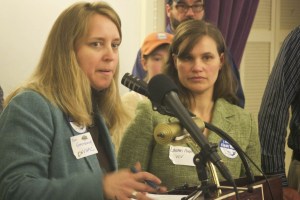
“We need to make the commitment now. This is the year to do it and get these dedicated revenue streams on the books so we don’t have to come back next year and fight for clean water,” Hierl said.
But many of the funding proposals presented this legislative session were opposed. On Wednesday, when the House Ways and Means Committee took up the property transfer tax, Chris Rice, a Montpelier lobbyist for the Vermont Realtors Association, opposed the tax increase.
“It increases the affordability challenge and for that reason it is something we don’t support,” Rice said.
The committee also proposed raising $1.3 million in fee increases on municipalities and developers that pollute waterways. The money is less than the Agency of Natural Resources’ original proposal, but it would still allow the agency to hire 13 new staff to implement the state’s clean water plan. An agency official said they would support their original proposal when the bill is taken up in House Appropriations.
Towns oppose the fee increases. The bill also removes several storm water permit exemptions for municipalities.
“The way it’s looking now is that municipalities are being hit in a number of different ways,” said Karen Horn, the director of public policy and advocacy for the Vermont League of Cities and Towns.
She said towns will have to invest in new road ditches, wastewater treatment plan upgrades, and storm water infrastructure for developed land.
But David Deen, D-Putney, chair of the Fish, Wildlife and Water Resources Committee, said he made sure that money in the Clean Water Fund could be used to help towns fund certain projects.
The committee also proposed raising $1.056 million in new fees for seven new staff at the Agency of Agriculture. The agency originally proposed raising $1.2 million through a $30 increase on each ton of fertilizer.
In place of the fee on fertilizer, the committee voted to require a $2,500 certification fee for large farms, a $1,500 certification fee for medium farms, a $250 certification fee for dairy farms with fewer than 100 cows, a $500 certification fee for dairy farms with 100 to 200 cows, a $100 fee on commercial feed, a $125 fee on pesticides, and a $30 per ton fee on non-agricultural fertilizer used for home gardens.
