

[N]o matter how the Legislature changes the way Vermont schools are governed, it’s clear that shrinking districts will soon have to decide how small is too small.
The pinch is most acutely felt in the state’s high schools — approximately 62 percent have fewer than 100 students per grade. Some are so tiny that the senior class is in the single digits. Chelsea Middle High School, for example, has eight students in the senior class this year.
The cost — and quality — of that education for students is at the heart of gut-wrenching conversations that are increasingly taking place in communities around the state.
“We need to give these kids as much opportunity as we can. Can that happen in a high school with only 40 students in it?” asked Jeffrey Francis, executive director of the Vermont Superintendents Association.
Over the past decade, Vermont has lost about 15,000 students across all grades – that’s a 15 percent decline, according to Rep. Tim Briglin, D-Thetford. He added that the schools have shrunk so much they can’t offer courses that will help students cope with job demands in a changing economy.
“The foreign languages, breadth in math and science offerings, and opportunities for socialization that exist with greater numbers of students in a school have evaporated in some districts in Vermont,” Briglin said.
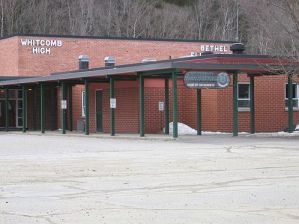
A lack of access to certain desired courses at Whitcomb High School in Bethel was identified as a problem by parents, teachers and students, according to an October 2013 report by education consultant Raymond Proulx. Whitcomb has 83 high school students and 15 seniors this year. Faced with an increasingly smaller student body, Proulx was hired by the school board to research and write a report on the school’s ability to provide an equitable, quality education at an affordable price.
After interviewing teachers, students and parents, Proulx wrote that, “at times students either did not participate in given classes at all, had to access courses elsewhere or substituted [a] desired class for another in order to fulfill requirements for graduation. Interviewees acknowledged that this challenge was common to all small secondary schools and were not faulting specific individuals. However, the question of equity in accessing certain courses remained a reality.”
Proulx’s research shows that there is an educational cost to “too” small. Shrinking high schools have responded by attempting to draw tuition students from “choice” towns; close their own school and tuition their students off; or merge with another nearby high school. Each option has its own costs and concerns.
Some communities are trying to attract tuition students to their high schools by enhancing their curriculum or providing successful sports teams, quality arts programs and attractive facilities.
“There are a lot of communities that have this hope that they can make their community such a model they will attract tuition students and that would get their enrollment up enough,” said Vaughn Altemus, the Agency of Education’s school finance manager.
Rochester High School is a good example of this approach. Principal Cathy Knight is offering a new curriculum focused on personal learning plans for each of the 55 students. She has also set up three “academies”: one for technology, another for sustainability and a third for performing arts, as well as providing additional course offerings in business, industrial arts, contemporary and British literature, artisan cooking and more.
The changes were implemented after a 2013 report by Vermont School Board Association’s John Everitt who found that if the high school didn’t grow it would “become increasingly difficult to provide a quality secondary education.” It also predicted that property taxes were going to increase “overwhelmingly.”
Jeff Sherwin, acting chair of the Rochester School Board, said that after reading the report, two-thirds of the town voted in favor of keeping the school open – even the high school – so they introduced the new curriculum “to try and attract more people to the school.”
Since then, another issue emerged – Rochester is not only competing for the same pool of tuition students as nearby schools, but also with far-flung ones.
“Middlebury started running a bus to Hancock and Granville taking students to Ripton Elementary School and Middlebury Union High School,” Sherwin said.
“We only have a finite number of kids to go around,” Orange-Windsor Superintendent Bruce Labs said. “Kids are going to be leaving there, as well as coming, and somebody is going to be shortchanged unless we get an infusion of kids not currently sending to us.”
Tuition savings debated
Towns with withering enrollments are also closing schools and tuitioning students out to other districts. Some towns reject this idea because they lose a say in how their children are educated, and often the cost of sending children to another district is too expensive.
In March 2013, Cabot voted to keep the high school open for 66 students because it would cost more to close. The school board found that eliminating the high school portion of their K-12 building would increase education spending by approximately $500,000. Cabot would then have to pay tuition for its students at a cost of $890,881 and the town would lose $149,291 from tuition students that reside in other towns. The voters chose instead to increase their school budget by a half a percent.
Concord in Essex County has a gone another route, offering tuition to some students while keeping their small community school open. For years, the perception by some parents that their children were not getting a quality education drove them to call for annual votes that threatened to close the community school. The board eventually acknowledged that some parents felt children would be best-served at other schools and offered the school choice.
This double-down approach in an era of plunging enrollments is challenging, Altemus says.
He said tuitioning “clearly reduces enrollment and that makes the high school cost per pupil and cost for equalized pupil more expensive. On the other hand, if you have a lot of parents and students wanting to go somewhere else, the classic reason might be that there are programs that a small high school can’t offer and they are really important to some parents and students to make sure they get an appropriate education.”
This year, 25 students will be tuitioned out of Concord’s high school, despite efforts made by the school board to increase offerings and electives, and despite an increase in enrollment from 44 in 2012-13 to 65 this academic year.
Essex-Caledonia Superintendent Brian Rayburn said students who stay at Concord do so for the smaller class sizes as well as athletics, the drama program and the student government.
“None get missed or fall to the wayside because someone is there to watch their progress,” he said. “The education they are getting here is a quality education. I’m proud of the work they are doing.”
Altemus calls tuitioning the “ultimate loss” for a community because local residents no longer have control over their children’s schooling, nor do they have a say in the cost of that education. Communities that have been tuitioning for a long time can “find themselves between a rock and a hard place,” he says. A town that has a K-6 school and tuitions out student in the upper grades still have to pay tuition by law.
“If the tuitions come in higher than expected they still pay, if they have a surge of students in a grade, they are going to pay for that, too, and they will have to cut services [at the K-6 school] or raise taxes,” to do so, he said.
Going to the altar
The other, and usually last, option has been to merge a school or a school district with a neighboring community’s school system. Many communities struggle with the realities of consolidation, too, because of the inevitable loss of local control.
Rep. Tony Klein, D-East Montpelier, has encouraged two schools near him to partner. Klein, who spent time on both the East Montpelier Elementary School Board and U-32’s High School Board, called together residents of that district and neighboring Montpelier last spring.
“For me, it isn’t about the money that would be saved but the incredible educational opportunity that would be created for these students,” Klein said of U-32 and Montpelier. Klein ticked off the savings that could be incurred if the two joined up, including reducing the number of school boards and administrative costs, as well as using the buildings to maximum efficiency while providing an enriched learning experience. “There is power with numbers. You would have two incredibly talented communities coming together to pool their resources.”
The majority of school and district mergers happen only after every other alternative — from cutting programming to eliminating staff — has been tried. This is a problem, because in order to merge the school has to find another school that is interested in partnering.
“It isn’t unusual that the school or district has cut out all the fat, and all the meat and they are hitting the bone. When a district (or school) hits that point it is not the most attractive partner,” Altemus said.
Giving districts a nudge
Many more districts across Vermont might soon be considering mergers if the House education reform bill H.361 becomes law. It calls for smaller districts to integrate into 1,100 student units. Districts are further pressed to partner with neighbors and explore ways to form a larger or even a regional system.
In the newly approved combined Supervisory Union for Orange-Windsor and Windsor Northwest there are four high schools with such small student populations that combined there are only 60 students in this year’s graduating class. Tuitioning won’t help because there just aren’t enough kids to go around. Merging into one high school is an option, but it isn’t on the top of anyone’s list right now, especially since transportation would still be a bit of a struggle for at least one of the schools. What everyone is focused on is creating a high school experience that will prepare all graduates for work in the global economy or to attend the college of the student’s choice.

“We want to build a system that is better than what we have now, even though we’re doing a lot of good work,” Labs said. That is why he has engaged Bill Daggett and the International Center for Leadership in Education to speak to the SU’s Transition Board, the teachers and anyone else who will listen.
“The work being undertaken by the newly merged supervisory union has the potential to be truly groundbreaking,” said South Royalton School Board member Laurie Smith. “We are beginning some deep and meaty conversations about educational quality for all the kids in our region.”
Smith and Frank Russell, a member of the Rochester School Board, both talked about the need to move beyond “silo mode” thinking that is centered on “towniness” and “buildingness.” Instead, Smith said, “We are trying to focus first on defining a high quality education for all our kids.”
“We are optimistic,” said Rochester’s Sherwin. “Once we get this thing consolidated we can find more opportunity within the SU. The mountainous terrain is a challenge in the SU, but Sherwin talked about utilizing technology to get around this, and instead of bussing kids, moving teachers between the high school and sharing resources. By rotating teachers among all four schools they hope to build a broader curriculum for students.
Not all board members are open to these ideas, Labs said.
“There is a point in time when board members stop thinking about their own little town and start thinking about the general good for all the students in the whole SU. We aren’t there yet — Rochester is still protecting Rochester and Chelsea is still protecting Chelsea,” he said. “We are going to have to grow the idea into more of a regional approach than just protecting your town. If we are going to really take care of students it is going to be with a broader vision and responsibility.”
Yet, the new energy and the vibrant discussions have not escaped the notice of Labs who is reaching for “a whole different way of doing things.” That is one reason he hopes to hire Daggett to act as a third party and help the SU develop a strategic plan.
“The idea of having Daggett is to look at what we can build – and I don’t mean a facility – I mean a vision, a curriculum that is better than what we have right now.”
Daggett spoke recently about student achievement to a crammed auditorium overflowing with teachers from across the new SU. He said Vermont has done a good job using a 19th century system to educate students but now the state is falling behind.
Moving through the auditorium, Daggett explained that Vermont schools are stuck – they function more like schools in 1890 than 1990. If Rip Van Winkle woke up today he would be comfortable walking into any Vermont school, he said. “Forgive me Vermont, your schools are really good and that is going to be your doing in,” he said.
Because in the most successful high schools students are collaborating in teams, and they are engaged in obtaining and applying knowledge. The teacher manages the learning process instead of lecturing at the front of the classroom. Unfortunately, in “too many of our schools our children come to watch their teachers work,” he said.
Sherwin echoes Daggett’s concern, “I think we’ve been teaching the same way for a long time. Nobody likes change, towns don’t like change, people don’t like change, but we have to get innovative here.”
Labs is proposing that Daggett survey the entire SU – the teachers, students, and surrounding communities. The results will inform a strategic plan for the next five years.
“These towns need to have a say in the school or schools that we build,” Labs said. He expects them to demand a seat at the table. “I want them to respect the process and go through the process. I want them to have the conversations and do the work and what we come up with is what we come up with,” said Labs.
As for the Legislature, he would like it to back off. “We have done what they wanted, now they need to give us some time to get this worked out so that we can make something out of it.”
