

The small town of Cabot in northern Vermont has overwhelmingly decided to keep its small high school, which has only 65 students.
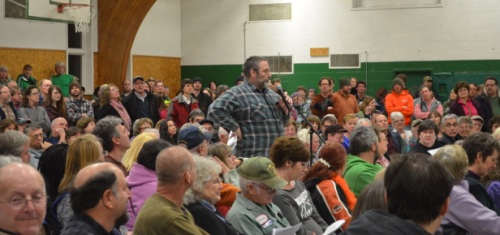
Nearly 500 Cabot residents congregrated in the town gymnasium on Monday night to determine the fate of the high school in a spirited debate that spanned the better part of the evening. In the end, the town voted 322-147 to keep the school open.
The vote marked the apex of many months of argument, which residents say has polarized the town.
A petition to close the high school started circulating in September 2012 and garnered 80 signatures, enough to earn a town meeting vote. The movement blossomed into a full-blown campaign, complete with a political action committee, dueling lawn signs and Facebook pages, and even, according to some residents, a “push poll” promoting school choice.
The air was congenial before and after the debate, but as people began taking turns at the mike, applause marked two distinct camps — parents dissatisfied with the quality of schooling and people exasperated by increases in their tax rates.
Cabot residents on this day rivaled state lawmakers in their appetite for debate and predilection for impassioned speeches — the meeting lasted more than four hours. They relentlessly bore into budgetary details, often putting Rob Billings, the Washington Northeast Supervisory Union manager, in the hot seat.
The first, and most contentious, vote of the night was held to determine whether or not the town would shut down the high school by July 1 of this year and tuition its students to nearby high schools starting in the fall. The crowd thinned with each subsequent vote, and by the end only a smattering of voters remained to approve the final articles of the night.
The school budget — normally the centerpiece of discussion on the night before town meeting — was instead put in a holding pattern until voters had cemented the future of high school.
Chris Tormey, who as chair of the Cabot School Board sometimes stood in line of fire, said the board’s challenge — and it’s been a perennial one — has been to prove to residents that the school provides quality education that matches or surpasses its cost.
But, Tormey said, it’s never been called into question quite so profoundly before.
In preparation for the vote, the board drafted a second school budget, calculating the cost of closing the high school. The board concluded that closing the high school would, in fact, increase education spending by roughly $500,000. Though the town would save some money by eliminating some teachers, staff, supplies and services, the board predicted that the savings would not be dramatic because most buildings would have to stay in operation to serve the elementary and middle school.
Meanwhile, Cabot would shell out $890,881 for tuition costs for 65 students; at the same time, the town would lose $149,291, which it currently receives in tuition payment from out-of-town students who attend Cabot’s high school.
In the end, along with the decision to keep the high school open, residents voted 161-59 to approve the board’s original budget of about $3.6 million. The budget is a half percent higher than last year’s budget, and it’s 2 percent lower than the year before that.
Even so, residents will have to stomach an 11 percent increase in their homestead property tax rate, in part because enrollment is declining and the town’s Common Level of Appraisal has declined. (CLA compares the appraised value of property to actual sale prices and is used by the state as a reimbursement factor to equalize costs across school districts statewide.)
Cabot is victim to a trend that plagues schools throughout the state — declining enrollment. But, in the tiny town, the problem has become particularly pronounced.
The high school underwent a major curriculum shift two years ago to try to maximize resources for a dwindling student body. It trained teachers in a curriculum called “project based learning,” and now students learn social studies and language arts by working on long-term projects with one overarching research question, rather than completing a broad survey of topics. The school has also begun to offer online AP courses. “Students say the learning is rigorous, and I think it’s really improved the school,” Tormey said.
But not everyone is pleased.
Brigitte Codling, one of the Cabot parents behind the petition, said she is one of a growing number of parents who are dissatisfied with the quality of education at Cabot. Codling said she pulled four of her children out of the school when she realized how unprepared her eldest daughter was for college after graduating from the high school in Cabot.
“We hear that story over and over. This school just isn’t preparing our kids for college. … More and more parents have become dissatisfied. More people have moved out of town. More people are homeschooling or sending their kid to private schools,” Codling said.
Codling also disputed the board’s assertion that closing the high school would increase residents’ tax rates. “The comparison budget is grossly inflated in my opinion.”
Other residents stood up in defense of the school.
“I would really prefer to have my property taxes go to my town’s school,” Mary Carpenter said, adding that, “I don’t think taking away the choice of having a public school increases school choice in any way.”
Tormey took the debate in stride. “This is an ongoing discussion in a town with a school of this size — is the cost worth what we are getting out of it? That’s sort of the backdrop of every town meeting we have.”
Residents say they won’t be surprised to see that discussion flare up again in upcoming years. The budget that voters approved yesterday doesn’t include roughly $3.5 million that will be needed down the road for school building renovations.
