

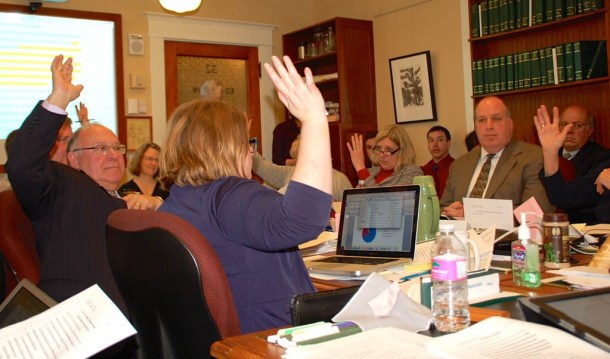
[T]he House Education Committee is poised to produce one of the session’s most anticipated bills Thursday.
The committee Wednesday fine-tuned its attempt to reform the state’s education finance system, a pivotal issue in last year’s election. Voters around the state have complained loudly about ever-rising property taxes and school spending, even as the number of students enrolled has dropped sharply.
The committee is charged with slowing the growth of school spending and stemming the property tax tide while at the same time ensuring equal learning opportunities for all Vermont public school students.
On of the key elements in the draft bill is language calling on school districts to work with their neighbors to create “integrated education systems” of 1,250 students by July 1, 2019. That figure grew from 1,000 over the course of discussion.
The committee also grappled with how changes to the small schools grant program will affect schools that are being supported despite dwindling numbers of students.
Under the draft, small schools grants will continue only under certain circumstances, but will remain untouched until 2020.
Exceptions to losing the small schools grant would include:
• having high student-to-teacher ratios;
• lengthy driving times or inhospitable travel routes between the school district and another district which has excess capacity;
• and that schools must be providing high quality educational opportunities that meet standards set by the State Board of Education.
Rep. David Sharpe, D-Bristol, chairman of the committee, has been pushing hard to get a bill out before the town meeting week break so taxpayers will have an idea whether property tax relief is on its way.
“From my perspective, the bill is complete,” Sharpe said at day’s end Wednesday.
He said some spending-control provisions still need to be finalized — whether it be a spending cap or making the excess spending threshold more stringent; studies need to be added on topics that have been raised during the session, including special education delivery; and what language the bill will contain on staffing ratios.
Size matters
Since 1997, the state’s public school enrollment has dropped by 21,000 students, but the number of teachers and paraeducators working in Vermont has not declined, according to a presentation made by the state education secretary in January.
The question, Rep. Kevin “Coach” Christie, D-Hartford, ranking member of the House Education Committee, said, is, “Can we help those schools deliver better quality education to the kids? It’s a bottom line situation. And with the costs being as high as they are in those smaller units, you can spread those costs out a lot easier with a bigger unit, that’s a given … all of the testimony we’ve taken supports that.”
Rep. Alice Miller, D-Shaftsbury, expressed apprehension about the larger districts the bill is calling for, saying she does not see the evidence, or the need to rush.
“Let’s get into the communities, hear what people are saying, let’s hear their voices on this, what is the crisis?” Miller asked. “We don’t have evidence that moving to larger regions is going to work. Let’s get that evidence, or we could take draconian measures and do everything” being talked about to find savings, she said.
Brad James, education finance manager for the Vermont Agency of Education, said size likely does matter.
“I think you need to look at larger units,” he said. “You’ve heard from superintendents that they think it would be more efficient; you’ve heard from business managers the same thing — we keep coming back to this same issue, that we have very small districts. It’s not necessarily about closing small schools, it’s about making a size unit that’s workable.”
Ratios discussed
Ratios for classroom teachers, staff and administrators have drawn the ire of the teachers’ union.
Joel Cook, executive director of the Vermont-National Education Association, lashed out at the ratio issue, saying “… when you start monkeying with forced ratios, you cross a line that we cannot ignore.”
“I think a lot of this could be done through teacher retirements, and not taking away people’s jobs,” said Miller of the possible consideration of including ratios in the bill.
Rep. Bernie Juskiewicz, R-Cambridge, said he believes something needs to be in the bill to push staff reductions.
“Otherwise the school boards if 900 go out this year, they’re going to bring 900 in,” he said. “We need to change the mentality of the school boards and the communities, that we need to absorb some of these positions and that’s going to help our property taxes.”

The draft bill includes language that would increase student-to-teacher, student-to-(district-level)-staff; and student-to-(district-level)-administrator ratios by at least 5 percent.
Work on ratios will continue Thursday.
Sharpe, a retired teacher, said, “I think there is serious money to be saved here. I worked in a school and it seemed to me there were a lot of people paid to be in meetings,” and that’s not good for students, he said.
Bridge to longer-range solutions
Wednesday’s discussion ended up seeing parallel tracks — what can be done to save on education spending and improve education for students in Vermont in the longer view, a few years out – and what can be done faster for taxpayer relief.
“The proximate problem is immediate tax relief,” said Rep. Ann Manwaring, D-Wilmington.
Rep. Kurt Wright, R-Burlington, stressed that the bill needs to give “the message to taxpayers we have heard you. We need that short-term bridge to the longer bridge.”
One such idea to help with the short-term bridge is H.257, a proposed cap on education spending for three years, introduced by Rep. Oliver Olsen, I-Londonderry.
Small schools concern
Concerns about how the proposed legislation will impact the state’s smallest schools was expressed by several legislators.
If a small school is doing a good job “and they’re doing it in a cost-effective way, do we really want to force that school to go into a merger?” asked Rep. Scott Beck, R-St. Johnsbury.
He heard a chorus of “yeses,” from several committee members at the table.
Having the resources of a larger district at hand if enrollments change or circumstances change, allows sharing of resources, “and delivery of quality, because they’d have access to more teachers, more support,” Christie said.
“I don’t think any of them should get a grant if they haven’t made an effort to merge with their neighbors,” Sharpe has said.

