

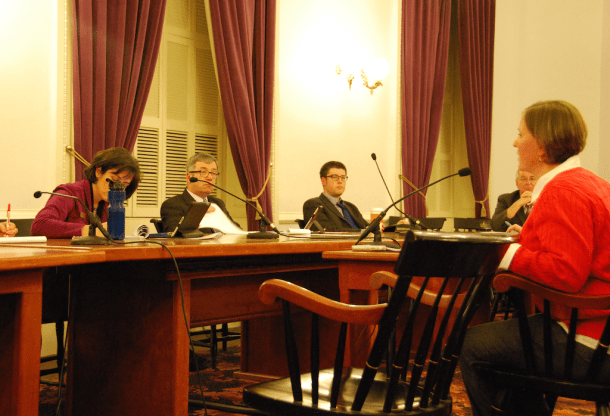
[N]early two dozen advocates sounded off to House lawmakers about underfunding for programs and services in the Shumlin administration’s proposed budget on Tuesday.
One by one, advocates from an array of backgrounds around Vermont, voiced concern to members of the House Appropriations Committee about levels of funding for housing, heating and health programs, many of which are run by community-based organizations and funded by grants from the state.
More than 30 grants across the Agency of Human Services face reductions if Gov. Peter Shumlin’s budget goes through as proposed, with more than a dozen of those being eliminated entirely.
Altogether the reductions and eliminations to grants will add up to a savings of about $7.1 million in the general fund.
However, once added to federal match dollars and global commitment dollars, AHS grant recipients will see a total reduction of nearly $10.9 million in money they receive to support their work.
More than half of the state’s budget goes to the AHS, which comprises the Department of Corrections, the Department for Children and Families, the Department of Vermont Health Access, the Department of Health (VDH), the Department of Disabilities, Aging and Independent Living (DAIL) and the Department of Mental Health.
Across departments, the budget proposes to reduce agency spending by $17.3 million.
The bulk of the reduction in grants comes from a $6 million elimination of state funding for a heating assistance program (LIHEAP). In comparison, most of the other reductions are in relatively small amounts — in tens or hundreds of thousands — but the recipients of those grants say that the cuts will have a big impact on the services they can offer.
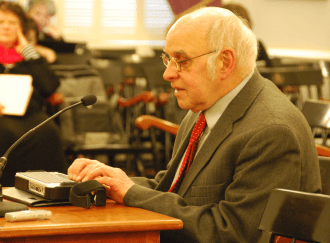
Franklin Shiner of the Vermont Center for Independent Living told the committee that a cut to a grant that funds adaptive vans will take a toll on Vermonters with mobility challenges.
“That is a huge loss,” Shiner said of the elimination of the $100,000 grant.
The majority of the grant, however, comes from federal money; Vermont pays for less than a quarter of it from the general fund.
That was a tough decision, according to Susan Wehry, the head of DAIL. In past years, the high federal match for programs like the adaptive van grant were a reason why programs did not get cut.
“The magnitude of this year’s gap required that we look at all programs and to balance multiple factors,” Wehry said in an email Tuesday.
Much of the funding for vocational rehabilitation programs, like the adaptive van grant, and funding for programs to support the blind and visually impaired, are funded by a generous federal match. If the state puts up 20 percent of the cost, the federal government will supply the remaining 80 percent.
Steve Pouliot of the Vermont Association for the Blind and Visually Impaired told lawmakers that even before the reductions in the proposed budget, the association is strapped.
“Our staff is just maxed out,” he said.
The association, which helps visually impaired Vermonters adapt to living at home, faces a $42,000 cut in the budget, amounting to a savings of $8,946 in the general fund.
“We know that you have a tough year with hard decisions,” Pouliot told lawmakers. However, in cutting funds for his association, “We really feel it would cost the state more money.”
According to Wehry, the department expects that the financial cuts will not lead to a reduction in services, but may cause a delay in services. The cut, both Wehry and Pouliot noted, might result in the loss of one rehabilitation teacher position.
“I guess it doesn’t hurt to state the obvious,” Wehry said in an email statement, “none of these choices were easy.”
In the case of some grant reductions, the state expects part of the impact will be padded by a 2.5 percent increase in the amount that providers will receive from Medicaid.
A grant to fund adult day care will be completely eliminated under the governor’s proposed budget.
Adult day care organizations, like the Gathering Place in Brattleboro, bill under Medicaid. DAIL expects that organizations like that will get some benefit from the 2.5 percent rate increase.
But Mary Fredette, executive director of the Gathering Place, says funding from Medicaid can be unreliable. If a client goes to the hospital or can’t make it due to weather, the organization does not receive a payment. The volatility can make it hard to hold on to staff and difficult to guarantee hours.
From the Health Department budget, a $135,000 grant from the general fund to support five HIV/AIDS community organizations around the state seems like a small cut compared to the $1.9 million reduction in the department’s services.
But, according to Marguerite Monet of the AIDS Project of Southern Vermont, that eliminates more than a quarter of the funding those five AIDS organizations across the state receive each year.
“We all understand that this is a very difficult financial time for the state, but to eliminate the entire state allocations seems really drastic,” Monet said by phone Tuesday.
The five organizations serve about 415 people across Vermont, which means the cut will average out to about $325 per client. That cut could hit services such as emergency assistance, transportation to and from doctor’s appointments and copays for medications.
If the state moves ahead with the elimination of the grant, Monet said, it would “indicate that the state isn’t interested in supporting services to its citizens with HIV.”
According to Health Commissioner Harry Chen, the department recognizes that the cuts will have an impact on the organizations that provide services, but expects that the cuts will not have a negative impact on Vermonters with HIV and AIDS.
“These were difficult choices driven by the constraints of the budget process rather than by an assessment of the program performance or results,” Chen said by email.
Having taken weeks of testimony on the proposed budget, the committee is beginning to move into marking up the 2016 budget bill.
Going forward, the chair of the committee Rep. Mitzi Johnson, D-South Hero, said lawmakers will be “trying to balance how much this reduction helps us to curb spending versus how much this reduction impacts Vermonters.”
When it comes to reductions to grants, the committee will consider each one individually.
“We’re going to be trying to answer the question, how does this particular expenditure meet the core function of state government?” Johnson said.


