



Editor’s note: This article is by Lisa McCormack, of the Stowe Reporter, in which a longer version was first published Feb. 12, 2015.
[C]opley Hospital has lost all three of its general surgeons and has two interim physicians filling in while it works to replace them.

Two general surgeons in private practice at the hospital have decided to close shop. The third, an independent general surgeon who had worked at Copley for 21 years, lost her job when the hospital terminated her contract.
Copley Hospital handles about 2,000 surgeries per year, not counting colonoscopies and minor surgical procedures.
Brian Smale, M.D., and Dyeanne Racette, M.D., ran their practice, Green Mountain General Surgery, from the hospital. They stopped seeing new patients late last year and plan to phase out their practice by the end of this month.
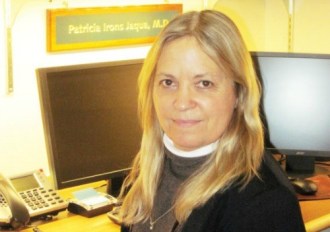
Patricia Jaqua, M.D., had a three-year contract that was set to expire on May 31, 2016. During a recent interview, she said that, on Dec. 3, hospital President and CEO Mel Patashnick gave her a notice of termination.
Jaqua was a Copley employee. Her contract was terminated “without cause.” Her responsibilities included seeing office patients, performing elective surgeries, and being on call for surgical emergencies around the clock 15 days per month.
Jaqua believes her contract was terminated because she had raised concerns about patient safety when she was on call 24 hours per day for 15 days a month.
Hospital spokeswoman Leah Hollenberger declined to speak about the specifics of Jaqua’s schedule, citing employer-employee privacy, but said, “All of our arrangements with physicians are within industry norms.”
The Stowe Reporter has obtained a copy of Jaqua’s termination letter, which was signed by Patashnick. The last paragraph of the letter indicated that Jaqua would be welcome to work for the hospital in a different capacity. Patashnick wrote:
“We hope you will consider remaining as a member of Copley’s medical staff so that we will have the option of offering you opportunities to serve as a locum whenever our need for general surgery locums coverage arises.”
Copley has been working with Weatherby Healthcare, a company that provides general surgery programs to hospitals. It was founded in 1995 and is based in Fort Lauderdale, Florida.
“Weatherby has been supportive of our practice philosophy and provided two long-term interim surgeons committed to excellent patient care and working closely with other physicians in our community,” said Hollenberger. “Because we have a long-term commitment from these physicians, there is continuity of care for our patients.”
The interim physicians are Andrew Smith, M.D., and Mark Nuqui, M.D., who work 14-day rotating schedules.
“We had to do something to provide the level of surgical care the community needs,” Patashnick said.
Both physicians have provided interim services at the hospital in the past and are familiar with the staff, according to Patashnick.
Weatherby is working to recruit two full-time general surgeons and the hospital is in negotiations with a candidate.
The surgeons issue came up as part of Copley’s application for a certificate of need to build a new $12.5 million surgical suite.
Its operating rooms haven’t been updated since 1979 and hospital officials say they are too cramped for modern technological equipment and the pre-surgery and recovery rooms don’t provide enough privacy for patients.
In a letter dated Jan. 29, the state’s Green Mountain Care Board asked Copley how the interim arrangement would affect patient care and continuity of care.
It also asked if the hospital had considered any peer-reviewed studies on the sufficiency of using temporary surgeons rather than staff surgeons for general surgery.
Copley must respond to the questions in writing before the board makes a decision about whether to approve the surgical construction project.
Interviews with prospective surgeons have gone well and the hospital could make a job offer soon, Patashnick said.
In the meantime, the current arrangement is serving the hospital’s needs and the needs of the community, he said.
“It’s not uncommon for rural hospitals to do this,” Patashnick said. “You have to rely on interim people once in a while.”
Jaqua is now working as an interim surgeon at North Country Hospital in Newport and at Littleton Regional Health Care in New Hampshire.
She’s concerned about the future of general surgery at Copley.
The hospital has no long-term vision for its general surgery practice, and that will make it difficult to recruit new surgeons, Jaqua said.
Further, in recent years, Copley has put an increasing focus on orthopedic surgery, which generates more money, she said.
In fiscal year 2014, 60 percent of Copley’s surgical services were orthopedic; 12 percent were general surgery, according to Hollenberger.
“The percentage of surgeries is not the only measure to consider with general surgery,” Hollenberger said in an email.
“General surgeons are critical to every hospital because they consult with emergency department physicians to evaluate surgical needs of patients in the emergency department; they serve as an occasional backup as needed for ob/gyn procedures, including C-sections; and they perform office-based procedures in addition to surgeries performed in the operating room.
“In many community hospitals, general surgeons perform most of the colonoscopies.
“Copley continues to offer excellent general surgical care in a sustainable manner to best meet the needs of our patients, our physicians and our community hospital overall.”

