

BURLINGTON — Members of the Save Open Space-Burlington citizens group continue to urge city officials to conserve at least part of the 27.5 acres of land recently sold by financially troubled Burlington College to a private developer.
Last week, the college and developer Eric Farrell closed on a $7.65 million deal for the property overlooking Lake Champlain, which includes a small house on North Avenue, a parking lot on North Avenue and an apartment house on Lakeview Terrace.
Burlington College owns 6 acres and the large former orphanage that had belonged to the Roman Catholic Diocese of Burlington.
Plans call for the college to also sell the former orphanage building to Farrell, who intends to build housing on the land, while college officials have said they will continue to operate in the modern wing of the building.
At Monday night’s Burlington City Council meeting, more than 200 people on the group’s Declaration of Open Space submitted signatures.
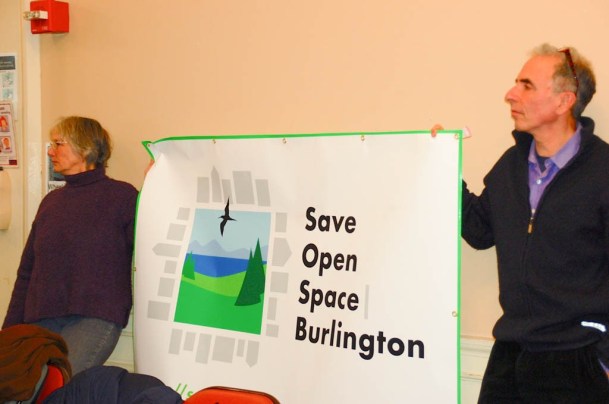
Group members Ruby Perry and Andy Simon held a large banner at the back of Contois Auditorium at City Hall as more than a half-dozen members of the group expressed concern about wildlife habitat, community gardens and the need for open space in the city to be preserved.
Members of the SOS-Burlington group held an Open Space Summit Meeting on Jan. 21, where dozens of residents signed the Declaration of Open Space. Since that time, group member Ruby Perry told the council Monday night, many more have continued to sign the declaration on the group’s website.
In a news announcement before Monday night’s council meeting, the group stated, “Even though the sale of the land by Burlington College has recently been completed, the fight to conserve this important open space is far from over.”
In the Declaration of Open Space submitted to the City Council on Monday night, “The proposed development of the lakefront meadow, bluff and forest land behind Burlington College into 700 housing units has called into question Burlington’s commitment to open space protection. Filling this land with buildings will disrupt wildlife corridors, impact significant natural communities, exacerbate surface water runoff problems, and restrict access to important recreational space.”
The group had hoped to halt the sale of the land to Farrell, and now that that has occurred, they remain steadfast in wanting the mayor and City Council, “to honor the values and goals expressed in the Open Space Protection Plan, the Municipal Development Plan and the Climate Action Plan,” by including a broad community discussion on the future of the land, to include the Neighborhood Planning Assemblies, the Conservation Commission, the Parks & Recreation Commission and other venues.
SOS-Burlington is also urging city officials to work with “appropriate land trusts and other organizations to keep this land within the public domain.”
Pamphlets distributed at Monday’s council meeting by SOS-Burlington urge careful consideration in developing housing on the parcel, and question some city officials’ ability to objectively evaluate the plans.
Efforts to obtain a comment from the new owner of the land, Farrell, on Tuesday, were unsuccessful.
Perry, the first from the group to address the council, was accompanied by Mary Twitchell, who held up the Declaration of Open Space with the more than 200 citizen signatures on it.
“The land is too precious to lose for a number of reasons,” Perry said. Each person speaking during the public forum had a two-minute time slot.
Perry urged the funds in the Conservation Legacy Fund be used to conserve the land “for Burlington residents human and non-human,” and that city officials look for land solutions that “do not sacrifice open space for private gain over public good.”
Charles Simpson, the group’s treasurer, spoke about three community gardens that now grow on the site, and said the city needs more healthy opportunities, not fewer.
“Gardening is an elemental experience, linking residents to the nurturing soil and to place,” Simpson said. “It is part of every city’s sense of place and well-being. Gardening creates community among those who work the raised beds and the perennial berry bushes, sharing ideas and produce and labor.”
“I would hope that Burlington officials have sufficient vision to appreciate and substantially increase the gardening/food production potential of the Burlington College campus and not see gardening there as either a token gesture – a paragraph in a planning book like a tot lot or heritage street lamps – or as a place holder,” testified Simpson. “Rather, I hope you will consider them as a key component in the urban fabric and identity, one that now exists at the BC campus and should be expanded.”
Resident Diane Gayer urged the council to keep close at heart the fact the property is an important habitat corridor for wildlife, and said the fund the city has on hand could be leveraged with other monies; she noted that the group has reached out to Preservation Burlington about the “historic nature of this land, and they are very concerned, as well.”
Twitchell, addressing the council, addressed climate change that has led to “continued erratic weather patterns” including hurricanes Sandy and Irene, and how they have impacted the Intervale, with repeated flooding and levels in Lake Champlain. “It doesn’t matter whether you are a believer or a denier of climate change,” she testified. “The orphanage property should be another part of our legacy to the 7th generation … showing them that we knew to save open space for the benefit of the many, not for the personal gain of the few.”
Many members of the Native American community have joined the fight to conserve the property. The 7th generation principle looks seven generations out to see how a decision will affect descendants.
Resident Glenn Eames said, “It’s hard for me to understand that we would let this jewel slip from our hands and into the hands of a private development.”
He pointed out several conflicts he believes exist between the board of Burlington College, the city’s planning commission and real estate interests.
“The only people I haven’t seen involved in this are the citizens of Burlington,” Eames said.
Simon also spoke to the council, and raised the issue that the city already is not taking care of the housing needs for people already in the city.
“Good housing and open space are not in opposition, let’s not treat them that way,” he said.

