

That hourly wage is only sufficient, however, if that single person is sharing housing expenses.
An annual basic needs budget for a family of four with two working parents is $81,799, data from the report show. The median income for a family of four in 2013 was $82,047.
The Joint Fiscal Office’s annual analysis of the “living wage,” is based on a “basic needs budget.” The cost of living in Vermont, as calculated by the Legislature’s fiscal analysts, includes housing, food, health care, dental care, child care, transportation, telecommunications charges, renter’s insurance, life insurance and savings. The calculation does not include college loan payments.
The report breaks down the livable wage and basic needs budget for seven different categories by household size. The methodology for the analysis was originally developed in 1999.
Last year, the livable wage for a single person in shared housing was $12.48 per hour.
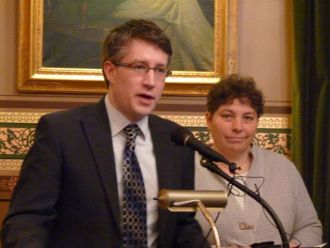
At a press conference last week, representatives from the Vermont Businesses for Social Responsibility and the Vermont Sustainable Jobs Fund touted the report as a baseline for employers who want to consider the cost of living in Vermont as a parameter for setting wage levels. Members of the business group said they pay a livable wage at the expense of their own profits because they believe it is the right thing to do for employees.
Liz Holtz, the founder and CEO of Liz Lovely a vegan bakery in Waitsfield, said when she founded her company 12 years ago she wanted to create jobs that are sustainable, “and I believe a living wage is a part of that.”
Holtz said baking requires skill and in order to retain production bakers, she has invested in higher wages, time off and benefits.
“They have to care about what they’re doing,” Holtz said. “The sustainability of our business is also the sustainability of their lives, and a livable wage is the only way to do that.”
Dan Barlow, public policy manager for Vermont Businesses for Social Responsibility, said $13 an hour “sounds like a lot of money,” but “that’s a difficult salary for a lot of Vermonters to survive on.
Ellen Kahler, the executive director for the Vermont Sustainable Jobs Fund, described the basic needs assessment as a “barebones budget.”
“If you’re working full time, and you’re playing by all the rules in this society, our feeling is, and I think this is shared by other Vermonters, you should be able to pay your bills,” Kahler said. “For far too long, Vermonters have been working two to three jobs at $9, $10 and $11 an hour, and they continue to struggle.”
While Vermont has a low unemployment rate of 4.2 percent, wages have remained stagnant. Kahler said the low rate should put upward pressure on wages.
Small businesses in Vermont are struggling with their own profitability, Kahler said, and the state and the nation need to find a new strategy for “raising up wages in this country and in Vermont for the middle class.”
When Vermonters don’t earn enough to meet basic needs, she said “it has a huge ripple effect throughout our whole economy.”
“It also impacts our state budget,” Kahler said. “If we have a diminished middle class in this state it means we’re not bringing in as much broad based tax revenue in terms of payroll taxes, in terms of income tax. It also means more Vermonters are relying on public assistance to supplement their earned income.”
Vermont workers who earn the minimum wage qualify for food stamps, heating fuel assistance and other benefits.
Russ Bennett, a member of the board of Vermont Businesses for Social Responsibility, said in effect, employees of companies that receive benefits because they don’t earn a living wage are subsidized by taxpayers and other businesses.
“That costs all of us money and it gives people who are not paying a livable wage an unfair advantage,” Bennett said. “Businesses that pay below a living wage are making money at the expense of those of us who are paying to subsidize those jobs.”
Lawmakers and Gov. Peter Shumlin increased the minimum wage last year. The rate in 2014 was $8.73 an hour, it went up to $9.15 an hour on Jan. 1. The rate is set to increase again in 2016 to $9.60 an hour, to $10 an hour in 2017 and $10.50 an hour in 2018.
A full time minimum wage worker now makes $18,150 a year. The phased in rate increases over the next three years amount to a $3,100 annual raise.
Tipped restaurant workers will also see a 35 cent raise, bringing their hourly wage up to $4.58 per hour.
Bennett says the minimum wage is not going up fast enough.
“We’ve lost a lot of ground over the years,” Bennett said. “The minimum wage is supposed to be a living wage, but that gap has grown quite large.”
He suggested that companies that don’t pay a living wage be subject to a higher corporate tax “because of the burden they are shifting onto society.”
