

[F]ollowing the closure of the Vermont Center for the Deaf and Hard of Hearing this summer, advocates for the hearing impaired want lawmakers to pass protections for their community.
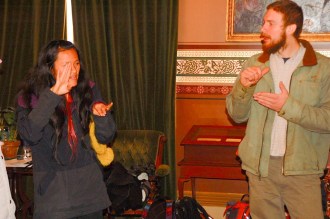
Their focus is access to educational and other support services for deaf and hard of hearing children and their families, said Mary Essex, president of the Vermont Association of the Deaf, at a rally attended by close to 100 members of deaf community this week at the Statehouse.
Vermont hired the special education company Nine East Network to take over $862,000 in state appropriations to provide school-based services for students, parent and infant services formerly administered by VCDHH.
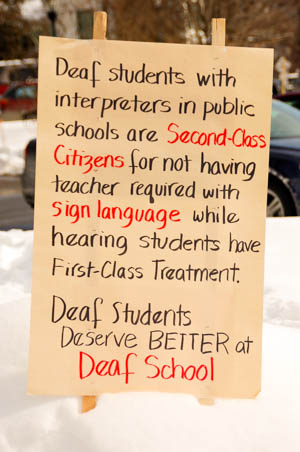
But services available through the public school system aren’t adequate, Essex said. For anyone with hearing loss, their family or friends, information about sign language, technology aids, educational access, interpreter services or help improving their own signing skills is much harder to come by, she said.
The deaf community also wants to play a greater role in public school system’s hiring of interpreters, many of whom are underqualified, Essex said.
“We want them to listen to us about providing interpreters in the school system, making sure they are credentialed,” she said.
 Sen. Anthony Pollina, D/P/W-Washington, says he will introduce legislation to accomplish that early next week.
The bill would have three primary components:
• Re-establish a commission on the deaf and hard of hearing that will work to ensure services are as good or better going forward as they were before the closing of the Austine School and VCDHH.
• A bill of rights for deaf and hard of hearing, that focuses on access to education and other support services.
• Work to ensure kids that are deaf and hard of hearing have access to quality education, which could mean the establishment of a centralized school or some network of learning environments to ensure they have the services they need.
The last component is especially important, Essex said, because deaf or hard of hearing students often struggle in Vermont’s widely dispersed rural public schools. There are 650 school age hearing impaired students spread across the state. In some cases there aren’t two deaf students of the same age group in an entire district. That can lead to an isolating educational experience, Essex said.
“I would say the public school education system for a deaf individual is not ideal for development education, emotionally or socially,” she said.
As a result, some hearing impaired students are traveling to deaf schools in Massachusetts, New York, Connecticut and even as far as Washington, D.C., Essex said.
Essex said her organization also supports House bill H.19 that would require health insurance to cover hearing aids.
Hearing aids cost close to $1,500 each, and typically aren’t covered by insurance, she said.
CORRECTION: Nine East Network is a for-profit, not a nonprofit company, as originally reported. Its funding comes from state, not federal, appropriations.

