

[S]OUTH BURLINGTON — Don Rendall is settling into one of the hottest corporate seats in the state.
Rendall became CEO of Vermont Gas Systems on Jan. 1, at a time when the utility is still in the early stages of building the first section of a controversial, multimillion dollar natural gas pipeline through Addison County.
The project has been criticized by environmental activists, has run into problems with neighbors and has nearly doubled its cost estimate in the past year.
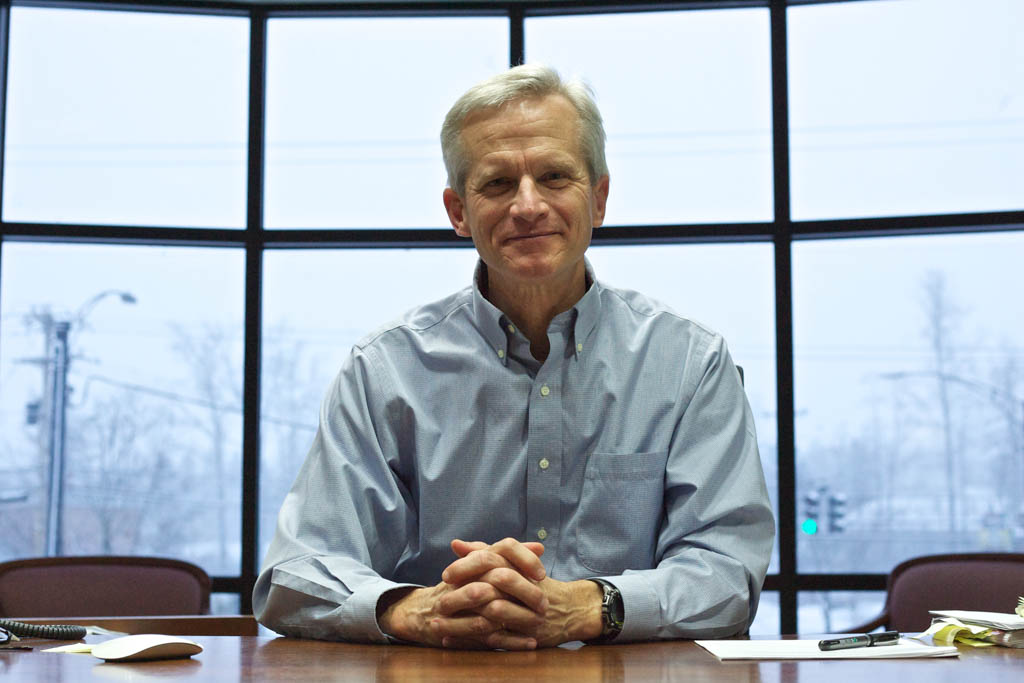
Rendall’s office at the company’s South Burlington headquarters is light on decor — an empty frame mount is tacked to the wall and a desk contains a few stacks of paper, a landline telephone and a laptop computer.
More than a week before Rendall moved into his new digs, he addressed the media to announce a second cost increase to build the first phase of the project, and to postpone regulatory review of the company’s permit application for a second phase until new cost estimates are available.
“Obviously, the project is a big challenge as we get our arms around it and we decide how best to proceed,” Rendall said in an interview Monday with VTDigger.
Rendall, 59, says he is enthusiastic about his new job. And he isn’t going too far afield. Rendall was general counsel and then an executive for Green Mountain Power, which is owned by Montreal-based Gaz Metro, one of Canada’s largest natural gas distributors.
Rendall replaces Don Gilbert, who retired after 13 years as CEO of Vermont Gas, which is also a subsidiary of Gaz Metro.
Under his leadership, Rendall says Vermont Gas will be open and engaged with the public and critics. He said the company plans to cover legal expenses for property owners along the pipeline route who are negotiating easement agreements. He also said he will use his position to advance stricter environmental regulations on the natural gas industry, among other goals.
For now, his attention is on the three-phase pipeline project that stretches through Addison County. The company one day hopes to bring gas to Rutland and later tie into a regional pipeline network across state lines.
But over the course of a year, the cost estimate for phase one has nearly doubled — to $154 million, up from the original $86 million when the project was approved.
On Monday, anti-pipeline groups pressed regulators to revisit the project. The Shumlin administration, which supports the pipeline, is also asking regulators to re-examine the costs and benefits of the project. The Public Service Board has yet to decide whether to review or amend the permit the company received in December 2013.
Still optimistic
“This is a big challenge. It’s a privilege to be be chosen to lead a team of dedicated employees,” Rendall said. “While I relish the challenge and opportunity, it’s an obligation that I take very seriously. I’m confident that we are off to a good start.”
But with only the first five miles installed, the ex-Green Mountain Power strategist said he is considering ways to bring natural gas throughout the state by truck to mini-depots.
“Our goal is to bring the opportunity to use natural gas as an energy source to more families and business in Vermont. And we are looking at a variety of ways to do that — both with expanded transmission pipeline and without,” he said.
Through a partnership with NG Advantage, a separate company, Vermont Gas is already trucking natural gas to a loading station that feeds a distribution network in Middlebury, a projected referred to as a “gas island.” Rendall said the company is considering a similar project in Rutland, even though it costs more to deliver by truck than by pipeline.
“It’s an alternative in the short term. Whether it’s an alternative in the long term, let’s wait and see,” he said.
Rendall said the company intends to be more transparent in engaging with communities and residents hosting the pipeline.
In December, Vermont Gas reached a tentative agreement with the town of Cornwall, which voted against the project last year. The memo of understanding would include payments to the town in exchange for hosting the pipeline. Rendall pointed to this as an example of a recent success. One former town official involved in the negotiations said the agreement was made possible by Rendall’s leadership.
At least 35 of the 221 property owners along the pipeline have yet to sign easement agreements with the company. The company invoked eminent domain, a legal process to secure land for public infrastructure projects, which caused a groundswell of media attention and criticism, even among supporters of the pipeline.
The company suspended its pursuit of eminent domain last month. In the meantime, the company hopes to reach agreements with landowners through a mediation process.
Vermont Gas says 13 easements have been reached through mediation and the company plans to reimburse landowners for legal expenses associated with that process.
Apart from sourcing more bio-methane gas and offering incentives for energy efficiency, Rendall said the company will press for tougher environmental regulations in the industry.
Environmental groups have dubbed the project the “fracked gas pipeline,” calling attention to the controversial drilling technique known as hydraulic fracturing, which uses water and chemicals to extract oil and gas from shale rock.
Rendall said he is committed, personally and professionally, to the environment. He said he will advance regulations and enforcement on the industry.
“I am confident that we can be a voice for positive change in the industry as we tackle the challenges around the environmental impacts of resource production,” he said.
