

[P]hilip Beliveau opened a map of his planned 19-lot subdivision over a pile of books and outdoor magazines, and then slid his finger along a line indicating the location of a proposed natural gas pipeline through his 58-acre property in St. George.
“The gas line goes through here. It’s actually touching a couple of lots,” he said. “What does that say about the prospective buyers of the lots? Is it going to reduce the value?”
Beliveau, 57, works seasonally as a ski instructor and sells bikes and equipment from his home. After five years of careful planning — mapping out septic capacity and wetland boundaries on his property — he is now re-evaluating a planned $2.5 million subdivision that would help to fund his daughter’s college education and his own retirement.
Vermont Gas Systems’ proposed natural gas pipeline, Beliveau believes, will undermine the value of the property, and he wants the company to pay more for an easement on the land. But Vermont Gas has refused to increase its offer, and so like 60 other landowners who have refused to give up a portion of their properties to make way for the pipeline, Beliveau is now subject to condemnation proceedings.
The company recently cleared regulatory reviews for construction of the 41-mile natural gas pipeline from Colchester to Middlebury. After a 30-day wetlands permit holdup and revelations about a 40 percent cost hike that was not made public until months after the original proposal was approved, the Public Service Board for a second time gave the utility permission to begin building the $121 million pipeline though Addison County.
The project has cleared all major regulatory hurdles and is underway. But progress on the pipeline could come to a halt. Landowners hold the rights to about 220 properties along the pipeline’s proposed route. Alarmed by the company’s initial right-of-way negotiations, dozens of those landowners have organized to help each other parse the company’s easement offers.
They have also joined environmental groups in their opposition to fossil fuel infrastructure. Vermont Gas, a subsidiary of Quebec’s largest natural gas company, Gaz Metro, must now secure easements from a growing group of landowners who oppose the project on principle.
Because the project has a certificate of public good from state regulators, the company can seize the right-of-way through eminent domain if it is unable to reach an agreement with property owners.
Vermont Gas in August filed with regulators to condemn four properties, and has settled at least one case through mediation. The condemnation hearings have not been scheduled, according to the state.
The utility will file to condemn more properties as soon as this week, according to the state. The company will likely seek to condemn an additional 20 properties, according to Louise Porter, a public advocate with the Department of Public Service. Vermont Gas did not return several requests seeking comment Friday.
Eminent domain
[B]eliveau inherited his farmland in Georgia from his parents. On a damp, late-summer morning, he pointed to a row of spruce trees he and his family planted decades ago. The land is now surrounded by overgrown brush and hay and lies next to an overhead transmission line that is kept cleared for maintenance.
Vermont Gas offered Beliveau $21,000 for a permanent 500-foot-wide strip of land parallel to the state’s utility corridor, beneath which the 12-inch pipeline would be buried. Beliveau counter-proposed $200,000 to compensate for losses he expected on his planned subdivision. On Aug. 19, Vermont Gas filed to condemn the property. Beliveau has hired a lawyer to represent him in the eminent domain proceeding before the Vermont Public Service Board.
There are about 20 landowners along the proposed pipeline route that the company says appear unwilling to negotiate — and an additional 40 or so who have not signed easement agreements.
Porter said eminent domain proceedings take at least six months.
“It can be a significant amount of time, depending on the board’s schedule and any appeals,” she said.
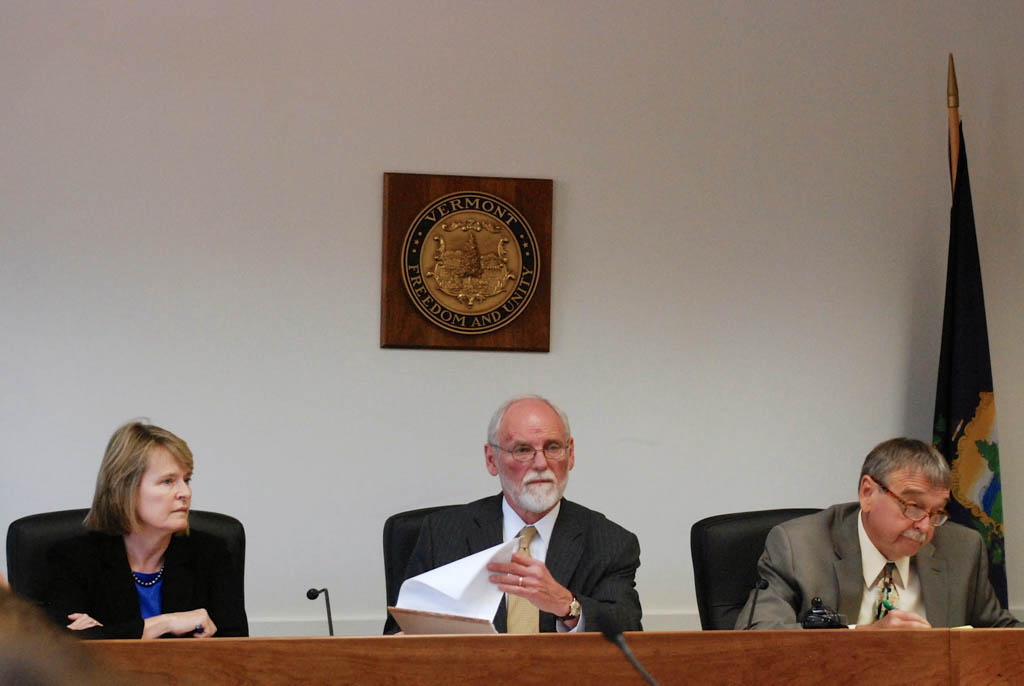
Since 1965, Vermont Gas has condemned 42 properties in Highgate, Colchester, Georgia and St. Albans to build the existing pipeline network, according to a state official. Now, the company will ask several additional landowners to either negotiate with a mediator paid for by the company, or appear before the Vermont Public Service Board, which will set an amount for the easement rights. The board’s decision can be appealed to Superior Court and then to the Vermont Supreme Court.
The company has resumed work on the pipeline extension and hopes to complete about eight miles before construction breaks for the winter.
By August 2015, the company hopes to have completed the first section of a three-phase project that could serve up to 4,000 residents and businesses in Addison County. Over the next decade, the company plans to tie into a natural gas pipeline network in New York or Massachusetts, but must first obtain permits for a pipeline to Ticonderoga, New York, and later to Rutland.
What price is right?
[S]everal landowners along the pipeline route are concerned the project will devalue their property.
An appraiser found Beliveau’s property to be worth $259,000, with a $2,300 loss due to the pipeline — about 1 percent. Vermont Gas used this appraisal as the basis for the easement negotiation. A real estate agent said Beliveau has not received any permits for his project, and therefore has little legal proof that his subdivision is underway.
The South Burlington real estate appraisal firm Allen & Brooks was hired by Vermont Gas to appraise the pipeline land acquisitions. Co-owner Steve Allen said he could not discuss the valuations the company performed for Vermont Gas.
But according to Bill Hinman, a professional property appraiser who is a contracted town assessor for Williston and Georgia, the trenching of a pipeline will negatively impact the value of the property, but only in the short term.
Hinman compared the pipeline to a suicide in a home. Typically, the value of the property takes a two-year to three-year hit and then rebounds.
“Five years from now, that stigma is forgotten,” Hinman said. “The market is funny that that way. It has a relatively short memory.”
Nonetheless, he said more data would be needed to predict the specific impact of the natural gas pipeline on real estate.
Some are not concerned that the underground pipeline will affect their property value.
Meg Barnes purchased a 1,300-head dairy farm in Shoreham in 1999. She and her husband are the last Vermont property owners on the proposed phase two pipeline proposal before it crosses under Lake Champlain to the the International Paper mill in Ticonderoga, New York.
“We have no problem having the pipeline going across the property.”
Meg Barnes
“It will not make any difference for our home,” she said. “We have no problem having the pipeline going across the property.”
Barnes said the pipeline would be buried 5 feet below her dairy farm and she and her husband plan to plant crops over the pipeline. She also said International Paper, a regional employer, will save money on cleaner energy. Plus, the pipeline will bring property tax benefits to the town, she said.
“Why would we say, ‘no you can’t save millions of dollars a year?’” Barnes said. “The pipeline does not inconvenience us.”
Landowners lose ground
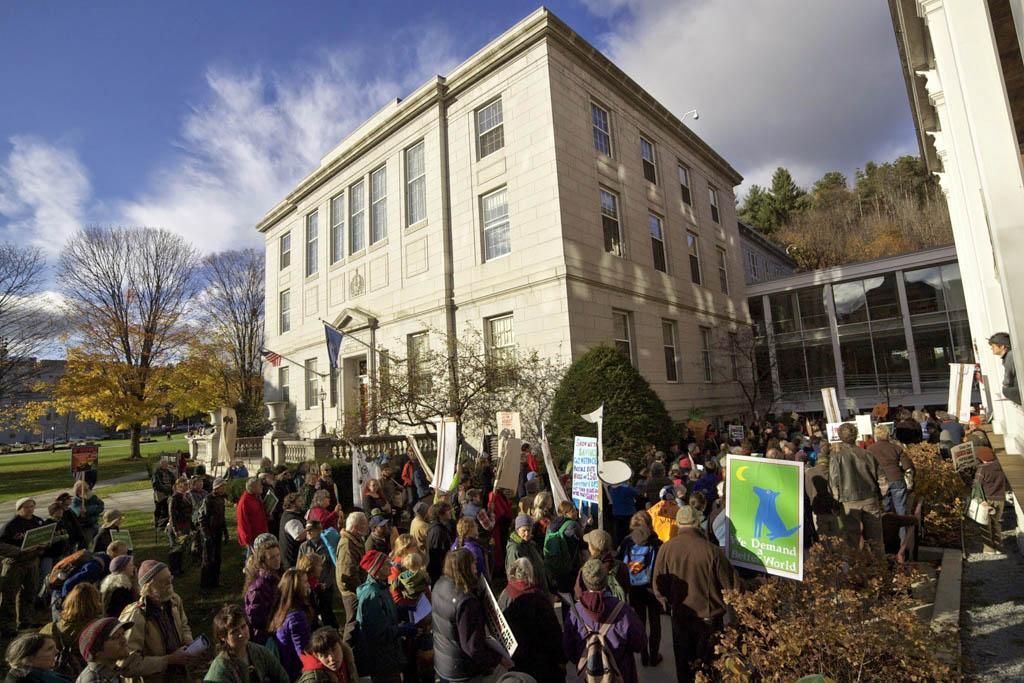
[P]ipeline opponents have failed to block the first phase of the pipeline. On Oct. 27, activists occupied the governor’s office. Sixty-four protesters willingly waited for hours to be arrested, calling on Gov. Peter Shumlin to withdraw his support for the project. He has not.
Beliveau, who has a minor in environmental studies from the University of Vermont, opposes the pipeline for environmental reasons. He said it is myopic for the state to invest in a fossil fuel, such as natural gas, that has a short future.
Despite his environmental and personal concerns with the project, Beliveau has not participated in civil disobedience activities.
“I consider myself to be environmentally conscious. I consider myself to be reasonably well-educated, which makes me more wary,” he said. “So I’m definitely opposed to the pipeline, but I’m also enough of a pragmatist to know that I’m not going to be able to stop it.”
Landowners have asked Vermont Gas to provide financial support for legal representation in the eminent domain proceedings. The utility decided instead to offer property owners a third-party mediator to expedite the negotiations.
The Shumlin administration is also hiring an independent appraiser to allow residents to “get a fair deal” for their property, Shumlin has said. He said homeowners don’t have “an arsenal of lawyers and experience” to negotiate right-of-way easements with Vermont Gas.
The state is still seeking an independent appraiser and has issued a request for proposals, according to the Department of Public Service.

Raphael Worrick of Cornwall, a landowner who is representing himself in opposing the second phase of the pipeline, said he spends 20 hours per week fighting the project before the Public Service Board.
He said the quasi-judicial regulatory review process is “inherently flawed,” and violates Article 4 of the Vermont Constitution, which states, “every person ought to obtain rights and justice, freely, and without being obliged to purchase it.”
The Department of Public Service, which represents ratepayers, does not represent individuals; it reviews projects based on the benefit to the public at large, Worrick said.
“There is no person or agency designated to represent the landowners. You are forced to either pay to obtain justice by hiring a lawyer or spending a huge amount of time, as we just said,” he said. “Or you can just give up, and what most people do is they just give up. And they (the company) count on that.”
Pipeline’s economic benefits hold strong, company says
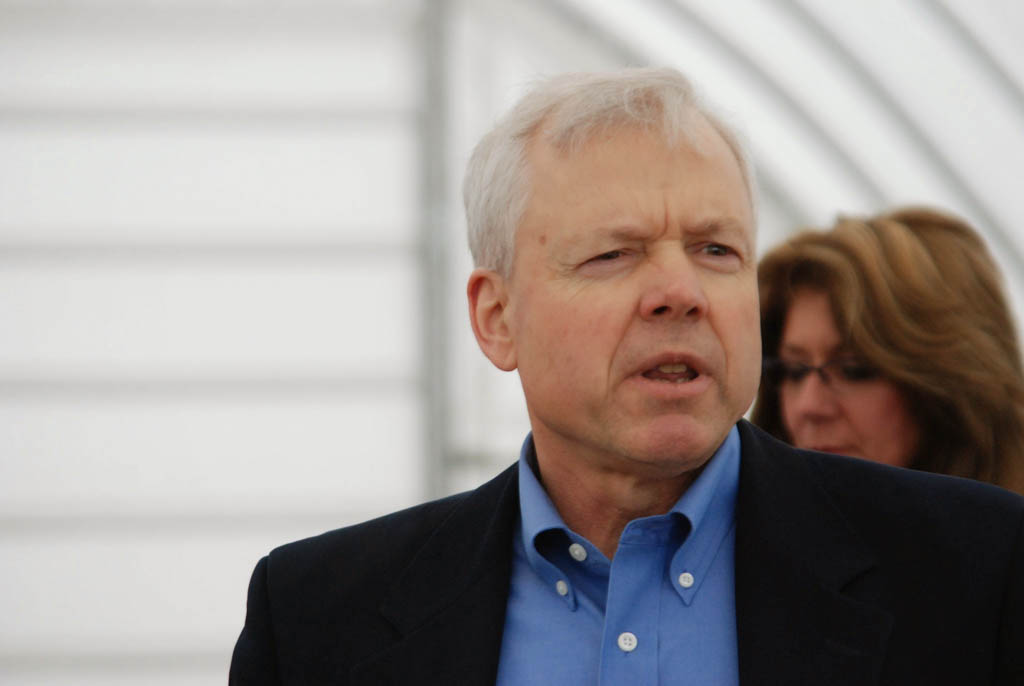
[D]on Gilbert, president and CEO of Vermont Gas, testified before regulators nearly two years ago on the same project. He said the effort is the latest in three decades of attempts to bring natural gas south of Chittenden County and across state lines to other pipeline networks.
Natural gas prices are again low, and he says the project will bring significant benefits to Vermonters.
“I think this is a once-in-a-lifetime opportunity,” he told the Public Service Board at a recent hearing.
Gilbert became president and chief executive officer of Vermont Gas in 2001, following 14 years with the company in various roles. Last month, the 59-year-old Hinesburg resident said he would retire Jan. 1. At that time the company will begin the permitting process for the second phase of its plan.
The company persuaded regulators in December 2013 to approve the then-$86 million natural gas pipeline extension; it was approved for a second time in October with a new price tag of $121 million. The price jump was largely due to national competition for pipeline construction.
The cost increase will not affect rates for the following rate year, which began Nov. 1. But the company estimates rates will jump about 3.6 percent in 2015. Under previous cost estimates, there would have been no rate increase. (The rate estimates are contingent on the company using more than $4 million it has already collected from customers and reserved in a special fund designed to smooth the rate impacts associated with the project.)
Vermont Gas says the project will generate $2.4 million per year in property taxes, save Addison County residents and businesses $195 million over the next 20 years, reduce carbon dioxide emissions and create trickle-down economic benefits through energy cost savings. State regulators have twice determined that these statewide benefits outweigh the costs of the project to ratepayers.
Opponents say the estimates are overstated, in part because they say consumers may turn to cost-competitive air source heat pumps, which use electricity to heat and cool homes, instead of natural gas.
Gilbert says heat pumps can work in tandem with natural gas as a backup for cold nights. Also, he says, heat pumps cannot provide enough heat for industrial and commercial customers in Vergennes and Middlebury.

Dan Rowell is CEO of Woodchuck Hard Cider, a winery-turned-cidery in Middlebury with a focus on environmental sustainability. The company uses propane at its Exchange Street cider mill to clean tanks and run the pasteurizer. Rowell said the company considered other options, including electricity from solar. But in the end, the company is making the switch to natural gas and estimates saving $75,000 per year, or about 50 percent over propane.
“We were silent on whether the pipeline should come down or not,” he said. “But if it does come down, we will use it.”
Woodchuck Hard Cider and other businesses in Middlebury will convert their heating systems to natural gas before the pipeline is built. Shipping gas by truck in a “virtual pipeline” is economically feasible for large customers.
The potential statewide economic benefits are among the most persistent talking points in favor of the pipeline. Even Shumlin, who signed a first-in-the-nation ban on the controversial practice of hydraulic fracturing in 2012, says the natural gas pipeline will grow jobs across the western side of the state.
“I’m convinced that as a bridge fuel, natural gas is better than dirty oil … it puts money in Vermonters’ pockets, it’s going to grow jobs in a job-challenged part of the state, and I’m unequivocal in my support for it,” he said in a recent interview.
International Paper believes the company will save so much on energy — its highest input cost — that it is willing to pay for nearly the entire $74 million cost of the second phase of Vermont Gas’ extension under Lake Champlain to its paper mill in Ticonderoga, New York, and about $27 million in upgrades to phase one, driving down rates for current customers, if the second project is approved.
International Paper spokeswoman Donna Wadsworth said before the pipeline is approved, the company will switch its kiln from No. 6 fuel oil to natural gas entirely and test it on its boiler during a routine outage between April and May. As the company waits for the pipeline to arrive by December 2015, she said it will ship compressed natural gas to its facility. The company has been speaking with NG Advantage in Milton about delivering compressed gas before the pipeline arrives, she said.

Personal price
[D]espite two regulatory decisions confirming the statewide benefits of the project, some landowners were shocked by the pipeline’s proposed route.
“When we looked at it, we thought, ‘who did we piss off at Vermont Gas?’” said Nathan Palmer of Monkton, holding a map of the proposed pipeline route and pointing to a wide-open pasture covering much of his property and the rest of Addison County.
“These people in the gas industry are not connected to the land. They’re just looking at it as rock and dirt.”
Nathan Palmer
Nathan and Jane Palmer purchased their rustic home 18 years ago. Jane Palmer, who was arrested at Vermont Gas’ South Burlington headquarters during a peaceful protest against the pipeline, said the property was sold as land only. Surrounding the home are piles of wood, a greenhouse, gardens and a buckled barn.
“The place was in bad shape. In fact, it was sold as land,” Jane Palmer said about the refurbished home. “We just loved the land.”
The home sits on a 77-acre plot between two farms. The Palmers grow organic winter rye, apples and other crops, though the farm is not certified organic. They typically lend plots to young farmers, Jane Palmer said, but this summer they were hesitant to do so.
“It’s like you don’t know what’s going to happen,” she said. “With this pipeline coming through, it’s like it put a brake on everything.”
The proposed route of the pipeline leaves the VELCO transmission corridor, follows the property line between the Palmers and Norris Berry Farm south and then it runs along Palmers’ property. The Palmers want Vermont Gas to reroute the pipeline slightly further away from their house and away from their apple orchard.
Nathan Palmer said the utility officials who are pushing for the pipeline don’t understand the attachment residents have to their land.
“It doesn’t make you a good person or a bad person. But it’s just how you are and how you’re wired,” he said. “These people in the gas industry are not connected to the land. They’re just looking at it as rock and dirt.”

Vermont Gas says the first phase of its pipeline may serve up to 4,000 eligible customers. The company says more than 65 percent of eligible consumers converted to natural gas when it brought service to Jericho in 2008.
But the Palmers see little benefit from converting to natural gas. They say it would cost $12,000 to replace their 1973 oil burner. And even if it did make economic sense, the two say they would not want natural gas delivered to their house for moral reasons.
“I would feel awful saving money at other people’s expense or the expense of the environment,” Jane Palmer said, in reference to the controversial hydraulic fracturing drilling process, which has unlocked new gas reserves and is credited by supporters for boosting natural gas production, creating jobs and offsetting foreign oil imports.
But even at home, the project is expected to impact the land as the pipeline is trenched through soil and rock and drilled below streams, rivers and wetlands. Vermont Gas’ phase one proposal crosses under or through 17,800 feet of wetlands and 55 rivers or streams. The second phase of the project, if approved, would cross under Lake Champlain.
