


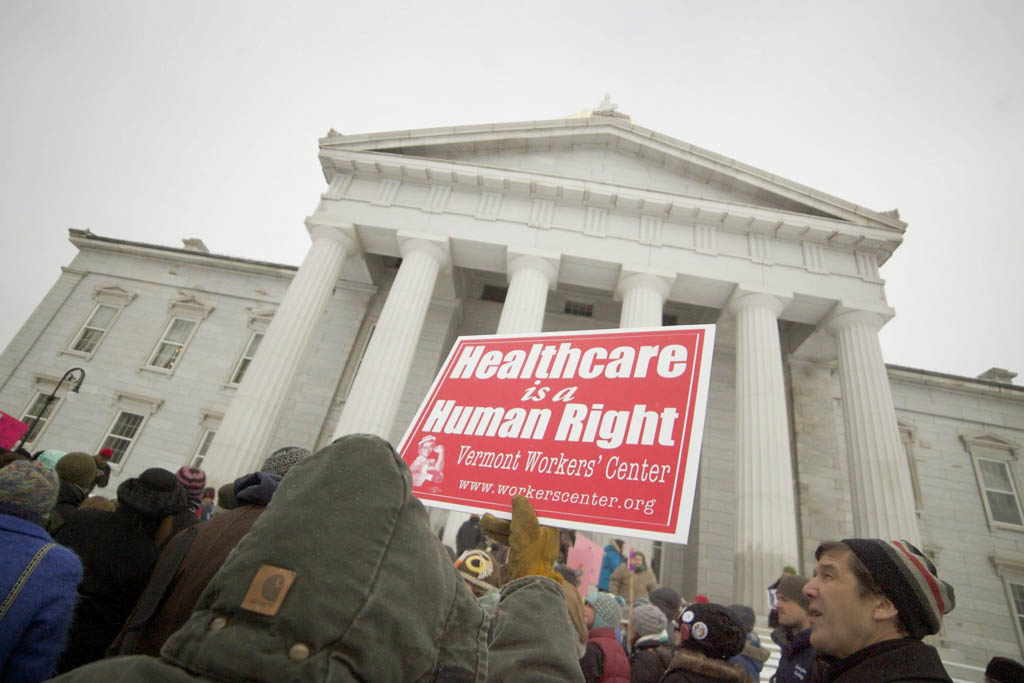
[L]ast week’s pro-universal health care demonstration during Gov. Peter Shumlin’s inaugural address drew attention locally and nationally, and left many wanting to know more about its organizers — the Vermont Workers’ Center, which has grown substantially in the past five years.
Founded nearly two decades ago as Central Vermonters for a Livable Wage, the nonprofit labor and human rights group has evolved into a substantial grassroots organization.
In 2001, as the Vermont Workers’ Center, the group affiliated with Jobs With Justice, a national pro-labor group, and is essentially that organization’s Vermont chapter. VWC founded the Health Care Is a Human Right campaign in 2008 because the cost of medical care and health insurance was creating crises for its members that “transcended” the workplace, according to the group’s website.
The campaign is viewed by some as a model for health care advocacy in other states.
Since launching the Health Care Is a Human Right Campaign, VWC’s annual budget has grown from $154,500 in 2008 to $638,700 in 2012, the latest publicly available tax filing from the group.
James Haslam, VWC’s director, said its current budget is close to $800,000, a more than fivefold increase since the campaign began. The money comes from donations and foundation grants in roughly equal parts, Haslam said.

The Ben & Jerry’s Foundation is its largest grantor, providing $50,000 this year, Haslam said. It has given the group $160,000 since 2010, including $35,000 to offer guidance to similar groups across the U.S. Grantees are voted on by a committee of Ben & Jerry’s workers, according to a statement.
“The Ben & Jerry’s Foundation supports grassroots organizations throughout the U.S. that are working for progressive social change and a more equitable society,” according to the foundation’s statement.
VWC also chose to start collecting dues from its members in 2014, Haslam added. The dues follow a sliding scale based on members’ ability to pay, he said.
The grassroots activists have strong affiliations with national labor and human rights groups including Health Care Now, Labor for Single Payer, National Economic and Social Rights Initiative, The Center for Popular Democracy and the Grassroots Global Justice Alliance, according to Haslam.
Kate Kanelstein, VWC’s lead organizer, is on Grassroots Global Justice Alliance’s national coordinating committee. Kanelstein was among those arrested during Thursday’s sit-in in the House chamber.
“We’re part of a broader people’s movement to turn things around for working people,” Haslam said.
Those connections have helped propel VWC to the forefront of national activism on universal public health care.

The National Economic and Social Rights Initiative provides strategic advice and training to VWC and similar groups throughout the U.S., said Anja Rudiger, director of programming for NESRI.
VWC has successfully, and appropriately, according to Rudiger, applied the principles of human rights advocacy to health policy by focusing on the hardship of individuals, rather than the “nitty-gritty” of policy debates.
By reframing access to health care as a human rights issue, VWC and others are able to highlight the injustices of the high cost of medical services and a for-profit health insurance system.
There are now Health Care Is a Human Right campaigns in Maryland, Pennsylvania and Maine. Groups in Oregon and Washington are also hoping to model health care advocacy work on the template created by VWC.
VWC is using the tactics and strategies of other human rights movements, including demonstrations and civil disobedience, which are well established, but have not previously been applied to health care, Rudiger said.
A ‘new environment’ and a national movement
Some have argued that last week’s demonstration hurt VWC’s credibility with the Legislature — one senator called the tactics “fascist” — but the demonstration has drawn increased attention from national groups and other advocates for universal health care.
Amnesty International, National Nurses United and more than 60 other labor and health care advocacy groups signed an open letter to the Vermont Legislature urging lawmakers to press on with Act 48, the state’s universal health care law. NESRI helped get many of the signatories to that letter, Rudiger said.
The Rev. William Barber, most famous for starting the Moral Monday movement, wrote a letter of solidarity, calling it immoral for people not to have access to medical care.
The backlash from lawmakers was anticipated, Haslam said, and he doesn’t think it hurts VWC’s ultimate goal of achieving universal access to health services.
“No one that truly supports universal health care is not going to support it because of a protest,” he said.
The visceral reaction from legislators may be partly because the Statehouse hasn’t been the venue for Occupy-esque demonstrations previously, said longtime State Curator David Schutz, though they’ve become increasingly common elsewhere in Vermont and nationally.
“It’s a new environment,” Schutz said, one ushered in by the October occupation of the governor’s offices in the nearby Pavilion Building.
That action was primarily the work of Rising Tide Vermont, the local affiliate of a national climate advocacy group, to protest the expansion of a Vermont Gas pipeline. The Workers’ Center helped organize that demonstration, which resulted in 64 arrests, though charges were later dropped.
Keith Brunner, the communication coordinator for the center, was among those arrested at the pipeline demonstration. Though he was present at the Statehouse last week, he was not arrested.
The only comparable event to Thursday’s demonstrations that took place in the Statehouse during the past 30 years was during the debate over civil unions in 2000, Schutz said.
It was necessary to rile official Vermont, Rudiger said, because it appears Shumlin has unilaterally stalled the state’s movement toward universal health care.
“It’s not about being disrespectful to lawmakers, it’s about highlighting the conditions in people’s lives that bring about those actions and that’s always what civil disobedience has been about,” she said.
Nationally, advocates for public universal health care were aware of the movement in Vermont, but few had received the news of Shumlin’s “wavering,” Haslam said.
Last week’s demonstration was an opportunity to get that message out and put Vermont back in the national spotlight in order to keep the momentum behind a universal health care program for the state, Haslam said.
VWC workers among those arrested last week
Many in Vermont’s political Twittersphere expressed surprise — or consternation — that several of Thursday’s demonstrators, including some who were arrested, are paid employees for the Workers’ Center.
In addition to Kanelstein, field organizers Shela Linton, Elizabeth Beatty-Owens, Avery Pittman and campaign coordinator Matt McGrath were among the 29 arrested.
Members, volunteers and staff were told at a planning meeting that the sit-in carried the risk of arrest, Haslam said. Those who participated in the sit-in chose to take that risk in order to push for legislative hearings on the governor’s single payer report.
The Workers’ Center employees who were arrested had “personal experiences with health care crises,” Haslam said. Many got involved because of that experience, and started out as members or volunteers before being hired.
Lobbying only a small part of what VWC does
The Workers’ Center is limited in its ability to lobby elected officials because it is a 501(c)(3) nonprofit. The organization is aware of that line, and takes steps to make sure it’s not crossed, according to Haslam.
Its field organizers are registered lobbyists, Haslam said, which is corroborated by the Secretary of State’s database.
The IRS threshold for tax-exempt nonprofits is whether lobbying activities constitute “a substantial part of its overall activities,” with expenditures on lobbying capped at 20 percent for a group the size of VWC.
The Vermont Workers’ Center keeps time sheets and records expenditures to ensure they meet the expense limits, Haslam said. Its 2012 990 tax filing, the most recent available, says those expenditures are available on request and does not list them.
Lobbying as part of the Healthcare Is a Human Right campaign is not a substantial portion of the center’s overall operation, Haslam added.
The group is involved in community organizing and leadership development, and helps build grassroots networks and coalitions on a broad array of issues, primarily labor-related, he said.
The Workers’ Center has supported striking FairPoint workers, recently unionized home care workers and workers at the University of Vermont who are trying to form a union.
They operate a workers’ hotline to field workplace complaints and employ an accountability monitor to help enforce Burlington’s livable wage ordinance.
The Workers’ Center also runs the People’s University for Learning and Liberation with a staffer dedicated to preparing workshops, skill building, continuing education for its members and affiliated groups.

