



Dr. Marvin Malek is alarmed by a pattern of violent patient behavior at the new Vermont Psychiatric Care Hospital in Berlin.
Malek started working at the facility in October as the lead consulting physician and his first day on the job ended with the examination one of the hospital’s psychiatrists whose patient “out of the blue had suddenly slugged him in the jaw.”
In the span of one week, two psychiatrists were punched in the face, a nurse had been hit, and one of the less violent patients was blindsided, according to Malek. Two to three violent incidents occur at the hospital each week, he says.
The old Vermont State Hospital in Waterbury had ongoing problems with patient violence and as a result was not able to provide a safe and therapeutic environment. Ultimately, the federal government pulled funding for the state hospital.

The new Vermont Psychiatric Care Hospital was designed to mitigate violent behaviors. But there have been 59 “incidents of direct physical actions against an employee” by a patient since the hospital opened in July, according to its CEO Jeff Rothenberg. Officials at Department of Mental Health, which oversees VPCH, would not provide any specifics about the episodes.
The number and frequency of violent attacks is abnormal for a psychiatric facility, according to Malek. He believes policymakers must re-examine policies for medicating psychiatric patients against their will. He also says the state must re-evaluate how psychiatric patients who commit violent crimes enter the mental health system, and the Vermont Psychiatric Care Hospital specifically.
Treating the most difficult cases all in one place
Malek is struck by the prevalence of paranoid schizophrenia among patients at the center, he said.
Only 1 percent of people in the United States have a diagnosis of schizophrenia. Only a fraction of them suffer from paranoia, and an even smaller number become violent, according to Malek.
And yet, paranoid schizophrenics make up a substantial portion of the population at the Vermont Psychiatric Care Hospital, he said.
The patients at VPCH often have a history of trauma, complex psychiatric and medical needs, said Frank Reed, deputy commissioner of DMH. In combination, those factors make the center a “very high acuity” environment, Reed says.

The severity of the patients’ illnesses makes them difficult to treat, but the situation is exacerbated because many are not taking prescribed antipsychotics, according to Malek.
Nearly half the patients at the center exercise their legal right to challenge or refuse medication orders, according to Malek, which, he said, can slow their recovery and, in the meantime, endanger staff.
At the same time, the 25-bed hospital has a significant number of patients who are sent from corrections “after being found guilty of a violent felony — usually assault, rape or murder.” These individuals are evaluated, found to be “criminally insane” and sent to the Vermont Psychiatric Care Hospital involuntarily, he said.
DMH officials said currently seven of 20 patients at the center come from the corrections system. The remainder were referred to the center by community mental health professionals.
The combined presence of unmedicated and “criminally insane” patients is driving the high number of violent attacks and creates “a palpable atmosphere of fear among employees at VPCH,” Malek said.
In his view, the hospital is one of the most dangerous workplaces in Vermont.
Involuntary medication and forensic patient procedures to be re-examined?
New rules for judicial review of involuntary medication orders were passed into law last year, but were not fully implemented until November.
That makes it difficult to assess what impact they’re having on treatment at VPCH and elsewhere, said Reed, and it’s unclear if they’ll be sufficient going forward.
Supporters of the new rules argue medication helps psychotic episodes to pass more quickly, allowing patients to return home sooner and freeing up inpatient beds for others in crisis.
Mental health professionals voiced safety concerns during debate in the Legislature saying unmedicated psychotic patients put mental health workers in danger.
Opponents of the new involuntary medication procedures argue they increase the use of coercion in treatment, and many patients medicated against their will say the experience is traumatizing.
Further changes to the involuntary medication process would likely be met with opposition.

Jack McCullough, director of the Mental Health Law Project for Vermont Legal Aid, lobbied against the new rules passed last year. His office represents virtually all patients in involuntary treatment proceedings.
“I don’t think Vermont should be apologetic in being solicitous to protect people’s rights,” McCullough said at the time the changes were being debated.
DMH will hold a hearing to gather public input on those issues Jan. 6 at the Pavillion Building auditorium, 109 State St., in Montpelier starting at 9 a.m.
Details on incidents scant
The 59 incidents that occurred at VPCH since its July opening include “anything from a push or scratch to a more physical engagement,” Reed said.
State officials would not say how many incidents left staff with injuries, saying they won’t have that information until the Department of Human Resources processes resulting workers compensation claims.
DMH has not tried to compare the number of violent incidents at VPCH to other psychiatric hospitals, Reed said.
The hospital keeps detailed records of violent interactions between patients and staff, but “that information is not available to me at this time,” Reed said.
“Certainly individuals have been hit,” he added.
Reed would not provide further details, except to say he was aware of at least one psychiatrist who was injured after being punched in the face.
After VTDigger exchanged initial emails with Rothenberg, DMH said any further communication would have to go through the commissioner’s office.
DMH Commissioner Paul Dupre declined to comment for this report, instead deferring to Reed, his deputy.
Emergency departments still bearing brunt
The new hospital was built as the cornerstone of Vermont’s mental health system. The facility was designed to house patients with complex mental illness, Reed said.
However, it appears the difficult work environment is creating a barrier to hiring and keeping enough staff to keep the hospital at capacity. At one point, the hospital had filled 22 of 25 beds. Currently 20 beds are filled, according to figures from the state.
The list of people waiting for inpatient admission for psychiatric treatment ranged daily from four to 11 over the last year-and-a-half, according to figures provided by DMH in September.
When the center opened, the hope was it would reduce the number of psychiatric patients waiting in emergency departments for an inpatient placement, but that’s not been the case thus far, according to Reed.
The average wait times for a placement have decreased, Reed said, although he acknowledged there are still “outliers” who are waiting for weeks instead of days.
Reed was unable to provide documentation of average wait times, saying those figures are still being “pulled together.” The numbers will be presented to a legislative oversight committee in January.
Housing psychiatric patients in emergency departments is disruptive, expensive and not appropriate for treatment, experts say.
Lawmakers will explore whether the state needs additional transitional services aimed at keeping patients out of hospitals altogether, but a $100 million budget deficit could make that a tough sell this legislative session.
Staffing an ongoing struggle for VPCH
The Vermont Psychiatric Care Hospital originally hoped to be fully staffed and have 25 beds filled by mid-August, but that has not happened.
It’s always been difficult to find nurses and mental health professionals, because there is a lack of qualified workers and the state has to compete with private hospitals, Reed said.
“It’s no different than it ever was, even when we had the Vermont State Hospital open, it’s always a challenge to keep the numbers up,” he said. “It’s not everyone who is suited to working with people who are mentally ill at their most acute.”
But Malek said nurses at VPCH who have worked at other psychiatric facilities, “uniformly indicate that the psychiatric facilities elsewhere in the U.S. have far lower rates of violent attacks by patients.”
The level of violence, he said, could be creating a barrier to attracting and retaining workers.
The hospital continues to rely on traveling nurses and a pool of temporary workers. The hospital relies on temps to cover shifts during holidays and vacations, Reed said.
In June, just prior to opening, the hospital had hired 150 of the 183 workers it would need to staff all 25 beds, and more workers were going through orientation, Rothenberg said at the time.
Since then, 12 workers who were hired never showed up for orientation, six people quit, two permanent direct-care staff retired, one manager retired and one permanent worker died, according to Reed.
There are currently 15 vacant nursing positions being filled to varying degrees by traveling nurses, who command higher wages because of the lack of job security.
There are seven vacant mental health worker positions; 13 vacancies for temporary positions filling in scheduling gaps; as well as four vacant non-care positions, being filled by temps, and the hospital is considering hiring two more, according to Rothenberg.
Six permanent and six temporary mental health workers are set to start orientation in January, he said.
Building a decentralized system
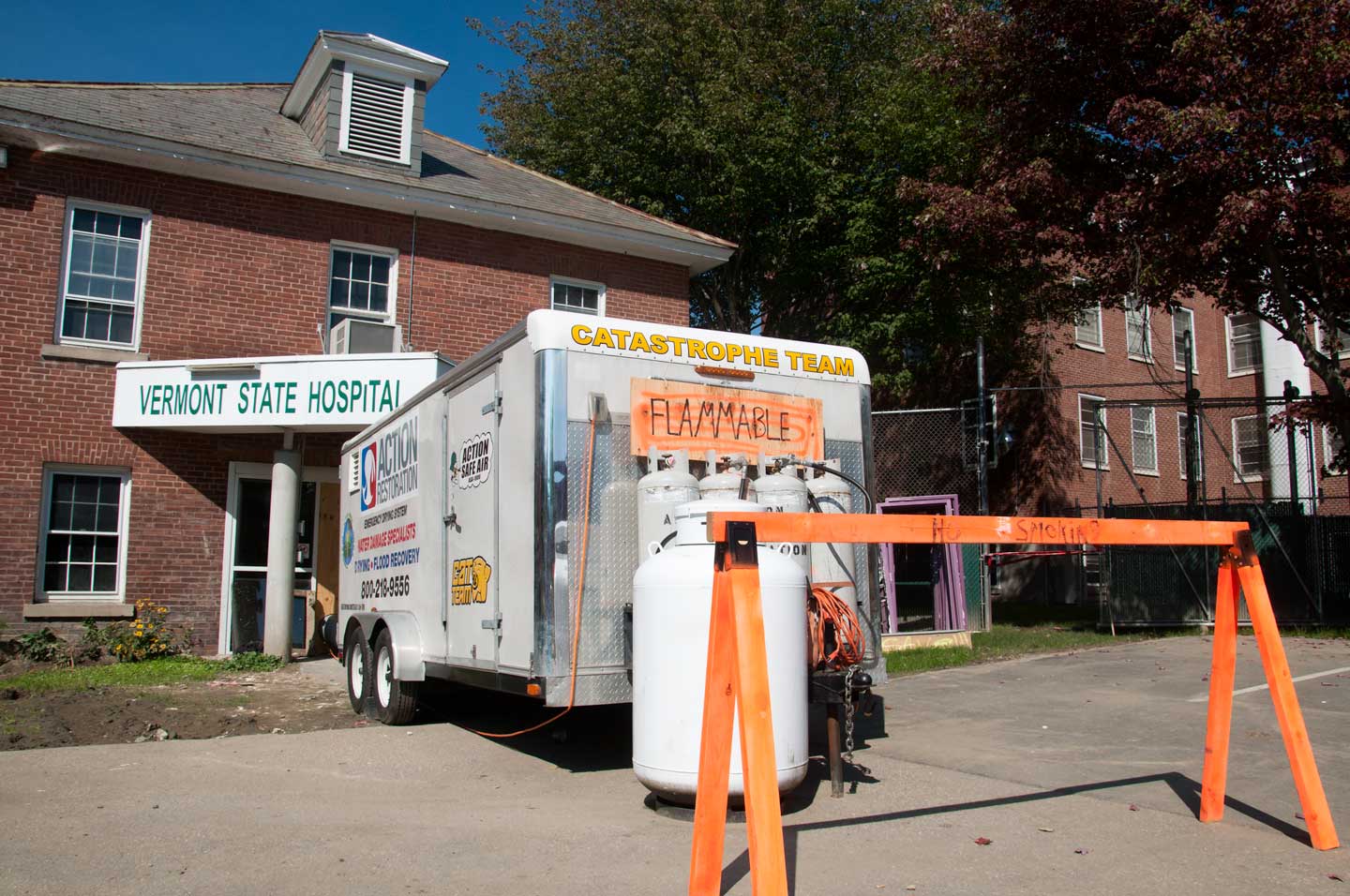
When the 50-bed Vermont State Hospital was damaged by flooding in the wake of Tropical Storm Irene and closed, the Shumlin administration and the Legislature decided to build a new psychiatric hospital that would serve half as many patients. State officials opted to create a decentralized mental health system that would be more reliant on community programs and less dependent on hospitalization.
The state invested in community-based treatment programs and facilities to avoid expensive inpatient stays and keep people with mental illness close to support networks.
But when someone who is mentally ill has a psychotic episode, they can quickly become a danger to themselves or others. When that happens, they need to be admitted, often against their will, into a psychiatric facility.
Since 2011, acutely ill psychiatric patients have wound up in hospital emergency departments that are poorly equipped to treat them. In some instances the state pays sheriff’s deputies to monitor dangerously psychotic patients in emergency rooms. Vermont has paid more than $1 million since 2012 to have deputies monitor psychiatric patients in emergency departments.
Patients are assessed by psychiatrists, and if they are unwilling but determined to need further treatment, they can be ordered into an inpatient psychiatric facility.
After the Vermont State Hospital was closed, the state opened a temporary psychiatric hospital in Morrisville and contracted with private hospitals to treat patients who were committed against their will.
There were not enough inpatient beds, however, and as a result, involuntary patients were spending far longer than the 72 hours allowed by law in hospital emergency departments, often languishing untreated and disrupting emergency rooms.
Of the 584 people who received an emergency examination in 2013, roughly 20 percent — 119 patients — waited more than 72 hours before being admitted to an inpatient facility, according to figures from the mental health department.
There continues to be a similar dearth of beds for people voluntarily seeking inpatient services. Reducing the need for private hospitals to take involuntary patients could free up more beds for people seeking inpatient treatment voluntarily, Reed said.
Transitional mental health services
One challenge for Vermont is providing enough “step up” or “step down” services to help people with mental illness avoid hospitalization or transition back into their communities after an inpatient stay, Reed said.
“If we can keep them moving through treatment, that will help free up (inpatient) beds,” he said.
One such facility, Soteria House in Burlington, is expected to open in February, Reed said, after more than a year of delays. As part of community-based treatment, it will have five beds for people diverted from hospitalization who want to wean from medication.
DMH is working with the Department of Buildings and General Services to draft a proposal for how to replace a temporary secure residential facility with seven beds in Middlesex.

“What we will be looking to propose is up to 14 beds for secure residential, since that’s often where people can get stuck if they don’t have a treatment option in the community that can provide some level of security,” Reed said.
Details of that proposal will be presented to the Legislature sometime in mid-January, Reed said.
Reed acknowledged this will be a tough budget year to propose a new project, as all departments in the Agency of Human Services have been asked to look for ways to reduce expenses, but “it’s always a challenge to continue to prioritize services for the people who need them,” he said.
