

Editor’s Note: This article is by Mark Rondeau of the Bennington Banner, in which it was first published Dec. 17, 2014.
BENNINGTON >> The Vermont Veterans’ Home Board of Trustees voted on Wednesday to take steps to reduce the number of patient beds it is licensed for, from the current 171 beds to 130.
The only no vote came from H. Jamie Percey, the Vermont State Employees Association representative on the board.
Home CEO/Administrator Melissa Jackson said that the year-to-date average census of the home has been 121 beds filled. She said the home currently has 13 open staff positions, which it will now not fill. That step will save $764,695 per year, and with other savings from having fewer licensed beds, the total savings comes to almost $1 million a year.
“Does it cover our deficit? No,” she said. “There may be some job cuts. We’d have to sit and really look at it … I do not want to cut any direct-care positions; there may be some ancillary staff that we can look at.”
The reduction in the number of licensed beds was a recommendation of an 18-page report produced for the Legislature’s Joint Fiscal Committee by Secretary of Administration Jeb Spaulding’s office.
The report aimed to suggest how the trustees could operate a viable veterans home without relying on state General Fund money to cover large deficits.
More people than usual attended the trustees’ meeting, and several voiced strong opinions, particularly those who opposed reducing the number of licensed beds. Among attendees were state Rep. Mary Morrissey (R-Bennington), Rep. Timothy Corcoran II (D-Bennington), Rep. Anne Donahue (R-Northfield), and Representatives-elect Kiah Morris (D-Bennington) and Rachel Fields (D-Bennington). Fields works at the Veterans’ Home and is an active member of the VSEA.
The numbers
Emily Byrne, a state budget analyst, noted that the census of the Veterans’ Home has been lower than budgeted for the last couple of years. She said the expectation of the state is that reducing the number of licensed beds would decrease, but not eliminate, the amount of General Funds needed.
The report also suggested non-General Fund revenue sources such as the proceeds of lottery tickets or boxes of break-open tickets. However, Byrne said her understanding is that break-open tickets will not be in the governor’s 2015 proposed budget.
In line with the report’s recommendation to better use its space, the trustees voted to explore creating additional private rooms at the home for which to charge more. They also voted to see about using unused administrative office space to attract a paying tenant.
According to the recent state report, the fiscal 2014 state budget included a General Fund appropriation to the home of $1.344 million. It was the first time since 2007 that the state had to appropriate General Funds to the home. The home in 2014 also required an additional General Fund appropriation of about $2.8 million to make up for lower than budgeted revenue.
The census at the home drives its ability to collect reimbursements from residents and cover operating costs. The report notes that despite attempts to better market the facility, the average daily census has dropped from 155.4 in July 2012 to 120.1 in July of 2014, with a low of 116.2 in April 2013.
The report featured a map showing how few veterans from the northern half of Vermont reside at the home.
In all, at the time of the report’s analysis, 78 of the home’s residents originated from the four southern counties of Vermont — Bennington, Rutland, Windham and Windsor — with 52 from Bennington County. Just 11 of the residents originated from the rest of the state, fewer than the 31 residents from New York and six from Massachusetts.
Arguments against the cuts
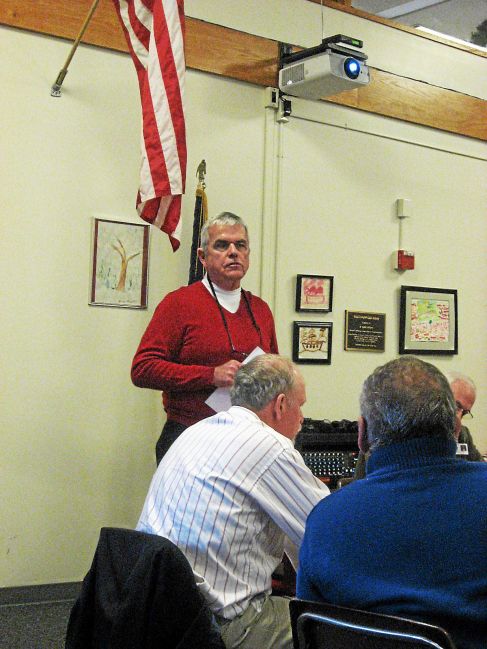
Don Keelan, of Arlington, a veteran and supporter of the Veterans’ Home, objected strongly to cutting back the number of licensed beds. He reminded the trustees that, although they were appointed by the governor, their loyalty must be to the home. The vote should be postponed, he said, because the trustees have received two state-mandated reports in the past two years “that are diametrically opposed.”
The first report, known as the Pulling Report, said there could be a need for hundreds more beds to accommodate Vermont veterans and their spouses and Gold Star parents. Yet the present report urges decreasing the number of available beds, indicating that the demand is not there for more.
Keelan urged the hiring of an expert in the field to answer such questions as how many beds would be needed in the future to serve Vermont veterans. “Having gotten that number from an expert, then determine how does the Vermont Veterans’ Home promote and market its services to meet such demand,” Keelan said.
“As a veteran of the Marine Corps, I can speak I think on behalf of my fellow Vermont veterans – don’t rely on the Legislature to treat the Vermont Veterans’ Home as an orphan facility of the state,” he said. “And don’t allow yourselves to succumb to the whims of certain legislators who are hell-bent on balancing the state budget on the backs of our veterans and their caregivers.”
Board of Trustees President Joseph Krawczyk Jr. offered a 26-slide presentation. First, his presentation emphasized high customer satisfaction with the home and a “much above average rating” from Medicare.gov. Several of the other slides indicated possible reasons why veteran enrollment in the home is significantly down.
One study projects that the veteran population will decrease from around 22 million in 2013 to under 15 million in 2043. Moreover, the “Choices for Care” element in Vermont’s long-term care system is increasingly helping keep people at home until the very end of their lives. Another trend in the veteran population is that they are moving in higher rates to southern and western parts of the country.
“My priority is the veterans. My second priority is my staff, the third is the governor, because he is the one who appointed us,” Krawczyk said. “I think most of the board members feel the same way. We will not see that line go down as far as quality of care.”
A VSEA statement read by Percey strongly objected both to the reduction in licensed beds and to any staff cuts as a result.
“As an initial matter, the workers at the Vermont Veterans’ Home strongly support a permanent general fund commitment to the care of Vermont’s veterans and believe that our state has an obligation to fulfill the promise that was made to the men and women who fight for our country,” it states.
The statement also referenced the Pulling report conclusion that there is a larger market for beds at the home. “Moreover, the proposed cuts to staff will result in a decrease to the quality of the current high-quality, nationally recognized care that we currently provide to our veterans,” it adds.
The next Vermont Veterans’ Home Trustees meeting will be held on Feb. 11.
