

The rearing site for tens of thousands of sport fish was washed away when Tropical Storm Irene flooded Flint Brook in 2011, and three years later the Roxbury Fish Hatchery remains virtually idle as the state and a federal agency wrangle over disaster recovery money.
Next week, the state will for the second time appeal a decision by the Federal Emergency Management Agency denying funding for upgrades to the hatchery, a state official said Wednesday. The state is required to make the upgrades in order to comply with federal water quality standards, officials say.
But FEMA has twice said it will not pay for the upgrades. One reason, the agency argues, is that the new pollution control system did not exist when the facility was damaged by Irene.
The state’s second appeal argues that FEMA misunderstands the Clean Water Act, which they say requires the state to upgrade the facility to meet pollution limits. State officials also argue the upgrades will prevent future flood damage.
The second appeal will be sent to FEMA’s national headquarters in Washington, D.C.
Deb Markowitz, secretary of the Agency of Natural Resources, is a member of a national task force pitching ideas to President Barack Obama on how to better adapt to the effects of climate change, which scientists link to floods and other natural disasters.
“Our goal was to build back better than before,” Markowitz said of Irene’s aftermath. “The way FEMA interprets many of its rules and procedures prevented that from happening easily or at all, and the Roxbury Fish Hatchery is an example of that.”
In 2011, the state was planning to upgrade the hatchery to comply with new state water quality standards required under the Clean Water Act. The Department of Fish and Wildlife, which operates the hatchery, applied for a new discharge permit before the storm hit in August, according to the state. The department did not, however, begin the upgrades before the storm.
During Irene, floodwaters swelled Flint Brook, dropped more than 4,000 cubic yards of sediment, sand and gravel across the five rearing ponds, damaged other internal infrastructure and swept away about 70,000 fish fry. The state determined the destroyed hatchery must be replaced entirely. It currently operates at about 2 percent capacity, according to the state.
To rebuild the facility back to the way it was the day before the storm would cost about $550,000, according to the state. The upgrades, which include a new effluent control system, put the cost of an improved facility at $4.4 million.
Officials from FEMA’s Region I office in Boston say they will not pay for the upgrades because they were not in place before the storm, among other reasons.

“It has to be something that can be substantiated in that later audit,” Pinkham said. “We want to give them every dollar we can legally give them.”
But the state contends that FEMA often pays for upgrades necessary to comply with other federal regulations when replacing older infrastructure. The agency, for example, pays for upgrades required under the Americans with Disabilities Act, such as a handicapped ramp to a building’s entrance. The state says FEMA should therefore pay for changes required by the Clean Water Act.
Pinkham said it’s easier to reimburse states for projects with clear engineering specifications, such as ADA standards. However, he said the Clean Water Act is based on performance “outcomes,” such as the concentrations of certain pollutants in the stream, rather than universal standards.
“The standard is there,” he said about pollution limits. “It’s how you achieve it that’s kind of out there.”
Improvements
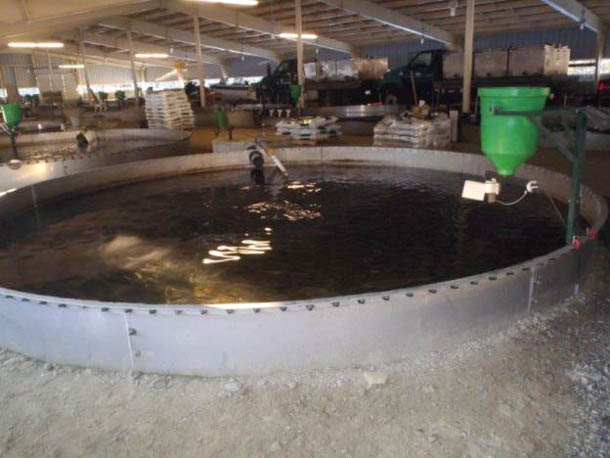
Among the upgrades, the state would replace the open-pond rearing systems with tank-based systems. The state currently uses a settling pond, which collects all the fish food and feces that accumulates in the other rearing ponds. The solids fall through a drain on the bottom of the pond and the rest of the water is discharged into a nearby stream. A permit is required to discharge this water, which still contains some pollutants, such as nitrogen and phosphorus.
Adam Miller, a fish health biologist for the state, said the problem with the current system is that some of the effluent dissolves in the water and is discharged. The proposed system uses stainless steel tanks that can suck the solids out of the water faster than the ponds so that less is dissolved and discharged. The new system also treats the released water with chemicals.
“It has functionality,” Miller said of the proposed system. “But as far as bells and whistles, there is none of that.”
FEMA does not agree that this specific upgrade is required under the Clean Water Act, but did not propose an alternative system in its response to the state.
Asked what upgrades, if any, FEMA would fund to allow the state to comply with the Clean Water Act, an agency spokesperson said in an email the upgrades must, among other guidelines, “be reasonable, formally adopted, in writing, and implemented prior to the disaster declaration date.”
According to Catherine Gjessing, an attorney for Fish and Wildlife, the project is entirely consistent with the legal requirements of the Clean Water Act and the costs of the upgrades are wholly in line with comparable facilities elsewhere.
“Not only are we meeting the current codes and standards to protect water quality, but we’re improving the site’s resistance to flood hazards and it’s going to be much much less likely that there is going to be damage from future floods,” Gjessing said.
Ben Rose, the recovery and mitigation section chief for Vermont Emergency Management and Homeland Security, works with towns and FEMA to secure funding for projects.
He said the second appeal is the state’s last shot to secure funding through FEMA. Otherwise, he said the administration must asked the Legislature for money in the capital bill this fiscal year or seek other federal grants.
The state says the hatchery also contributes to Vermont’s economy. A 2011 federal survey reported that anglers spent about $147.2 million on fishing that year.
Fully operational, the hatchery sent 25,000 pounds of mature fish into Vermont waters each year, according to the Department of Fish and Wildlife. Now, there is a 30 percent shortage of trout stocked in Vermont’s waters, and all the other state hatcheries are operating near capacity, Miller said.
“It’s a significant piece of historical infrastructure that right now is sitting idle,” Miller said of the Roxbury hatchery, which was first established in 1891.

