

WILLISTON — The Department for Children and Families failed to follow its own policies and moved too quickly to reunify two children with their families when it was not safe, an outside report released Friday found.
That push to reunify, along with other system failures, contributed to those children’s deaths this year, the report found.
Gov. Peter Shumlin commissioned the report following the deaths of 2-year-old Dezirae Sheldon and 14-month-old Peighton Geraw.
The panel of Vermont medical, education, law enforcement and child development professionals reviewed case records from both incidents and produced a 27-page report that details many areas in which systems failed and communication broke down.
The strongly worded report includes seven pages of bulleted findings and seven pages of equally detailed recommendations in six areas: training, policies, communication, courts/laws, staffing and child safety/risk.
It outlines areas in which DCF and other sectors of the child protection system, including courts and police, can improve policies and make sure workers follow those policies in the field.
Many breakdowns in the cases of Dezirae and Peighton hinge on the fact that social workers and the courts pushed to reunify the children with a parent without ensuring the homes were safe.
There is an incorrect perception among social workers and family courts that “reunification at all costs” is the formal policy of DCF, the report says. That misperception causes officials to incorrectly assume that reunification is more important than a child’s safety, the report says.
“The casework reflected a push to achieve permanency through reunification in a manner that did not appear to adequately address these risk factors,” the report found.
Part of the pressure to reunify comes from the federal government, which oversees state child welfare programs, according to Dr. Joe Hagan, a co-chairman of the Vermont Citizens Advisory Board, which created the report.
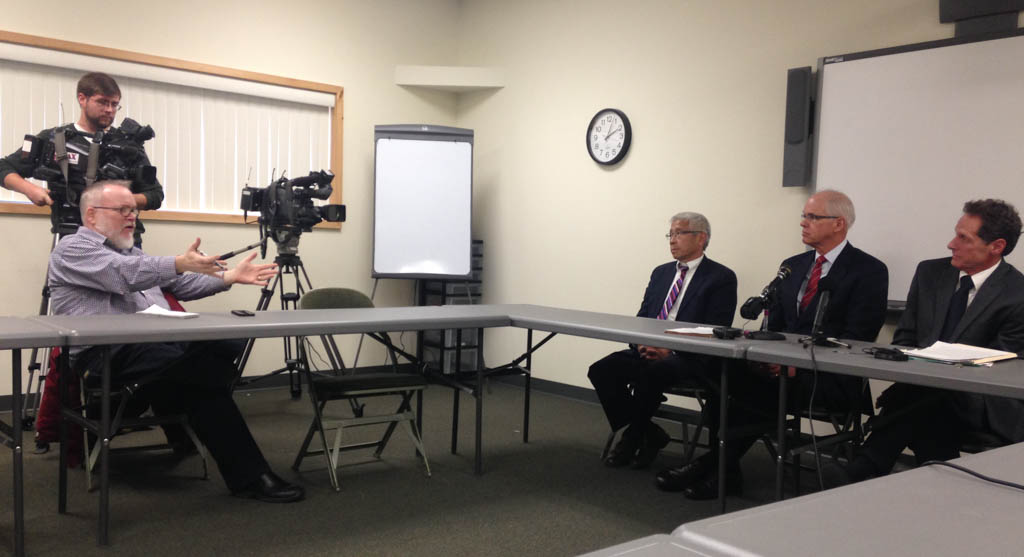
“There has been a tremendous push federally for reunification,” Hagan said at a news conference Friday about the report.
A VTDigger special report found federal pressure, tied to funding, contributes to the emphasis on reunification.
DCF officials in the past and at Friday’s news conference said that reunification when it is safe for the child will continue to be the state’s policy.
Officials at the news conference downplayed the report’s findings but said it is clear the department has room to improve.
“We found no wrongdoing, what we found was opportunities to do things more efficiently, more effectively,” Hagan said.
Individual employees are not to blame and no employees have been disciplined as a result, DCF Commissioner Ken Schatz said. Rather, the proper systems were not in place that could have reduced the likelihood of the deaths, said Harry Chen, acting secretary for the Agency of Human Services, the umbrella organization for DCF.
The report also found that little or no information was shared between DCF, the corrections department and others, including judges, attorneys, guardians ad litem, contracted service providers, law enforcement and doctors. A police report had similar findings.
“As a result, decisions were made too quickly, without the benefit of all relevant information,” the report found.
State officials said they do not plan to act on the recommendations contained in the report until they receive another report, from the national organization Casey Family Programs, in December.
A legislative committee is also working on a proposal for legislation to reform the department. An internal report recommending additional staff was released in October. Next year is expected to be an especially tight budget year, but officials said they hope to be able to avoid making cuts at DCF.
Meanwhile, DCF has received an increase in the number of child abuse and child neglect reports since Dezirae’s and Peighton’s deaths and as a result has more children than usual in custody, DCF staff said at the news conference.
The 18 new social workers added as an emergency measure earlier this year have served merely to stabilize the caseload ratio at around one social worker for every 16 cases, whereas the recommended ratio is 1:12, officials said.
“It is clear that all agencies within the child protection system are carrying caseloads that are too high, which causes workers to triage, to burn out and leave, and to cut corners in an effort to do the best they can,” the report found.
Other findings include:
• DCF workers appear to have lacked training and expertise dealing with drug abusers;
• Court proceedings reveal caseworkers closed cases quickly by returning the child home when it was not safe;
• DCF does not have adequate staff to monitor cases for quality control;
• Staff turnover at DCF is around 20 percent, meaning there are many new hires who lack experience;
• There were no ongoing support systems in place to ensure children were safe after they were reunified with parents;
• There was little or no contact with a range of people, including kinship caregivers, intervention services or others who had more knowledge than DCF workers about the risks to each child’s safety;
• The DCF case files lacked complete documentation and explanation;
• Supervised visits conducted by DCF did not meet the department’s own standards. DCF in Dezirae’s case minimized and failed to follow up on concerns about the mother, Sandra Eastman’s, mental health, including failing to endure that Eastman completed a psychological evaluation;
• DCF lacks technical resources to effectively document and share information;
• Law enforcement’s investigation into Dezirae’s broken legs in 2013 was insufficient.
The report contains recommendations including:
• Training that addresses the misperception that reunification should always be pursued first and foremost;
• More quality assurance staffing in the central office;
• Supervisors should conduct annual evaluations of caseworkers under their supervision;
• Quality of case files should be improved;
• Hospitals should provide specific training to emergency room staff to recognize injuries caused by abuse;
• Training to understand how to deal with substance abuse;
• DCF caseworkers should have relevant background education such as a social work degree, preferably a master’s degree in social work. DCF should define case worker professional standards and ensure workers are trained;
• DCF should ensure that serious cases are assigned to experienced investigators and social workers only;
• Confidentiality barriers to information sharing should be reviewed to ensure that all parties who need to share information about child safety may do so.
