Editor’s note: In This State is a syndicated weekly column about Vermont’s innovators, people, ideas and places.
[W]hen Robin Ingenthron’s wife, Armelle, a Middlebury College professor, took the kids abroad for a year in 2007, Robin remained at home and turned their five-bedroom house into a temporary international hostel of sorts, with visitors from around the world staying and breaking bread over his pots of chicken, rice and beans.
With five bedrooms available, he welcomed friends and associates from Malaysia, Peru, Mexico, Burkina Faso and Egypt.
“There was an old friend from Cameroon who came and a fellow from Senegal, who was in the business of buying and selling computers,” says Ingenthron.
“They weren’t here all at once; some arrived for six weeks, some six months,” he says, smiling at how the visits raised suspicion. “The cops showed up one night – they were very polite – but wondered what was going on, why all these people were living in our house.”
The answer: Robin likes company; he is interested in international affairs, and he has a business that exports.
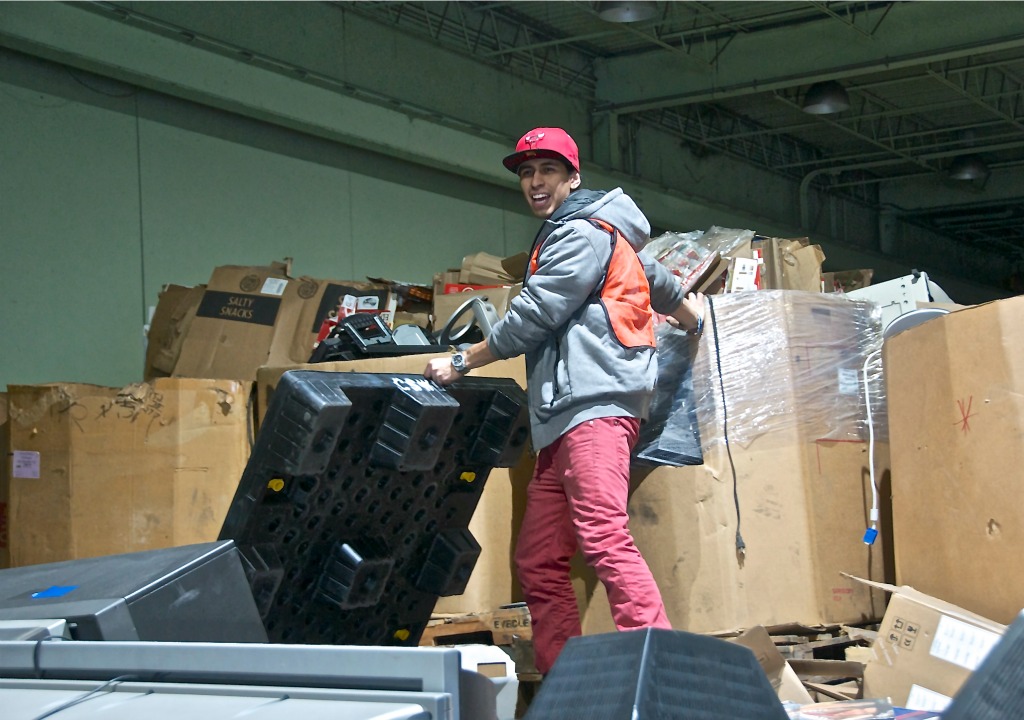
Ingenthron is owner of Good Point Recycling in Middlebury, a company that collects virtually all of Vermont’s electronic scrap — the old TVs, cell phones, iPods, computers, CD players, printers that we throw away, a total of 5 million pounds of the stuff a year from deposit sites across the state. It processes another 3 million pounds a year from nearby states.
Good Point, with a $15,000 a week payroll, repairs electronic goods or it strips them of their plastics, metals or anything else marketable. Additionally, the company serves as a distributor of e-trash after it arrives; it bundles and ships items it can’t handle to other recyclers in New England for reprocessing.
“My passion is recycling!” says Ingenthron, wearing a yellow “Good Point” hoodie with red reflector vest as he leads a visitor through his expansive building. Some electronic gear is stacked eight feet high; some is in bins waiting to be sorted, some is wrapped in protective plastic to be shipped.
His “passion” began early.
Since age 16, Ingenthron has been recycling. Only the scale has changed.
As a teenager, he says, he was a curious, pot-smoking, Buddhist-leaning, bookish type, a “hippie-hillbilly,” who subscribed to a waste-not, want-not formula for planetary survival, who viewed himself as “an agent of conscience” and who initiated a recycling program in his hometown of Fayetteville, Arkansas.
At Carleton College in Minnesota in the early 1980s, where he majored in international relations, Ingenthron ran the campus recycling program, collecting bottles and paper, and carting it to the Twin Cities in an old pickup for proper disposal. He and friends once filled a 55-gallon drum with crushed glass but found it so heavy they had to recruit football players to move it.
Fast forward, and Ingenthron is in the Peace Corps in Africa; then he’s earning an MBA from Boston University, and then he’s recycling and consulting for a living in Boston. Finally, he winds up as recycling director at the Massachusetts Department of Environmental Protection.

One day in 1997, he said to Armelle, who had just finished her PhD.: “’Accept the faculty job offer at Middlebury, and I will recycle in Vermont.’”
He formally launched Good Point in 2003, and it was the right time. Vermonters in the early 2000s were just starting to dump their analog TVs in preparation for the 2009 deadline for switching to digital, which meant a steadily increasing amount of e-trash would become available. Later, in 2011, Vermont added to the stream of recyclables by banning disposal of all electronic equipment in landfills. By then, Good Point had a contract with the state to deal with all of its electronic trash and the company had a 50,000-square-foot facility in Middlebury.
(There have been bumps along the way: Good Point last year lost its state contract for nine months to Casella Waste Management, which caused a big drop in it e-scrap supplies; but then after a legal settlement and re-bid Ingenthron won it back for at least the next two years. Its relationship with the state still somewhat uncertain, the company now plans to lease out some of its warehouse space.)
If Ingenthron is an advocate for recycling, he is a champion for what he calls “fair trade” in the e-trash world. And by “fair trade” he means encouraging — not discouraging — the growth of international markets for reuse of discarded electronics.
Ingenthron takes issue with the news accounts over the years that he says inaccurately suggest poor countries in Asia and Africa are awash in electronic detritus from America.
Publications, among them The New York Times and National Geographic, and television programs, including “60 Minutes” and PBS’s “Frontline,” have shown workers, many of them children, disassembling and melting down e-waste for the precious metals in horrendous conditions. They labor in a stew of air and water pollution at great health risk.
In 2002 an e-waste watchdog group, BAN (Basel Action Network), produced a film titled “Exporting Harm: The High-Tech Trashing of Asia” that became the blueprint for many journalistic reports. BAN, based in Seattle, has assumed the role of upholding at least the spirit 1989 Basel (Switzerland) Convention, and a later treaty, which the U.S. has not signed, that aims to curb the export of hazardous waste to poor countries.
BAN goes so far as to support a ban on exportation of nearly all discarded electronics, including equipment that’s repairable.
Ingenthron, however, argues in a blog and most other opportunities he gets that a ban would unduly limit chances for legitimate repair businesses in developing countries. These days, he says many countries, and not just India and China, are now creating their own heaps of e-waste and need reliable business infrastructures to deal with the buildup. Banning repairable used goods from America would serve no purpose.
When Good Point doesn’t send a computer or TV overseas – which Ingenthron says is about 5 percent of his business — it takes the devices apart, with the plastics going to “high-demand countries” like China; the circuit boards to smelters in Belgium or Japan, and the copper, aluminum and steel going “all over the world to scrap markets.”
CRT tubes, from old TVs and computer monitors, with their high lead content, pose a special challenge. Some, he says, goes to India where they are melted and reused. He says he’s trying to find a smelter in Mexico, but is hampered by “red tape.” Recently, The New York Times reported that many “recyclers” in America are just allowing the tubes to stack up in their warehouses because there are few profitable or reliably safe ways to recycle or dispose of them. Ingenthron says that has not been the case at Good Point.
With his contacts abroad, with the consulting he has done overseas, Ingenthron says he’s hoping for new opportunities in other countries. “I would like to be the Kentucky fried chicken of recycling,” he laughs..
He already has one franchise. In Fronteras, Mexico, just over the border from Arizona, he has helped a group of middle-aged women get started in the recycling business. Called Las Chicas Bravas, the women’s partnership with Good Point receives electronic devices shipped from Vermont, Arizona and Mexican cities nearby.
For their start, several of the women visited Middlebury, where they trained at Good Point. Their business was later featured on National Public Radio’s “Living on Earth” and “Marketplace,” during which the women expressed gratitude for the experience in Middlebury.
“It’s been a melting pot,” says Ingenthron of his expanding world of recycling.