


Editor’s note: In This State is a syndicated weekly column about Vermont’s innovators, people, ideas and places.
[W]hen Scott Wheeler was growing up in Skunk Hollow along the banks of the Clyde River in Newport, his father would take him to the dump on Saturdays, where they would find old furniture, farm tools, vases and other glassware – you name it – that Scott considered “junk” but that his father correctly viewed as antiques. His dad, Wayne, would take the treasures home to the family’s 19th-century converted schoolhouse and store them in one of the sheds that Scott says “continually popped up on our property.”
“Dealers would come from across Vermont and New England to buy what we had,” says Scott, now 49. His father loved the stuff, but, more important, the antique business was a helpful sideline for a man who had a wife and kids to support with a regular job installing television antennas.
The family’s brick house, built in 1826, coughed up a few artifacts of its own over the years. Hidden in a wall that Wayne once took down were two gaffs with hooks used maybe a century ago by someone to nab walleye as they swam up the Clyde from Lake Memphremagog to spawn.
The family also found two notes from 1891: one, a list of all the pupils in the class at the schoolhouse; the other a note from a girl, Grace, to a boy, Ernest, explaining why she couldn’t go out with him.
Mentioning that the second president of Cornell University, Charles Adams (1835-1902), was once a pupil in the Wheeler family home, Scott states the obvious: he grew up waist-deep in history.
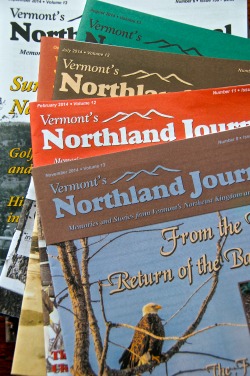
So it should come as no surprise that son, like father, is a collector – though it’s not artifacts that Scott collects. Rather, he gathers stories and recollections and publishes them in his Northland Journal, a monthly non-glossy magazine he founded 13 years ago that now has plenty of ads and a circulation of 5,000.
“We mail to people in almost every state,” says Scott proudly, over a plate of fried rice, chicken fingers and eggrolls, his “regular” at Wok and Roll, a Chinese restaurant on East Main Street in Newport. The eatery is on the way to Derby, where Scott lives and where he and his wife and daughter and two employees put out the magazine.
He is also the author of three books, one about rumrunners and Prohibition in Vermont, another about salmon fishing on the Clyde, and the third about a vaudeville performer who became a local outdoor movie-theater pioneer. The three non-fiction books, along with Northland Journal, are, together, a celebration of the ways and traditions of Orleans, Essex and Caledonia counties, the “Northeast Kingdom,” so-labeled in 1949 by George Aiken, Vermont’s legendary governor and U.S. senator.
Not so fast, corrects Wheeler, eyeing an eggroll. “Two businessmen! “Two businessmen from the area might also share the credit. It was George Aiken who popularized the expression!”
Scott mentions that Vermont historians have identified the men, now long forgotten, as W. Arthur Simpson of Lyndonville and Wallace Gilpin of Newport. They came up with the name earlier in the ‘40s. Aiken liked the handle and embraced it.
Though he says, “I don’t know everything; I just know those who know,” Wheeler get credit for having learned a lot along the way.
“I encountered Scott when he worked on ‘Rumrunners & Revenuers’ and was fascinated and charmed by his enthusiasm and willingness to go out and capture his stories,” says Gregory Sanford, Vermont’s former state archivist, who has helped Wheeler and been helped by him.
“He’s proud of his local area and has interest and takes action on his interest.”

Wheeler decided to write about the fabled rumrunners of Prohibition after winning a New England Press Association award about 15 years ago for a series on the subject for the Barton Chronicle, where he started as a correspondent in Derby after graduating from Johnson State. His interest was piqued, he adds, by the fact that “an older relative” had been jailed for smuggling or distilling – he’s not sure which.
Rumrunning was a way of life for many in the Kingdom, especially during the Great Depression, as jobs dried up along with respect for the 18th Amendment.
Wheeler ran ads in newspapers, checked with town clerks, tapped all other local sources to track down and interview aging Vermonters who could recall the wild days of smuggling from Canada by horseback, by boat in the dead of night down Lakes Memphremagog and Champlain, or by souped-up cars racing down dirt roads sometimes under a hail of police gunfire.
Often, the booze was delivered to distribution centers in Barre or Lyndonville. Wheeler mentions a 1931 Boston Evening Transcript article that “described Lyndonville as home to one of New England’s biggest bootlegging gangs and a gathering spot for criminals from all across the country.”
Wheeler eventually plunged from rum to river.

“When Salmon Was King: Voices From the Clyde River,” is a collection of memories, photos and factual tidbits from bygone days on the Clyde, when fishing was best and Newport and the river would attract hundreds of anglers from around the country for the spring salmon runs. An iconic photograph from the era shows scores of people jammed on the Newport railroad bridge, poles in hand, a steam train in the background.
In his introduction, Wheeler describes his boyhood in Skunk Hollow on the Clyde and confesses he and his chums often poached walleye. “We certainly weren’t totally to blame for the destruction of the walleye population, but we didn’t help it either,” he writes apologetically.
“When Salmon Was King” focuses on much-celebrated (by anglers) destruction by floodwaters in 1994 of a Citizens Utilities hydroelectric dam located a mile upstream from the mouth of the Clyde. Anglers cheered its collapse because they figured the dam built in 1957 had ruined fishing. But Wheeler, the duty-bound journalist, offered balance, giving ink to Al Flory, who back in the day headed Citizens Utilities and who maintained that in building the dam he “had worked to strike a balance between providing fish with a healthy habitat and area residents with a cheap source of renewable energy.”
Wheeler’s own sources are legion. That is reflected in Northland Journal, which might include anything from his readers – from a maple pudding cake recipe to a feature on how Barton was affected by the War of 1812, to memories of a ‘70s commune in Charleston.

With his inimitable folksy and homespun style, Wheeler interviews local characters and politicos on local radio and a cable-TV talk shows, among them, recently, former state Sen. Vincent Illuzzi, who was invited to predict Tuesday’s election outcome. Wheeler has addressed pressing social issues like abuse and suicide on the programs, but the past is his thing.
“I think Scott has done a great job preserving the history of the Kingdom,” says Howard Frank Mosher of Irasburg, the novelist who has entertained and enlightened readers with his own stories about the region for four decades.
“Scott comes from a family of many generations of Vermonters and has excellent contacts in the Northeast Kingdom – better than I have – so he has been able to include stories about whiskey-running, log-driving and farming, all kinds of indigenous subjects that someone not brought up here would find nearly impossible to find,” says Mosher.
“I tell lies, but he tells the truth,” says Mosher, the fiction writer, with a laugh.
Dirk Van Susteren of Calais is a freelance writer and editor.

