

Vermont’s three leading gubernatorial candidates agree about a need for property tax solutions, but couldn’t be more different in their approaches.
Democratic Gov. Peter Shumlin and his challengers, Libertarian Dan Feliciano and Republican Scott Milne, all agree that the problem with rising property tax rates stems from public education costs going up and enrollment going down. What each thinks should be done about it is a different story.
The facts on which their proposals are based are largely undisputed among the candidates. Enrollment has come down but spending continues to increase.
Here is a look at each proposal.
Libertarian Dan Feliciano wants school choice
Feliciano applies free-market ideals to the problem and advocates for full school choice. Set a specific dollar amount per year for each child and send 80 percent of the money to whichever school the parents decide is best, he says. The other 20 percent would stay in the child’s home district, and school districts could compete to offer the highest quality education at the lowest possible cost.

Feliciano’s proposal includes tax credits for contributions to scholarship organizations that support tuition at faith-based schools, as well as tax credits for homeschooling.
Allen Gilbert, executive director of the Vermont chapter of the American Civil Liberties Union, said the first stumbling block with Feliciano’s proposal is constitutional law that prohibits state money from going to religious schools.
“You can’t use state money to support religious schools,” Gilbert said, citing a 1995 Vermont Supreme Court ruling. “It sounds like he’s trying to get around it, and I don’t think it would pass the straight-face test. That’s a subsidy to religious schools no matter how you cut it.”
In Feliciano’s position paper on property taxes, he criticizes the current system for dropping public education money “from the sky … and the costs may bear little relationship to the amount of taxes levied on local homestead owners.” But his proposal doesn’t specify the source of per-child funding for choice or address changes to the education tax formula.
Joint Fiscal Office staffer Mark Perrault, who specializes in education finance, said he couldn’t discern enough specifics from the Feliciano plan to comment on its implications.
Gilbert said that if the Feliciano plan would render some municipalities less able to raise money to educate their children, it could bump up against another Supreme Court case: the 1997 Brigham decision from which the current funding model, Act 60, was born.
Republican Scott Milne would freeze statewide tax rate
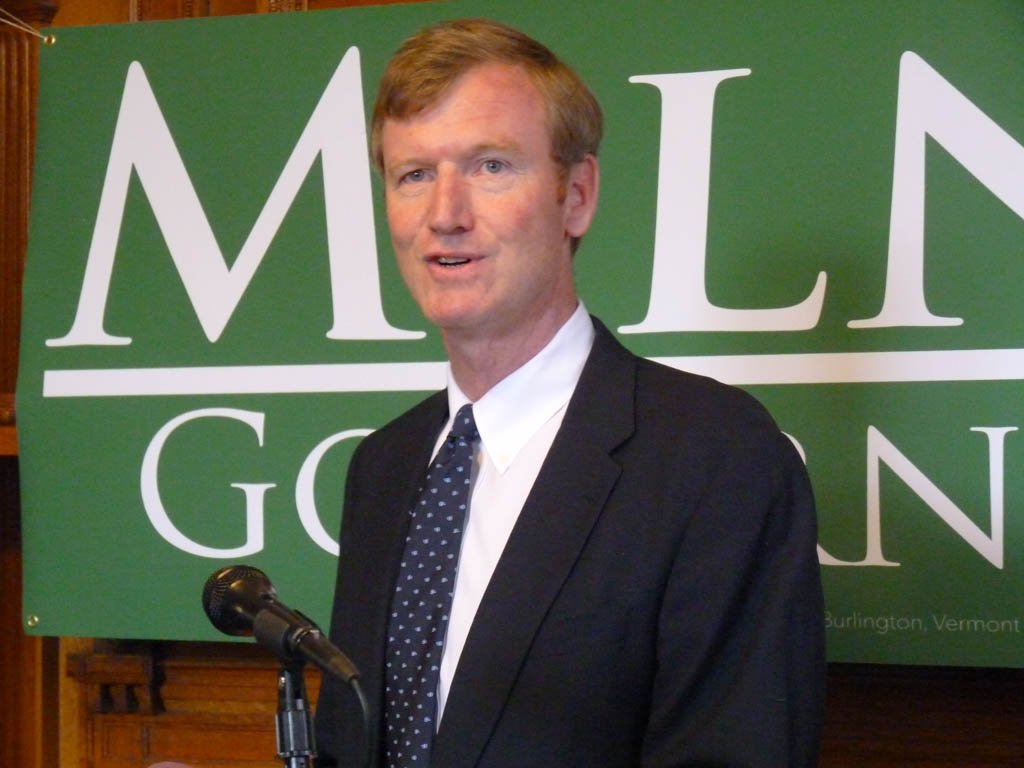
Milne wants an outright cap on statewide property tax rates. His proposal emulates a petition circulating among selectboards and school boards across the state. When it comes time this fall for the tax commissioner to recommend changes for the next fiscal year, Milne told Vermont Public Radio in September, Mary Peterson should call for a zero increase.
But it’s state statute, not personal preference, driving the recommended tax rate changes every fall. By Dec. 1, a consensus estimate of the next fiscal year’s statewide education spending is agreed upon by the Agency of Education, Tax Department, Joint Fiscal Office and administration officials. One-third is funded from non-property tax sources, such as lottery proceeds, and the remainder is raised through statewide property taxes.
If property taxes were capped and school spending continued to increase — as is expected to happen, Perrault said — the money that’s not raised through higher property taxes would have to come from somewhere else. According to a memo he prepared in response to recent questions about this idea, capping property tax rates at their current levels could hypothetically generate a $42 million shortfall.
One alternative would be to institute a cap on education spending, according to the memo. But such a spending cap is not the intention on which Milne’s proposal is based.
Another option would be to identify a different source of revenue to fill that gap. This could come from the General Fund by reducing other expenditures, Perrault’s memo suggests, or raising additional revenue from a new or existing source.
“Given the recent revenue shortfall and known pressures on the state’s budget in FY2016, it seems unlikely that the Legislature would be able to create additional General Fund capacity of this magnitude over the next two years.”
A different response would be to reduce the base education amount the state contributes for each student. But with more than 80 percent of school budgets driven by personnel contracts, there’s little likelihood spending could come down accordingly.
Steve Jeffrey, executive director of the Vermont League of Cities and Towns, said the result could create a spike in local residential school property taxes to make up the difference.
Milne has said publicly that he knows the impact could be hard for some districts to absorb, but that the pressure would force a solution.
Steve Dale, executive director of the Vermont School Boards Association, said the impact wouldn’t be just difficult for some districts, but devastating.
“These are kids we’re talking about,” Dale said. “Not commodities.”
Milne has yet to release a detailed position paper on his proposal. Public statements have hinted at a suggestion of statewide teacher contracts.
Democratic Gov. Peter Shumlin urges ‘right-sizing’ of schools
Shumlin’s proposed solution is more than hypothetical. Already in office and directing his newly appointed Secretary of Education, Shumlin continues to promote the strategy of voluntary cost-saving methods, including consolidation or other partnerships.

He resists forced consolidation, but to date the state’s merger incentives have produced little result. As of May, a voluntary program encouraging the formation of Regional Education Districts had generated one RED, which produced modest savings, according to previous reporting by VTDigger.
In August, Shumlin directed Education Secretary Rebecca Holcombe to embark on a road show with the Vermont School Boards Association to encourage cost reductions, particularly in very small districts where projected enrollment is severely unaligned with a community’s ability to pay for its own schools.
But a recent Campaign for Vermont report questions the correlation between school district consolidation and financial savings. Statistical analyses in “Education Outcomes and Spending” found per-pupil spending unrelated to pupil counts. High- and low-spending school districts are found across the spectrum of school district sizes, according to the report, written by Campaign for Vermont co-founder Tom Pelham, along with policy and operations manager Benjamin Kinsley.
“It seems the Governor and Holcombe are still on the trail that consolidation of local school districts will save money and provide more opportunity for students, when there is no evidence that this is true,” Pelham said by email.
“How right-sizing will reconnect the decision-making process with regard to approving budgets with raising revenues or mitigate the economic effects of income sensitivity is not part of his package.”
Until any solutions can be found, Perrault confirmed that it’s likely property tax rates will increase again for Fiscal Year 2016. Grand list values that also drive property tax rates are expected to remain flat, he said, “and there’s not really any reason to think school spending won’t go up 3 to 5 percent.”
Perrault and Gilbert agreed that the timing of any changes to education finance also are crucial, as school boards already are crafting their budgets to put before voters on Town Meeting Day in March. Gilbert said any tweaks would have to be implemented at least a year in advance.

