


Editor’s note: In This State is a syndicated weekly column about Vermont’s innovators, people, ideas and places.
The Zebedee Wetland, a 27-acre tract in Thetford, teams with wildlife, from beavers to kingfishers to eastern salamanders, painted and snapping turtles, dragonflies and damselflies. And plants? All kinds, from towering hemlocks along the upland perimeter to tiny delicate maidenhair ferns poking from the damp rich soil near water’s edge.
The dampest areas are covered with cattails and marsh grass, looking lush and expansive on a late September day like a cornfield in early August.
Around the Zebedee Wetland is a trail, and across that trail at one spot runs a creek that drains the wetland and then goes on to meander and gurgle its way four miles through forest and hayfields before spilling into the Connecticut River.
The Zebedee Wetland is a place of serenity. It also is one of study. It’s a classroom as surely as is Joanna Waldman’s second grade classroom at Thetford Elementary School. Her cheerful room has all the instructional trappings you’d expect for children learning to read and write and use numbers. But there are also charts and pictures and a trove of items that emphasize science and nature – a reflection of many trips to Zebedee.


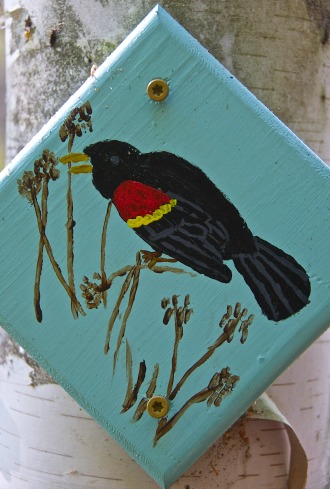
There is the art in tempera paint by students depicting wildlife, some the result of accurate observation, others of observation plus imagination. There’s a stack of student journals with drawings and brief narratives about time spent inspecting animal and plant life. On a shelf are the red binoculars and magnifying glasses that the pupils use during their weekly walks to the wetland.
“Schoolchildren have been visiting Zebedee Wetland for some 20 years,” explains Waldman, who on Thursday mornings, from September through May, weather permitting, guides her 17 charges across Route 113 to a dirt road leading to Zebedee a half-mile away.
The wetland has become the school’s laboratory for Waldman’s students and another second grade and a third grade class. It’s a place to view nature directly, to learn about the cycles of life, habitat, predation, migration, hibernation, in short, how this tiny part of the natural world in this little corner of Vermont ticks.
“What we have is something unique and progressive, and that’s thanks to a community’s dedication to preserving a special natural resource,” Waldman says.
Five years ago, the town almost lost this resource. But then what followed was remarkable and could serve as another school subject, a civics course titled “Lessons in Participatory Citizenship.”

According to Connie Snyder, who serves on the Thetford Conservation Commission, the then-owner of the property, an elderly fellow, decided to sell the land. Over the years the property owner had generously let the schoolchildren and others use it.
But, finally, he wanted to collect on his investment, so the wetland owner secured the necessary permits to build a lengthy and winding driveway skirting the property’s wet spots to a building site.
The Upper Valley Land Trust, which is based in Hanover, New Hampshire, and serves both the Granite State and Vermont, heard word of the development plan, saw opportunity and gathered up funding to make an offer on the property. But its offer was not enough. The trust had all but given up on the purchase when, in November of 2009, it approached the local conservation commission for help.
“We had just four weeks at most to drum up $22,000,” says Snyder, a task that seemed impossible. But Snyder and the commission’s chair, Li Shen, got on the phone and made their pitch.
“I never fundraised in my life, but I found myself calling people cold and asking for money, and I was amazed at the response,” says Snyder. “Some people gave $20 and others gave hundreds; and many even thanked me for asking them to give.”

The schoolchildren became involved too, with a promotion on Facebook and a campaign to forgo a Christmas present in exchange for a donation toward Zebedee. Their parents held a big bake sale that Christmas Eve, which has morphed into an annual fundraising tradition.
“Connie is most humble, and she won’t admit it, but she deserves the credit,” says Jason Berard, stewardship coordinator for the Upper Valley Land Trust, which now proudly owns the property and, with Berard’s guidance, maintains it for public use.
Besides the second-graders from Thetford Elementary School, Zebedee has been visited by students from the nearby private Open Fields School; from Thetford Academy, the high school; from Community College of Vermont and from Dartmouth College.
Dartmouth students, in fact, helped build the trail.
On a sunny Saturday last month, Waldman, Snyder and Berard are on the mile-long path around the wetland discussing every aspect of Zebedee that popped into mind.
Berard mentions the trust’s plan to remove invasive plants species from Zebedee, among them buckthorn, honeysuckle and barberry. “A problem with ‘invasives,’” he later explains, “is that birds are attracted to their berries, which don’t have much nutritional value, but they gorge themselves and then disperse the plants” by dropping seeds. The plants take over.
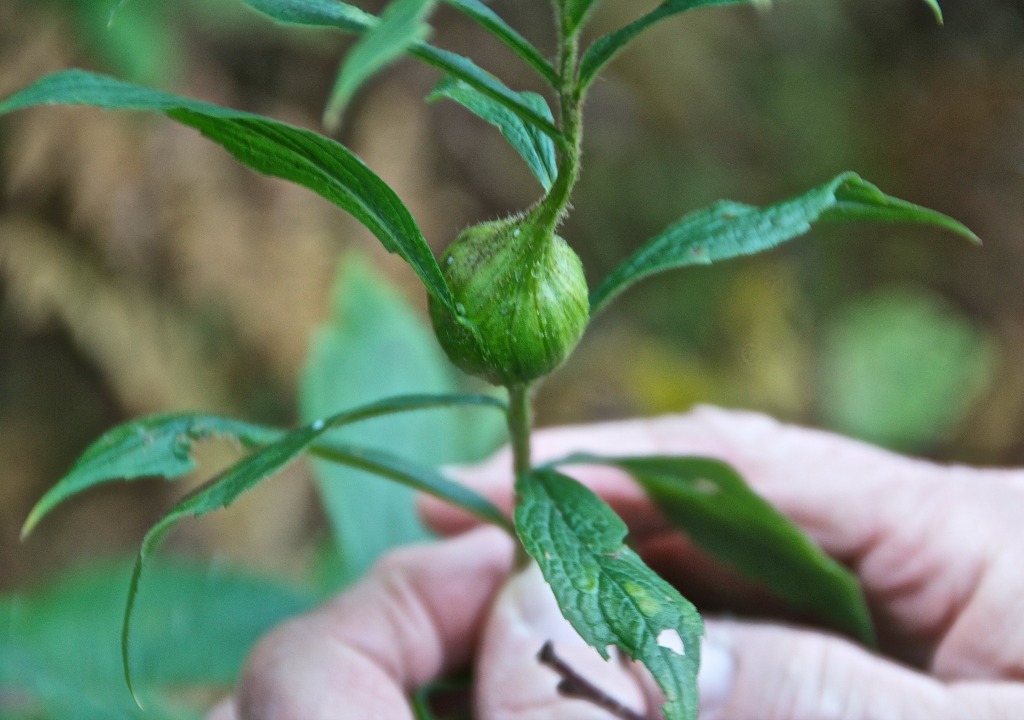
With exuberance, the trio rummages along and about, finding things and making observations: Waldman discovering a gall growth on golden rod; Snyder collecting, pinching and smelling wintergreen; Berard pointing out the entrance to a beaver lodge that Waldman photographs.
Among the first things the Land Trust did upon taking title to Zebedee was to remove an earthen dam to help return the spot to its natural state, explains Berard. But soon an Army Corps of Beavers went to work building its own set of dams.
They find scat on the trail and decide it’s from a fox not a fox terrier. They consider duck feathers, investigate ferns, and Snyder points to “beaver chews,” the gnawed tree stumps that look like badly sharpened pencil stubs.
During a break on rough-hewn logs that serve as a bench overlooking the marsh, they reflect on the merits of an outdoor lab like Zebedee.
Waldman mentions that the youngsters do more than just observe, they are learning to think critically and write and deliver oral reports on what they see and can expect.
Berard says part of the Land Trust’s mission is to protect land near schools as a way to further discovery and education. “At the land trust we work with teachers to make sure what we do here doesn’t get in their way,” he stresses. “We try to strike a balance between wildness and accessibility. … We don’t want this place to be too manicured.”
There was once talk, for example, of installing interpretive signs on the trail so visitors would know immediately what they were seeing. But that idea was dismissed.
“We would prefer to have questions raised, than answers (promptly) given,” says Berard, whose own three children made many treks to Zebedee while in the early grades.
Dirk Van Susteren of Calais is a freelance writer and editor.
