

Editor’s note: Nancy Price Graff is a Montpelier freelance writer and editor. In This State is a syndicated weekly column about Vermont’s innovators, people, ideas and places.
Most of the former occupants of 110 Mill St., in Plainfield, are dead now. Some have been gone for more than a century. Yet anyone who steps into this two-story Federal-style brick house can still sense their presence.
Joan Clark, for example, hung a photograph of George W. Bush on her kitchen wall, where he smiled benignly at her while she ate. It’s still there. A long, plaid dress possibly worn by Imogene Batchelder, Joan’s grandmother, hangs in an upstairs closet, untouched by time. Maurice Clark, Joan’s husband, made the sturdy wooden toy trucks and John Deere tractors for his sons and grandsons. The toys have been left behind by boys long grown to men.

Since approximately 1880 five generations of the Batchelder-Dailey-Clark family have occupied this homestead on the edge of Plainfield village. Off the south side of the building stretches an addition, brick on the first story, clapboard above, that’s nearly the size of the rest of the house itself, and attached to that is a barn and then a chicken coop.
The sprawling footprint of the homestead demonstrates what architectural historians call continuous architecture, a vernacular design that keeps the occupants indoors during foul weather while they do their chores. At right angles to the addition are two old garages, both sheathed in tin pressed to look like bricks. Every room in every building is filled with relics from this family’s past.
“Where do you even start?” asks Keith Clark, son of Joan and Maurice Clark. An energetic and friendly at 67, he is standing in the yard under maple trees that appear mature in photographs more than a century old. He points up toward the chicken coop. “There’s a whole surrey in the chicken coop. How do you suppose they even got it up there?”
When his mother died last January at age 86, Clark decided it was time to sell the homestead. He had bought it 40 years ago from his grandparents to ensure that his parents could live out their lives there, and that purpose was served. Both his mother and father died in their bedroom. Before Clark bought the house, he had grown up in it, sharing its rooms with his parents, four brothers, one sister, and his Batchelder great-grandparents, as well as, briefly, an aunt and uncle and their three children.
“We had to be kind of close,” he says of the arrangements, “but we worked it out.”
His aunt and uncle, for example, had the only television set, so their apartment is where all the children gathered every night. His father had all the tools, so he was the handyman. The front parlor was their living room, dining room, kitchen, and funeral parlor.
“I remember when I was seven running for the outhouse past my great-grandfather lying in his casket. That’s just the way things were,” he says.


Now the day of reckoning is at hand: The house, ells, sheds, barn and workshops all have to be emptied before Clark can sell the property.

His situation is not unique. Vermont is full of old houses and barns that are unofficial repositories of the state’s history. Old military uniforms, butter churns, christening dresses, scythes with weathered handles represent just a fraction of the kinds of artifacts that lay hidden in attics and back rooms awaiting rediscovery.
“I get phone calls every week from people emptying houses. And I’m always interested in hearing about what they have,” says Jacqueline Calder, curator of the Vermont Historical Society. She oversees preservation of the society’s collection, a never-ending and expensive task. She also helps decide what will be added to the collection. Anything that is commonly available doesn’t rank high enough to be collected by the VHS, but anything that has a story associated with it intrigues her.
“The stories are really what catch me,” she says. “And if we don’t take something, we hope people will also talk to their local historical societies.”
Clark is a fount of family stories. In every room he can pick up at least one object and rattle off a tale about it. Still, the magnitude of the task before him is daunting. Everything must go to the local or state historical society, be sold through brokers or online, be distributed among family members and friends, go to agencies such as the Salvation Army, or be trucked to the dump.
“It might take three or four years,” he says about the work. “There isn’t any hurry.”
That’s a good thing. Almost daily Clark is surprised by something he finds: a 50-year-old box of new horseshoe nails. A 40-foot-long wooden ladder, too heavy for any two men to lift, straddling trusses in the barn. A radio the size of a washing machine, probably from the 1930s, that might have brought Jack Benny’s wry humor to this quiet village. Three thousand marbles. Clark is curious about all of it, and also sad to see it go.
“I’m torn because I grew up here and there’s so much history here,” he says of the culling. He mentions the 25-foot-long “Batchelder’s Hardware” sign, from the early 1900s, hanging in the barn. There’s also the late 19th century stereoptican viewer with images of New Hampshire resorts lying off to the side in the kitchen, and the jumping jacks his father built in the 1940s for his children.
Consider, too, the early treadle sewing machine in the attic, made at a time when the grace of a design was as important as its function, as well as the many skillfully repaired mismatched chairs scattered around.
“My father could keep a chair alive forever,” Clark says.
Batchelders moved to what was then St. Andrew’s Gore with the first settlers, in 1792. By the time St. Andrew’s Gore had annexed some land and become Plainfield five years later, Batchelders had settled down in this area like a flock of sparrows seeking seeds.
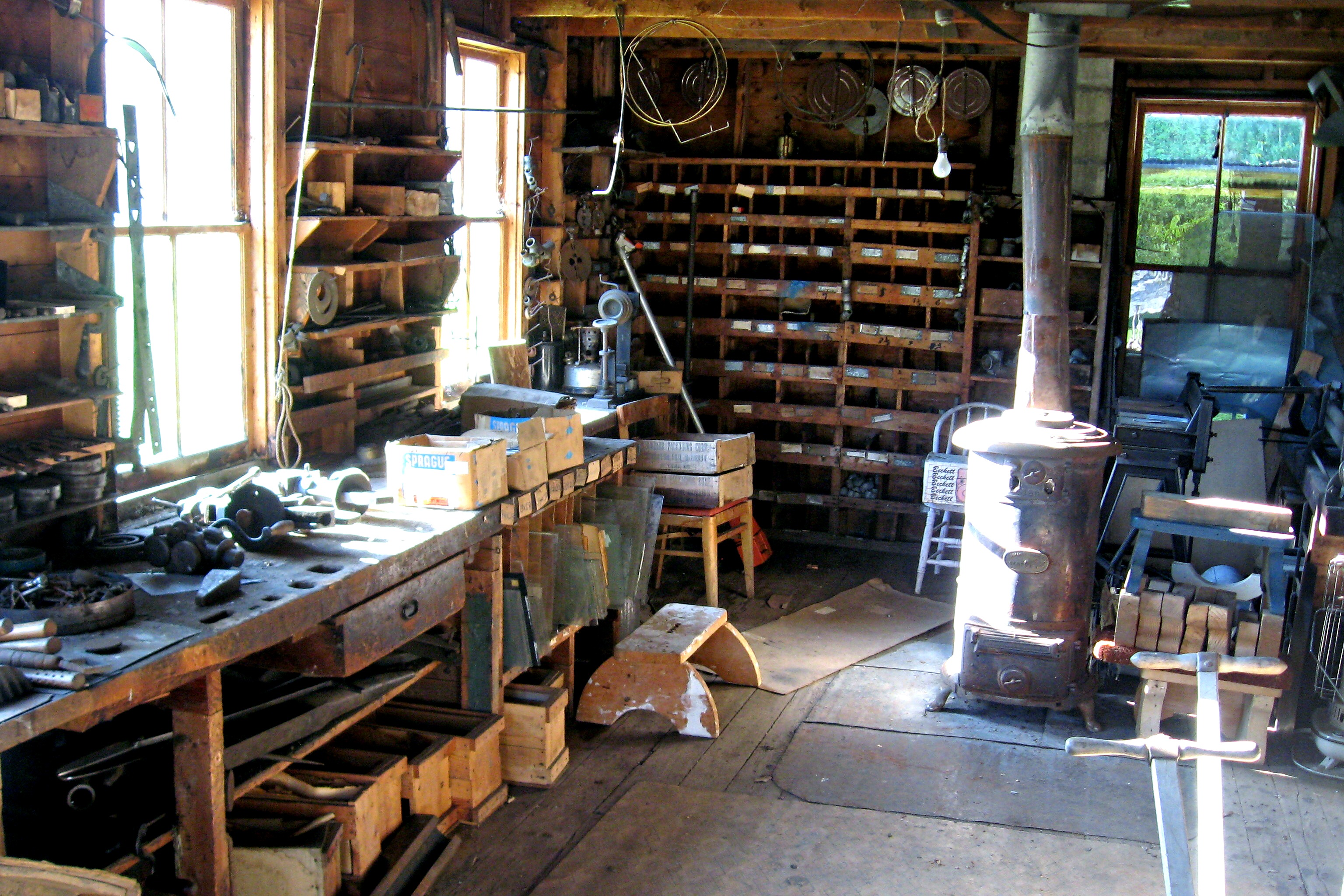
Clark’s strain of the Batchelder family, led by Alpheus, purchased this brick house around 1880. Alpheus was a butcher, and he and his wife, Betsy, had five children. Their youngest son, Arthur, took over the house. Arthur was an industrious man who started out as a peddler and then became a plumber and entrepreneur when he opened Batchelder’s Hardware in the ells beside the house. He and his wife, Imogene, had one child, daughter Edith, who married Claude Dailey, a house painter, who probably owned the long ladder, and together they raised three children in her parents’ house. Eventually, their daughter Joan married Maurice Clark, and they moved in, raising six children, including Keith. Maurice worked for a granite quarry and later at Sprague Electric in Barre as a machinist, but his workshop, in one of the garages, is a wonderland of well-tended tools and machinery for working with wood or metal.
Keith Clark bought the house in 1969 from his grandparents and lived there with his parents and wife until 1973. Until recently, the house has always been home to at least two, if not three, generations of his family.
Clark acknowledges that there isn’t any silver or priceless antique furniture hiding in the eaves. Most of what’s here is the bone and gristle of hardworking Vermonters’ lives, the kind who built the state.
“This is my family’s life,” he says.
