


RUTLAND — About three years ago, staff at the Burlington Boys & Girls Club realized how bad the drug problem had become. Teens were afraid to walk home at night, afraid to cross the park, afraid of being assaulted by someone on drugs.
Staff heard from 13-year-olds asked to sell drugs, 15-year-old girls offered money from drug dealers for sex. They heard about guns and gang affiliations.
“These messages are coming from all different kinds of kids — rich, poor, middle class, from natives of Vermont, from places far away,” Boys & Girls Club Executive Director Mary Alice McKenzie told U.S. Sen. Patrick Leahy, D-Vt., on Monday afternoon in Rutland.
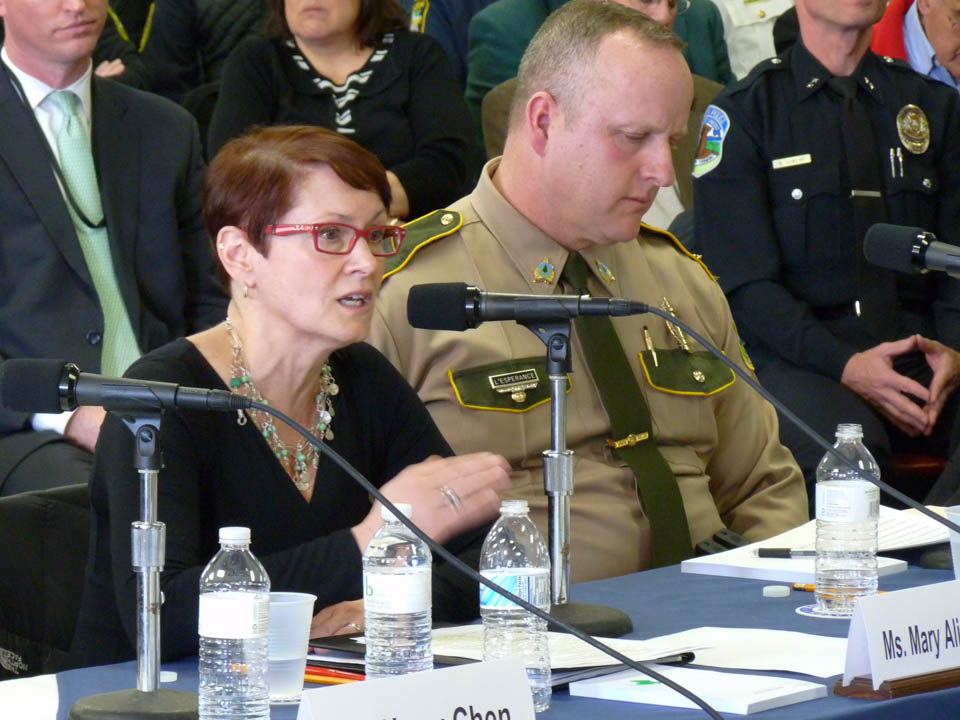
McKenzie and four state and federal officials told Leahy and Rep. Peter Welch, D-Vt., about the multiple fronts in the battle against addiction in Vermont at a field hearing of the U.S. Senate Judiciary Committee, which Leahy chairs.
Vermont’s U.S. Attorney Tristram Coffin, Rutland City Police Chief James Baker, Health Department Commissioner Harry Chen and State Police Col. Tom L’Esperance also testified at the Howe Center hearing, which attracted more than 150 spectators and several local officials.
All five witnesses emphasized how the state weaves together law enforcement and public health services to treat not only crimes but the underlying problems, saying Vermont “can’t arrest our way out of the problem.”
Leahy commended Rutland for its creative strategies to treating addiction and stopping drug crime. State and local solutions to criminal justice can inform federal policy as well, Leahy said.

“If it works in the state system, we ought to adopt it in the federal system,” Leahy said. “Vermonters don’t shy from a challenge and they don’t hesitate to tell you what’s on their mind, and so we’ve got some innovative programs.”
Baker described how he arrived at the police department in 2012, for the second time in his career, to find the staff demoralized and the community distrustful of police.
The low morale and distrust stemmed from an unrealistic expectation that police alone were responsible for solving the illegal drug problems, Baker said, and as a result law enforcement grew more aggressive.
“The trouble with those metrics was that history clearly showed that arrests alone were not going to change the environment because it does not take into account the underlying social issues relating to drugs,” Baker said.
He explained how the city has now meshed its criminal justice and social services programs in a program called Project Vision.
The project allows law enforcement, social services providers, educators and other program providers to work out of the same office. The so-called “water cooler” effect makes it easy to collaborate and swap knowledge, Baker said.
“It’s where it happens, it’s where we’re finding out what’s going on in our community that is putting members of our community in harm’s way,” Baker said. In some cases, the collaboration also means groups don’t have to fight for the same funding, he said.
Coffin said prosecution of heroin trafficking is rising. Indictments for heroin trafficking more than doubled last year, he said.
There were 21 fatal heroin overdoses last year, twice as many as the year before, Coffin said, and he urged first responders to carry an overdose-reversing drug called Naloxone. U.S. Attorney General Eric Holder has told Coffin and his fellow U.S. attorneys to be “smarter on crime, not just tougher.”
“Every one of these numbers has a face and a name,” the federal prosecutor said.
Leahy and Welch listened to all five witnesses, then asked each follow-up questions on everything from how to provide youth activities and services to rural teens to how to make Naloxone, an overdose-reversing drug more available to police and the public.
“We have to get ahead of addiction, we can’t let it corrode our lives and our communities,” Leahy said.
McKenzie called on parents to set good examples for their children.
“Kids are like sponges and they pick up messages,” she said. “As adults, if we accept our responsibility for the health, safety and wellbeing of our children, then we all need to walk the talk.”
McKenzie described the network of educational services the club lined up and the hours she and others spent listening to teens, figuring out which strategies work.
“Just say no” is a joke to teens, she said. They want facts about how drugs affect the body. “’If you think that I am serious then treat me serious,’ is what they’re saying,” McKenzie said. “They have told us a lot. They have told us ‘if you talk to me in high school about drugs, it’s way too late. I smoked or my friends smoked their first joint when they were 8 or they were 9 or they were 10.’ It’s shockingly young.”
Health Department Commissioner Harry Chen updated the legislators on the state’s public health efforts to tackle opiate addiction, which the administration views as a “chronic illness.”
Nearly 4,000 Vermonters are in treatment for opiate addiction and half are young adults, he said. More are on waitlists.
Chen said 2013 was a milestone for Rutland with the opening of the West Ridge Center for Addiction Recovery, a methadone treatment clinic. That project had in the past met strong opposition.
“We now acknowledge that addiction is a chronic illness like diabetes and heart disease,” Chen said, as he explained the state’s hub and spoke system of treatment and recovery services.
Chen offered suggestions for communities that want to prevent addiction, such as identifying risk factors, and said prevention needs to start as early as possible.
L’Esperance said drug task force sweeps in Bennington, Springfield and St. Albans have successfully disrupted heroin rings.
“These operations were a success not only because we slowed the supply of heroin by arresting those responsible for distribution, but it was because we were able to impact so many other lives in positive ways,” he said.
He cited an email from the mother of a girl who was arrested who said the bust saved her daughter’s life and got her into treatment.
“There are many similar untold stories,” he said.

