


In This State is a syndicated weekly column about Vermont’s innovators, people, ideas and places. This installment is by Nancy Price Graff of Montpelier, a freelance writer and editor.
Ashley Bullard and Richard Gravel shuffle papers at the front table, scrutinizing the pages of brackets that have given all 56 entrants a fair shot at winning. The battles for light- and middle-weight division winners at the recent Dustin Mason Memorial Arm Wrestling Tournament in Morrisville are already decided. The only empty lines after three hours of competition are for the winner and second-place finisher in the heavyweight division and the afternoon’s overall champion.

“John, George, you’re up. Whoever wins will take first place in the heavyweight division,” Bullard announces.
Many of the participants and an equal number of spectators gathered around the arm-wrestling table cross their arms and nod. They have been on their feet throughout the afternoon, through bout after bout, four and five people deep in the dim light of the VFW hall. There’s been plenty off whispering, but not a lot of cheering. Occasionally, someone will yell, “Pull, Jeremy” or “Don’t give up, Marcy!”
But for the most part these athletes at every level have been accorded the courtesy of being allowed to focus completely on their strategy. These final two bouts are what many have come to see. Dustin Mason himself was a three-time heavyweight state champion who died last fall in a car accident, leaving behind a young family.
John Jackson and George Sheldrick disengage themselves from their tribes of supporters and stride to the table. Although both men are among the best in Vermont in the sport of arm wrestling, neither remotely resembles Charles Atlas with his grotesquely chiseled body. John, around 30, is a bear of a man, well over six feet tall, sporting a thick dark beard, and the blushing complexion of a farm boy who was raised on whole milk. George looks more like a Giacometti sculpture, elongated and slouch-shouldered, fair complected.
Both John and George have massive hands, big as catcher’s mitts. For a serious puller, an enormous hand is a natural gift. It provides greater surface area for exerting strength. Both men are as strong as bulls.
The arm-wrestling table meets regulations: 40 inches high, and 38 inches by 26 inches. There are naugahyde elbow pads in front of each puller to serve as anchors for positioning, touch or pin pads at both ends of the table that are used to determine the winner of the bout, and a six-inch peg behind the touch pads for each puller’s spare hand. The pegs provide arm wrestlers with stability and a critical point of leverage.
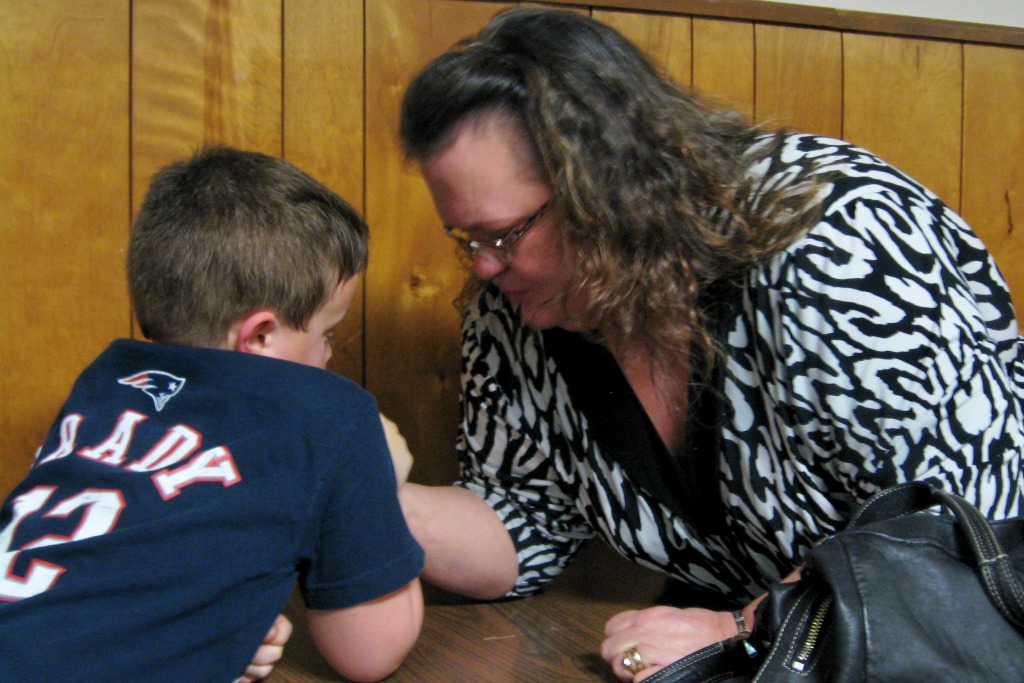
The pullers must keep their elbow on the elbow pad, their spare hand on the peg, and one foot on the ground. To win a bout, a puller must bring an opponent’s hand down to touch one of the pin pads.
John and George shake hands briefly, but as soon as their hands disentangle, they start sparring for position on their grip. Most pullers choose a top roll grip, in which one puller tries to achieve a grip high on his opponents’ hand, or a hook grip, which forces an opponent’s hand to bend backward at the wrist. The men slap their giant paws together and grapple to get their fingers into their preferred positions.
Kinetic energy crackles around the table, the pullers’ bodies are rigid with tension, and their hands jump wildly, as if they were trying to hold a handful of grasshoppers.
Two referees spot this process. Today, one of them is Bill Sinks, from Weybridge. By day he’s a contractor, but in pursuit of arm wrestling titles he has traveled to national tournaments, where he has taken first place seven times, winning as both a left hander and a right hander.
In fact, at Nationals he has never been defeated in his weight class. He has also attended world championships. The first time, he lost soundly. Since then he has always come in second or third. He’s won countless regional and state competitions, and is one of the legends in the sport. A young-looking 49, he is barely six feet tall but as solid and taut as a sailor’s knot.
“I like to give back to the sport,” he says. He does so by organizing the Vermont state championship each year, usually held in April or May, and the annual competition at the Addison County Field Days. At events such as today’s, he refs and then hangs around afterward sparring with much younger pullers and coaching them through the finer points of the sport.
A good grip, quick reflexes, and strength are three obvious essentials in this sport. Stamina is essential, too, although in today’s bouts, many have been decided in under two seconds. Sinks has his own prerequisites, however. “You need a desire to win, a desire to train, and a good attitude,” he says. His advice to pullers of all ages: “If you can control some part of their hand, their arm will usually follow.”
Sinks peels John and George’s rigid fingers from their grip and repeatedly repositions them, forcing the two to find a fair grip. Once he achieves that and both refs determine the contestants’ arms aren’t tilted in anyone’s favor, Sinks says “Go!”
This match is not won quickly. Both men explode, leaning in hard, their faces only inches apart. First one has an advantage, then the other. Whoever has the advantage at any moment twists his entire body to get his shoulder and therefore more of his body weight behind his hand, although it’s against the rules to touch one’s shoulder to one’s hand. Eventually, the table itself succumbs to the tremendous exchange of energy and starts rearing up. The refs stomp down on the metal spreaders to hold it in place, but they keep their eyes on the pin pads.
And then suddenly, without warning, the men’s hands slip apart and both men stagger back from the table. As John and George shake their arms and wiggle their fingers trying to bring life back into their limbs, the refs get the straps. To finish the match, John and George will be strapped together at the fist. No one will be able to concede by letting go or stepping back from the table. This is now a fight to the finish. It will end only when the back of someone’s hand touches the pin pad, one of them audibly gives up, or an arm breaks.
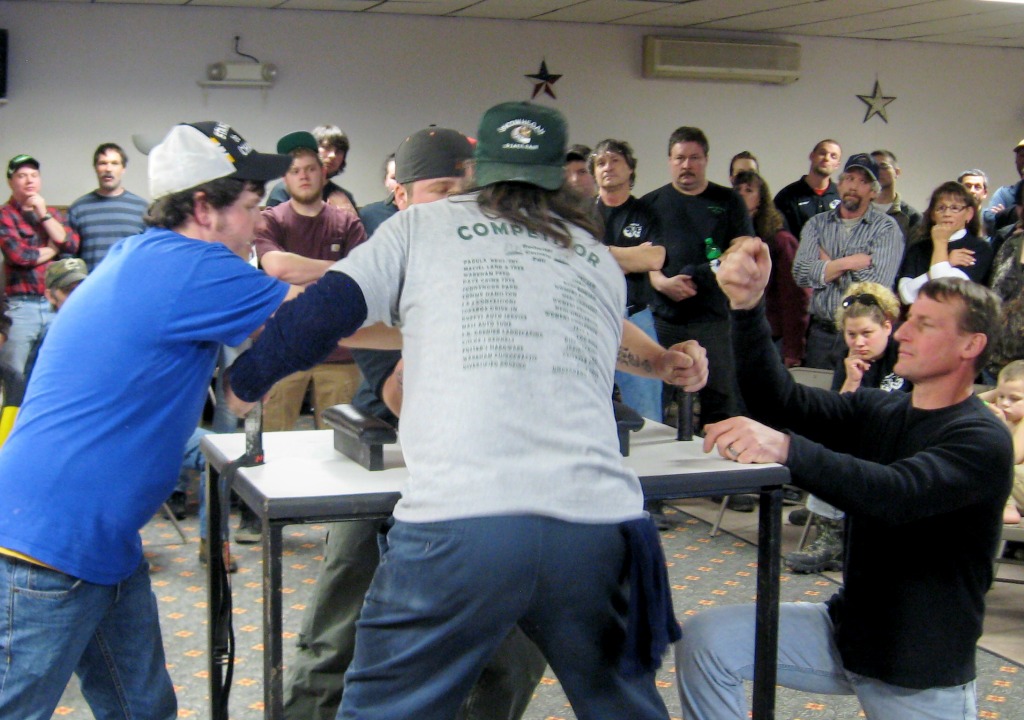
Hundreds, perhaps thousands, of Vermonters participate in arm wrestling, or what the state’s official arm-wrestling organization calls armsports. Even informal tournaments like this one come complete with gleaming trophies and participation ribbons for the youngest competitors. Today Adam Barup, an up-and-comer who may well reach the same heights in the sport as has Bill Sinks, will emerge as the overall champion after he beats the winner of George and John’s match. He will walk out of the VFW hall with a three-foot-tall statue as glitzy as an Oscar in one hand and his 12-pound daughter in the other.
Once John and George’s fists have been tied together using the proscribed method of binding, the bout resumes. The black straps have an odd effect. They raise the stakes. They turn the opponents into gladiators. Advantage goes back and forth. John’s face is the color of plums, and he and George are both grunting and gasping for air like fish out of water.
Fifteen seconds pass. Twenty. George is close to laying the back of John’s hand on the touch pad, and John is using every ounce of strength he has to bring the two fists back to upright, where he will still have a chance at winning. It’s not to be. Sinks calls a touch.
George takes first place in the division. He has about five minutes to rest before he takes on Adam Barup for the overall championship. This time it’s George’s time to lose. He will go home with a blue trophy, the award for best sportsmanship, and a sore hand.
