

There is a lesson to be learned – actually two lessons – from the news this week that Vermont’s leading politicians are … well, up in arms over the possibility that the federal government might cut back on the size of the state’s National Guard.
But not the lessons they intended.
“I am proud of the Vermont National Guard and the role our troops continue to play in keeping our nation safe and Vermonters protected during storms and other crises here at home,” intoned Gov. Peter Shumlin.
Not to be outdone, Sen. Patrick Leahy mourned what he called the Pentagon’s refusal “to recognize the versatility and effectiveness of the National Guard.” And Sen. Bernie Sanders said that, if anything, the country needs more National Guard troops, not fewer. After all, said Sanders, “the Guard already makes up nearly half of the Army’s combat personnel and more than a third of that of the Air Force, but accounts for just 7 percent of the total defense budget.”
That Bernie. On top of everything else he’s a great accountant. Who else could have figured out that it’s more expensive to pay, feed, house and clothe a few hundred thousand people every day all year long than just one weekend a month and two weeks every summer?
As to Leahy, he offered no evidence for his claim that Defense Secretary Chuck Hagel, the Joint Chiefs of Staff, and their minions dismiss the fine qualities of the Guard, or that their budget-cutting plan “guts our citizen-soldier force.” Perhaps that’s because there is no such evidence. Evidence, such as it is, leads to the opposite conclusion. The Pentagon has proposed smaller cuts to the Guard than to the active force, as if it does in fact “recognize the versatility and effectiveness” of the part-time warriors.
Note that none of the Vermont leaders voiced any objection to the idea of cutting defense spending in general. Sanders, in fact, noted that, “at a time when the United States spends almost as much as the rest of the world combined on defense, we can achieve substantial savings and maintain the strongest military in the world.”
The message from Vermont, then, is: cut something else – anything else – but leave our precious National Guard alone.
Hence, we come to the first of two lessons. Shumlin, Leahy, and Sanders are engaging in Buncombe, defined (by the Free Online Dictionary) as “insincere speechmaking by a politician intended merely to please local constituents … humbug.” The word appears to have been coined by U.S. Rep. Francis Walker (1753-1828), whose district included Buncombe County, N.C., where Walker felt impelled to tell the folks what they wanted to hear.
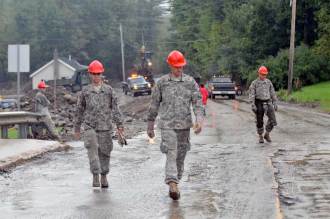
In all 14 Vermont counties, praise for the National Guard is what many voters want to hear. There may be only 4,000 members of the Vermont National Guard (roughly 3,000 Army, 1,000 Air Force), but they have spouses, siblings, parents and neighbors. They are held in high regard, as they should be. Without the National Guard (from Vermont and eight other states), the damage and possibly the death toll from Tropical Storm Irene in 2011 would have been much worse. For any Vermont politician (though Rep. Peter Welch has so far held his peace), not praising the Guard would be about as unthinkable as not praising dairy farms or maple syrup.
Not that Vermont is unusual here. Lawrence Korb, who as a senior Pentagon official in the Reagan administration was responsible for helping get the military budget through Congress, remembered that he would always ask for a little less than necessary for the National Guard.

“Congress would add to it and we’d all be happy,” Korb said. He had the right budget totals and the politicians could go home and brag about how they’d gotten more money for the Guard.
But there is more going on here than mere hokum for the homefolks. The governor and the senators – though they be liberal Democrats who oppose military adventures and most lavish new weapons systems – love the National Guard because of what it brings to the state from Washington: money.
That’s why all three of them (and Welch) supported basing the new F-35 fighter jet at Burlington. So it is the most expensive weapons system in the history of the world (at least in nominal dollars). So it is seven years behind schedule, millions of dollars over budget, and still not cleared for flight. So it was conceived to defend against the Soviet Union, which no longer exists.
No matter. Like the National Guard, it brings in federal money. In supporting both the F-35 and the Guard, these Democratic politicians are allied with the state’s business leader, most of whom are Republicans who – like most Republicans – rarely fail to declare their devotion to a free enterprise system as unfettered as possible from the participation of government, especially the federal government.
Except (though of course they don’t say this) when that participation includes the federal government sending money.
So whatever happened to unfettered free enterprise?
This is not the place to answer that question. But it might be useful to wonder if there is or ever was any such thing.
So the F-35 is the most expensive weapons system in the history of the world, seven years behind schedule, millions of dollars over budget, and still not cleared for flight. So it was conceived to defend against the Soviet Union, which no longer exists. No matter. Like the National Guard, it brings in federal money.
For now, just consider the second lesson of the Shumlin-Leahy-Sanders complaints: these office-holders are advocates – deny it though they might – of military Keynesianism, the belief that more military spending is good because it will increase economic growth. (From the British economist John Maynard Keynes, who proposed more government spending to revive a moribund economy).
But since our political trio only wants more (or at least no less) military spending in Vermont, it would be more accurate to consider them parochial military Keynesians. They only want to protect what the Guard brings to Vermont, which appears to be well over $100 million a year.
Capt. Dyana K. Allen, the deputy state public affairs officer for the Vermont National Guard, said the total payroll only of the Guard’s roughly 1,000 full-time employees was $93 million a year.
“This number does not include drilling guardsmen, personnel on other orders, contractors, etc. This is strictly the number for the Active Guard Reserve (AGR) and Federal Technician workforce,” she said via email.
From the tone of the Shumlin-Leahy-Sanders statements, they seemed to fear that the Pentagon intends to decimate the Vermont Guard. But if the 5.2 percent cut applies in Vermont, there would still be almost 3,800 Guard members and about 950 full-timers bringing in tens of millions of federal dollars.
Though the Pentagon has not provided many details, most if not all the Vermont cuts are likely to hit the Army’s National Guard. Korb, now a senior adviser at the Center for American Progress, a liberal policy advocacy group in Washington, said many military experts think the Air Guard “should really be a reserve.”
It effectively functions as one. The F-16 fighters flown by the Vermont Air Guard are hardly suitable for helping flood victims, putting out forest fires or quelling riots. But the pilots and their support staffs, who keep their skills sharp in their Guard training, might one day be needed somewhere.
So might some Army units. But not as many of them considering the near consensus among defense planners that, as Korb put it, “The chances of (the U.S.) fighting a land war again are slim.” He recalled that former Defense Secretary Robert Gates said that any commander proposing a major land war “should have his head examined.”
Vermont’s Army National Guard units perform various functions, but some of them involve fighting or supporting land warfare. If there is going to be less of that, the Army needs fewer of them. Acknowledging this reality may diminish the opportunity for political Buncombe. It would, however, be more patriotic.
