



The Senate Health and Welfare Committee continued Thursday to hone in on how proposed changes to the process for involuntarily medicating acute psychiatric patients might impact the quality of care they receive.
The Senate Judiciary Committee passed an amended version of the bill, S.287, last week, leaving a tight window for Health and Welfare to tackle the bill and get it to the Senate floor before the March 14 crossover deadline.
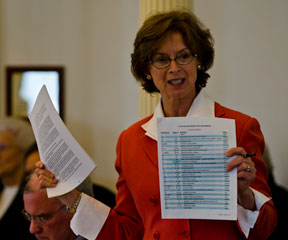
Chairwoman Sen. Claire Ayer, D-Addison, said the bill is a priority for her committee, and while senators have yet to begin a markup, she’s hopeful they will vote on it Friday.
The state’s current practices for involuntary treatment and medication date back to the 1990s. Previous attempts to revise them have sputtered out, in part because there is a vocal contingent of patients, clinicians and attorneys who don’t think the process needs fixing.
The mental health system has moved away from long-term institutionalization, according to previous testimony from psychiatrists and state mental health officials. Its focus is on helping patients cope with their illness in a community setting, and ideally they are committed only during episodes of psychosis.
The goal of clinicians in those cases is to help patients recover to a point at which their symptoms can be managed outside of a secure psychiatric facility.
The bill is meant to address concerns about a small population of severely mentally ill patients who are committed against their will and refuse to take the medications they are prescribed. In those instances, clinicians have the option to seek a court order to have the patients forcibly medicated.
Vermont currently has about 50 involuntarily committed patients at four acute psychiatric facilities across the state.
Close to 15 of those patients have cases in which clinicians to petition the court for them to be medicated against their will, according to figures from the Department of Mental Health.
Involuntary medication is a distinct process from federal laws that allow for patients to be chemically sedated in emergencies, though the two are often conflated.
The involuntary medication process that the bill would alter is for the ongoing use of psychiatric drugs clinicians believe will have therapeutic value for the patient rather than for emergency situations.
The bill seeks to address the waiting periods from when a patient is admitted to when a court rules on the clinician’s request that the patient be involuntarily medicated, which averages roughly 56 days but in some cases can take months.
At the heart of the issue is whether those waiting periods hurt a clinician’s ability to provide appropriate care in certain cases, or if the waiting periods built into current law protect people’s rights and afford them a chance to participate voluntarily in their treatment.
The two aren’t mutually exclusive, and the senators on Health and Welfare must decide if the bill strikes the appropriate balance between the two for the state to deliver the best care for these patients.
Clinicians who favor the bill say in rare cases those waiting periods can put staff and other patients at risk because unmedicated patients can become violent with little warning. The wait can also do serious harm to some patients’ recovery, they say.
The family members of people with acute mental illness say it can be excruciating to see their loved ones languish in unmedicated psychosis.
But many patients say the indignity of being forcibly medicated left them with lasting trauma, and the bill’s opponents argue that streamlining the process undermines the opportunity for patients to willingly take medication.
Figures from the courts show that 70 percent of applications for involuntary treatment are resolved without a court ruling and 30 percent of involuntary medication applications are resolved without a ruling.
“The passage of time is not necessarily a bad thing,” said Jack McCullough, an attorney with the Mental Health Law Project, which represents the majority patients in involuntary proceedings.
It can give people time to get over the trauma of being forced into a psychiatric facility and decide to cooperate in their treatment, he said.
“Sometimes waiting longer is good, and engaging that patient is good, and sometimes it’s not good; sometimes time is the enemy,” said Jill Olson a lobbyist for the Vermont Association of Hospitals and Health Systems. “What this bill does is it actually creates flexibility.”
It allows clinicians and the state’s attorneys who represent them in these proceedings to look at what’s best for patients on a case-by-case basis, Olson said.
McCullough, who opposes changing the current process, said S.287 would lead to more applications for involuntary medication and ultimately more patients being forced to take medication.
The bill allows an application for involuntary medication to be filed once the application for involuntary treatment is submitted.
McCullough said that means patients could face a proceeding to be medicated against their will before the court ever finds there was reason to commit them in the first place.
“I just think that it’s very clear that more involuntary medication cases will be filed if that’s allowed to happen,” he said.
Judge Amy Davenport, who hears many of these cases, said she too is concerned the changes could result in more involuntary medication procedures.
If the applications can be filed earlier, medicating difficult patients might come to be seen as the easiest option for hospitals, she said.
“I don’t have a crystal ball, but I’m worried,” Davenport said.
Clinicians who testified in support the bill say the option to file involuntary medication applications before a determination of the patient’s need for treatment won’t affect how they administer care.
Another change in the proposed bill would create an expedited application process for potentially dangerous patients or those who have responded well to medication in the past.
That allows judges to consider a psychiatrist’s request to prioritize certain cases when there’s a compelling reason, said John Wallace, an attorney for Rutland Regional Medical Center.
McCullough said there are informal ways, such as status conferences between the parties, to allow for the prioritization of certain cases. An expedited process would complicate the ability of his office to prepare for its cases.
Wallace pointed out that the bill still allows both sides to request a continuance if they aren’t prepared by the scheduled hearing date.
The bill would not directly address the time some mentally ill patients spend in emergency rooms waiting for an inpatient admission to a psychiatric facility, which routinely exceed the statutory limit.
Proponents of the legislation argue that by allowing some patients to be medicated against their will sooner, they will recover to a point where they can be treated in the community, thereby opening up beds.
McCullough said he believes that part of the reason the hospital association is pushing for the bill is that hospitals were unprepared to take on so many acutely mentally ill patients in the wake of Tropical Storm Irene and the closing of Vermont State Hospital in Waterbury.
“Now they don’t have an outlet valve like the state hospital,” he said, “I think to some extent the private hospitals are dealing with patients whose conditions are beyond what they’ve ever had to deal with before, and they’re possibly unprepared to treat appropriately.”
The opening of a new state hospital in Berlin this summer will help, McCullough said, but he believes the private hospitals will still be overwhelmed.
Correction: An earlier version of this story said S.287 would affect the process from commitment to court ruling. The bill would actually affect the process from inpatient admission to a court decision on an involuntary medication petition.
