

Environmental watchdog groups told lawmakers Thursday that a bill to expand local input in the state’s review process for energy projects could hold back Vermont’s goals for renewable power.
The Senate Natural Resources and Energy Committee heard testimony Thursday on legislation to give property owners and local planners a stronger voice in the state’s energy project review process. The bill is partly a response to a strong negative reaction from local residents to industrial-scale energy projects.
Environmental advocates say the policy could undermine the state’s renewable energy goals by blocking future development.
In a testy exchange, Paul Burns, executive director of Vermont Public Interest Research Group, told the committee the bill could obstruct the need to develop renewable power sources in the state.

“It seems to me that the bills here, as previous witnesses noted, are not about advancing clean energy, renewable energy solutions here, but are instead designed to put up barriers, roadblocks, to the direction that the state has already established (as) its policy and should be headed,” Burns said.
Sen. Peter Galbraith, D-Windham, replied that the committee’s intent was not to stifle renewable energy development.
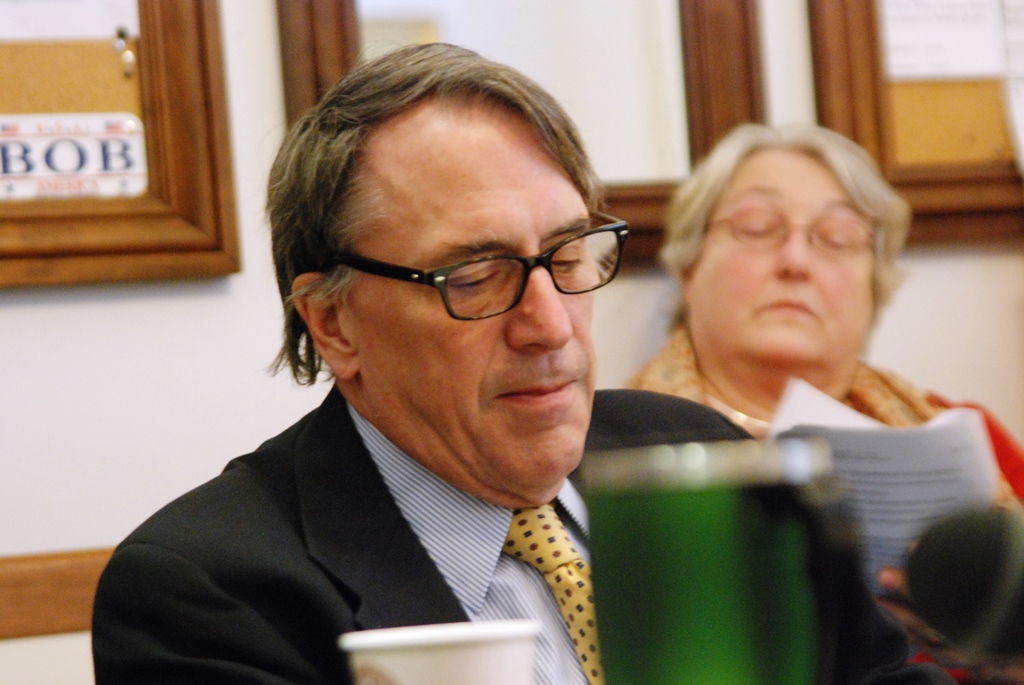
“I don’t know a single member of this committee who is against renewable energy,” Galbraith said. “I know some members who are concerned about the location of a certain type of a renewable energy that indisputably does great environmental damage to a pristine ridgeline and that goes against the interest of adjacent citizens, as strongly expressed, and that may not actually reduce carbon by any significant amount.”
Bill S.201 would remove intervention requirements for local parties to speak before the Public Service Board. The bill also gives “substantial deference” to local energy plans, rather than “due consideration” under current statute.
In part, the proposal builds on recommendations made by the Energy Generation Siting Policy Commission. The commission was appointed by the governor last year to review the Public Service Board’s Section 248 process.
Noreen Hession of Newark said some towns in the Northeast Kingdom voted against the recently erected wind projects in Lowell and Sheffield. She urged the committee to give communities a stronger say in the board’s review process.
“Our town plans don’t matter. Our regional planning commission doesn’t matter and our regional plan doesn’t matter,” she said. “The PSB routinely ignores all of these things. If enacted, S.201 and 292 could change that.”
She said the bill is a good start, but it should go further to give towns full veto authority on energy production projects.
“We’ve all voted ‘no.’ Please help us ensure that in Vermont, no means no,” she told the committee.
Brian Shupe, executive director of the Vermont Natural Resources Council, said his group supports giving local planners a role in the board’s review process, but not at the expense of the state’s renewable energy goals.
“We don’t feel as though ‘substantial deference’ should be extended to the municipalities, because these are regional issues, they are really statewide issues,” he said.
Shupe said if towns were given “veto authority” in the board’s review process it could undermine the state’s renewable energy goals.
Pat Haller, a founding member of the Westford Energy Committee, said the bill should give funding and guidance to municipalities that do not have town plans.
“We need directions,” he said. “We need to understand how to investigate the siting of a wind turbine or photovoltaics in someone’s yard to the scale of what we are looking for.”
He said Westford supports renewable energy projects, but the two bills do not provide adequate commitments to support municipalities and regional planning commissions.
“But nonetheless, I submit that it’s extremely difficult on the local level to bring forward appropriate planning and zoning that will meet the goals of the state for renewable energy,” Haller told the committee. “And I don’t see in these bills much support in trying to make that happen.”
