


Editor’s note: Mark Bushnell of Middlesex is a freelance writer, whose special interest is Vermont history. In This State is a syndicated weekly column about Vermont’s innovators, people, ideas and places. Details are at maplecornersmedia. com.
The stories couldn’t be true, could they? Some people discounted them, because the reports mostly came from folks deep in the backwoods of Vermont. These folks had to be crazy or feeble-minded, or they were joking, right?
The stories rose as the waters fell following the November Flood of 1927. People reported seeing the dead bodies of odd-looking creatures floating in the state’s rivers and streams. The creatures were said to be about 5 feet long and pinkish. Witnesses wrote of their sightings in the Rutland Herald and Brattleboro Reformer. Soon, a lively debate ignited in the papers’ letter-to-the-editor sections between believers and nonbelievers.
A literature professor and amateur folklorist, Albert Wilmarth, suggested that the accounts were merely a modern iteration of an old Native American tale. Wilmarth became embroiled in the debate and began corresponding privately with a fellow academic, Henry Wentworth Akeley, who lived in Townshend in Windham County.
Akeley swore to Wilmarth that the stories had basis. He knew because he had seen these otherworldly creatures.
The creatures, of course, did not exist. Nor did anyone ever really claim to have seen them. And Wilmarth and Akeley? Equally fictitious. They were all figments in the wild imagination of writer H.P. Lovecraft, who created the details for his 1931 horror story, “The Whisperer in Darkness.”
(The story can be read online in its entirety here and, given that it is nearly Halloween, might be appropriate to share with older children, provided you don’t want them to walk alone in the woods again.)
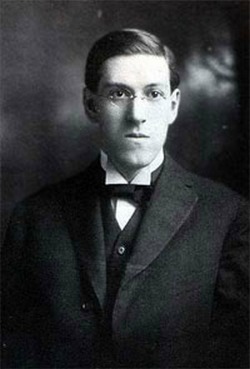
At the time he wrote “Whisperer,” Lovecraft was an obscure writer of what were known as “weird tales.” Today, more than 75 years after his death, he has a cult following of admirers, including horror writers Anne Rice and Stephen King.
Lovecraft’s story of strange happenings in the back hills of Vermont was inspired by visits he made here in the late 1920s.
Lovecraft was a New Englander. He grew up in Providence, R.I., and could trace his ancestry back to the Massachusetts Bay Colony in 1630. He loved New England’s heritage, but feared it was eroding.
While visiting Vermont, Lovecraft seems to have glimpsed, at least in his imagination, a sort of primordial New England. In 1928, Lovecraft was the guest of Vrest Orton, a native Vermonter and friend from the New York publishing world, who would later found the Vermont Country Store in Weston. Orton admired Lovecraft’s work, commenting that he “is a very great writer … perhaps so great that he will never be appreciated.”
In “The Whisperer in Darkness,” Lovecraft employs Wilmarth as his narrator. Wilmarth is writing in 1930 about his experiences two years earlier in Vermont. It has taken him that long to muster the courage to explain the events he experienced.
The story starts with Wilmarth’s correspondence with Akeley. At first Wilmarth isn’t sure Akeley is sane, his stories are so fantastical. Akeley tells of the strange race of winged, crablike aliens with pink exoskeletons that he stumbled upon in the hills near his home. The aliens, Akeley believes, have been there for centuries, mining a mineral unknown on their home planet. Wilmarth is intrigued, but skeptical. To convince him, Akeley photographs strange footprints and records nonhuman voices in the woods.
As their correspondence progresses, Akeley grows more frightened. Something keeps killing his dogs. After several trips to the pound, he amasses a small herd of German shepherds, but still visitors skulk outside his house at night. Soon, shots are fired into his house. The shots become a nightly occurrence. He becomes convinced that some local residents have been co-opted by the aliens. Akeley considers fleeing, but he is the sixth generation to live on that land and can’t imagine leaving. Eventually he becomes convinced the aliens wouldn’t let him escape alive anyway; he knows too much.
But suddenly Akeley has a change of strategy. He soon writes that he has communicated with the aliens and that they mean no harm. He encourages Wilmarth to visit immediately, saying that for a man of intellectual curiosity, this is the chance of a lifetime.
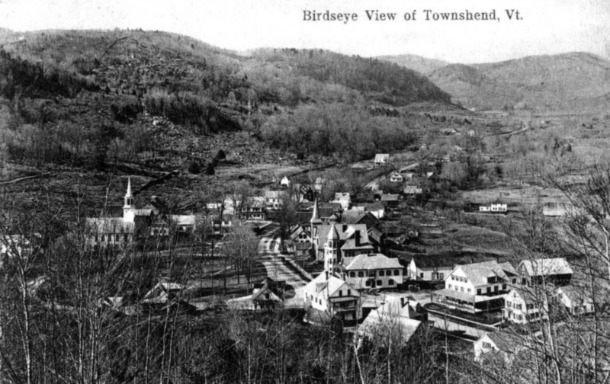
Wilmarth ventures north by train, full of trepidation. As he reaches Vermont, the conductor advises him to set his watch back an hour, “since the northern hill country will have no dealings with new-fangled daylight time schemes. As I did so, it seemed to me that I was likewise turning the calendar back a century.”
During the trip, Wilmarth writes, “I knew I was entering an altogether older-fashioned and more primitive New England than the mechanised, urbanised coastal and southern areas where all my life had been spent; an unspoiled, ancestral New England without the foreigners and factory-smoke, bill-boards and concrete roads, of the sections which modernity has touched.”
Upon reaching the Akeley homestead, Wilmarth is shocked by what he discovers. We won’t reveal the ending for those interested in reading the story, but suffice it to say, Akeley and Wilmarth will never be the same after encountering the aliens.
Writing later, Lovecraft explained that “Whisperer” grew out of two basic concepts: “the idea of a man in a lonely farmhouse besieged by ‘outside’ horrors, and the general impression of weirdness in the Vermont landscape.”
Lovecraft found the inspiration for Akeley when he met the reclusive Vermonter artist Bert Akley, whose name he changed only slightly. After visiting Akley’s “ancient farmhouse,” Lovecraft wrote to a friend that the man “turned out to be a highly remarkable rustic genius.” Akley, now buried in West Brattleboro, was a painter, photographer, and a skilled jack-of-all-trades. Akley’s handiness appears in Akeley’s character.
For Akeley’s home, Lovecraft apparently drew from his visit to another isolated Vermonter — the poet Arthur Henry Goodenough. Like the character Akeley, Goodenough preferred to stay near home. “Squire Goodenough … has never set eyes on a city,” Lovecraft wrote a friend, “and goes but once or twice a year to quaint Brattleboro, three miles distant.”
Lovecraft said Goodenough’s home was “at the heart of this weirdly beautiful” Vermont. It is hard to say where all this sense of weirdness came from. Perhaps it’s just how horror writers view the world. For the most part, Lovecraft apparently admired Vermont.
Lovecraft wrote to a friend: “I never seen no country niftier than the wild hills west of Brattleboro, where this guy (Goodenough) hangs out. …(O)nce you climb the slopes toward the setting sun, you’re in another and an elder world. All allegiance to modern and decadent things is cast off … The nearness and intimacy of the little domed hills become almost breath-taking — their steepness and abruptness hold nothing in common with the humdrum, standardized world we know, and we cannot help feeling that their outlines have some strange and almost-forgotten meaning, like vast hieroglyphs left by a rumoured titan race whose glories live on in rare, deep dreams.”
