

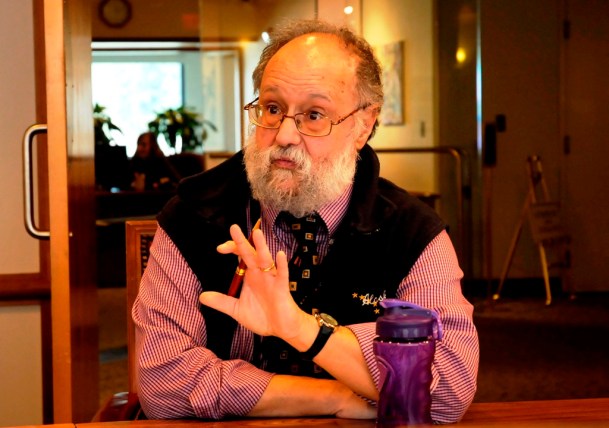
- Richard Moffi, chief of the state’s Fuel Assistance Office, explains the heating benefits LIHEAP participants will receive in the coming winter months. Photo by Hilary Niles/VTDigger

Gov. Peter Shumlin and the state Emergency Board approved an extra $2.1 million in state spending to help low-income residents heat their homes this winter.
Richard Moffi, chief of the state’s Fuel Assistance Office within the Department for Children and Families, said the boost in funding brings the average yearly benefit to $797 for 28,600 households. It would have been $717 without the additional appropriation.
In previous years, fewer households were eligible for heating fuel assistance, but the average dollar benefit was higher — nearly $900 in fiscal year 2013, and more than $1,700 in 2009.
Shumlin said Thursday that there is broad bipartisan support in Vermont for prioritizing heating assistance and sustaining the program through fluctuating federal support.
“Everyone regardless of income should have the opportunity to not make horrid choices — between food on their table, prescription drugs, and particularly seniors and others,” he said. “We’re going to make sure that they have the oil in their tank to get through the winter.”
This installment brings total LIHEAP funding in Vermont up to about $25 million for the coming winter months. State officials say that about $17 million is likely to flow from federal coffers, although that figure is not finalized. The Legislature previously allocated $6 million for fiscal year 2014. The additional money brings the state’s total contribution up to $8.1 million.
The Emergency Board, which must approve certain unbudgeted expenditures, unanimously approved the appropriation.
Sen. Tim Ashe, D/P-Chittenden, cautioned that the state’s willingness to contribute heating assistance should not be seen as the start of a trend. In addition to his seat on the Emergency Board, Ashe chairs the Senate Finance Committee.
“With sequestration and all the things going on in Washington, this won’t be the only program where suddenly very serious human needs are not being met by the federal sources that used to exist,” Ashe said. “And I would hardly call this precedent-setting in that context, because people going cold in the winter is substantially different than some of the other areas.”
What it buys
Applications for heating fuel assistance are accepted through February. The program is intended as supplemental help, not a complete subsidy.
Most of LIHEAP money this year will be transferred electronically by the middle of November to certified fuel dealers who service LIHEAP customers. The funding subsidizes petroleum heat (oil, kerosene and propane) plus wood pellets, firewood and coal, but not electric heat.
Dave Yacovone, DCF commissioner, said this year’s total program dollars are less, but the money will wield the same purchasing power as last year for most participants.
“We’re going to be paying 32 percent of the bill for people who use petroleum,” Yacovone said, referring to the vast majority of LIHEAP recipients.
He gave two main reasons that less money is calculated to go the same distance: Moffi and assistant program administrator Tina Wilder negotiated “more aggressive discounts” with fuel dealers. The average cost of petroleum products is pegged at $3.50 per gallon this winter — down 35 cents a gallon from last season. Ample propane supply also helps keep that cost down, Yacavone said.
Changes to the crisis fuel program also account for some of the stretch. Yacovone said structural changes in eligibility for emergency fuel deliveries have built up regular benefits and cut down on more costly crisis intervention, thereby making fuel subsidies more efficient.
Fluctuating funding
State contributions to LIHEAP have varied over the years, as have enrollments and average benefit payouts.
Shumlin blamed Congress for reducing LIHEAP funding so much that state officials felt they had to step in.
“Congress in their wisdom continues to cut funding for low-income Vermonters who desperately need to stay warm,” he said sarcastically. “Why they continue to do that puzzles me. But that’s where we are.”
In fact, federal LIHEAP funding has fluctuated since 2005 — the first year the state chipped in, Secretary of Administration Jeb Spaulding said.
This winter’s federal funding exceeds that of 2005 by about $3 million. But it’s less than half of what the federal government paid in 2009. Spaulding said the federal government’s $38.6 million contribution that year was artificially high, because it was near the height of the recession and subsequent federal assistance to states.
Rep. Martha Heath, D-Westford, said the Legislature anticipated reduced federal funding for several programs, and planned ahead.
Out of all tax revenues the state collected in fiscal year 2013, one-quarter of any higher-than-expected performance was set aside for just such an occasion, Spaulding said. That totaled about $6.5 million, from which the $2.1 million LIHEAP boost is drawn. The remainder has not been earmarked.
“There’s nothing else anticipated at this time,” Spaulding said. “But that doesn’t mean it couldn’t happen.”
Recalculating program benefits
The Emergency Board also discussed future changes in data collection and management that will alter some calculations of purchasing power, making fewer dollars appear to stretch even further.
A preliminary look at new data from fuel dealers indicates that LIHEAP households use an average of only 500 gallons of fuel oil per winter, compared to the 766 gallon statewide average.
When this more accurate figure is used next year, it will be plugged into an equation that projects the percentage of heating fuel that LIHEAP benefits subsidize. In other words, the equation will start with a closer estimate of the fuel a family actually uses, and calculates the portion that’s paid for by LIHEAP.
With fuel usage being less than previously thought, the same amount of funding could cover a higher percentage of the family’s winter heating bill.
Department officials hypothesized at the Emergency Board meeting that lower heating fuel usage among LIHEAP participants might be attributable to a more frugal general philosophy necessitated by poverty, by smaller home sizes or a combination of the two, and other factors.
It also could be the product of several years of weatherization projects directly benefiting LIHEAP households, they said. That’s another data point state officials hope to fold into future program calculations.
