

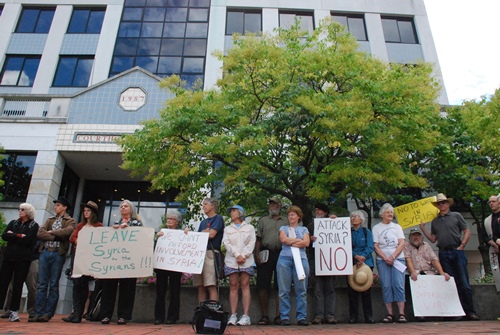
While Vermont’s congressional delegation wrestles with whether to support a military intervention in Syria, many of their constituents have sent a blunt message: Don’t.
Congress is expected to vote next week on President Barack Obama’s plan to launch airstrikes on Syria in response to what the administration says is clear evidence that the regime used chemical weapons on its people.
A band of several dozen protesters congregated outside the delegation’s Burlington offices Thursday, cantillating anti-war slogans and demanding “no” votes from each member.

Members of Vermont Action for Peace, the Vermont Workers Center, the Peace and Justice Center and other residents also launched a petition drive Wednesday to oppose military intervention in Syria.
One of the protesters, Jim Ramey of the International Socialist Organization, said military intervention would only complicate the civil war.
“Bombs don’t bring democracy to these people, it only, it only [sic] entrenches the regime further,” Ramey said. “Our action here is really important, our petition is really important. We need to figure out the fight that it is going to take to stop the bombing.”
The delegation has taken pains, in interviews and statements, to explain the nuances that make their decision an agonizing one. Their indecision condenses to this: None of them want to see chemical weapons attacks go unpunished, but all three are skeptical that a U.S. strike could be both effective and short-lived. And, since global support has yet to coalesce, they’re troubled by the prospect of the United States going solo.
All three lawmakers say their phone lines and inboxes have been flooded, and there’s not much nuance in the messages they are receiving.
Leahy spokesperson David Carle said “by far the majority of messages” the senator has received are against intervention. Sanders has said in broadcast interviews that his office phones have “bopping off the hook” with calls from constituents “almost unanimously” against Obama’s proposal. Welch, too, said in an interview that the Vermonters he’s hearing from are “overwhelming against any kind of military involvement in Syria.”
Vermonters’ misgivings aren’t surprising, and broader public opinion is leaning the same way — a recent Washington Post-ABC News poll, published Sept. 3, showed 59 percent of Americans oppose a missile strike in Syria.
As Leahy, Sanders and Welch wrestle with how to weigh the military intelligence they’re getting from Washington versus the phone calls and emails they’re getting from war-weary constituents, their insistence on maintaining an open mind is rankling some Vermonters.
Sanders, the only one to address the protesters face-to-face Thursday, told them, “I don’t know when the vote is going to be. I don’t know what the resolution will be. My job is to keep an open mind …”

A protester interjected, “No, your job is to vote no, and stop this war right now!”
Sanders responded sharply, “I’m happy to be here but I don’t want to be interrupted,” to which a protester cried out, “We’re your constituents.”
After suppressing the din, Sanders spelled out his “grave doubts” about intervening in Syria, focusing on the potential fallout for the middle class.
“I worry very, very much that whether the president understands or not, there is a real possibility that we can get dragged into another war that can go on for a long, long time,” Sanders said.
Leahy staffer John Goodrow and Welch staffer Patricia Coates fielded protester demands for their bosses.
Goodrow read a statement released earlier in which Leahy said, “I remain skeptical of the United States going alone, and about what comes after.” But he also made it clear that his mind wasn’t made up — “It makes sense to have the debate and then decide, not to decide and then have the debate.”
Welch, who repeatedly called for the vote in Congress that Obama eventually granted, is also wavering.
He acknowledged the pressure he’s getting from Vermonters — “A lot of folks want me to say yes or no.” But he made the case that even if he isn’t immediately acquiescing to the feedback he’s gotten from constituents, he’s fulfilling his duty to them by “really kicking the tires” on the decision.
“I’m doing my due diligence,” the congressman said Thursday, pointing out that he’s been out of the country and, while he’s had phone briefings from Washington, he won’t hear any of the classified briefings until next week.
At the same time, Welch downplayed the substance of those briefings.
“I’ve been getting a lot of so-called sophisticated information from the administration,” Welch said. “But the Main Street wisdom of folks in St. Johnsbury and St. Albans … I take that very seriously.”
But Welch, in an interview on WDEV Friday morning, also indirectly suggested that a “yes” vote wouldn’t necessarily fly in the face of his constituents’ demands. He said that while he knows most Vermonters are against a strike, he thinks “they are also appalled at the use of chemical weapons.”
And on Vermont Public Radio on Friday afternoon, Welch said that while he understands Vermonters are “against war,” he thinks, “Vermonters are for the rules of war,” noting the chemical weapons ban in the Geneva Protocol.
“Basically this is going to boil down to a judgment call,” Welch said.
