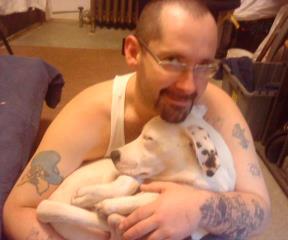
Last Friday, 38-year-old Robert Mossey died in the custody of the Department of Corrections. Family members and prison rights advocates are awaiting the results of an autopsy and investigations by the Vermont State Police and the Prisoners’ Rights Office.
Mossey, an inmate at the Northern State Correctional Facility in Newport, was found unconscious in a bathroom mop closet Friday afternoon. Vermont State Police described the death in a news release as a “possible suicide by hanging.”
Detective Sgt. Darren Annis said Tuesday he expects the chief medical examiner to disclose the official cause of death within the next day or two. The Vermont State Police detectives are also looking into the incident to confirm the death was not a homicide. “Right now,” Annis said, “there is nothing to indicate that. All information is pointing to a suicide.”
Corrections Commissioner Andy Pallito said the department, in addition to calling state police to the scene, will conduct a Department of Human Resources investigation to look for potential employee misconduct. In addition, an outside entity will review corrections policies.
Mossey’s stepfather, Todd Jimmo, said his stepson, a Burlington resident, had a longstanding drug addiction and his brushes with the law dated back to his teenage years.
Mossey had been released under community supervision after fulfilling a minimum sentence for an earlier offense; he was re-incarcerated in July after pleading guilty to a retail theft charge.
His most recent stint in jail should have been a short one — he had reached the end of his minimum sentence and had been trying, without luck, to secure housing that met DOC standards, according to Pallito.
Mossey’s criminal past consisted of “petty stuff,” Jimmo said, and the crimes stemmed from his addiction. “Almost every time, in his adult life, it had to do with drugs, even though the charges didn’t have to do with drugs.”
There had been a glimmer of hope in October after Mossey completed a rehabilitation program at Maple Leaf Farm in Underhill. He left “bound and determined to get his life together,” according to Jimmo, but the spell of sobriety was brief and he started using crack cocaine soon afterward, his stepfather said.
Jimmo did not know whether Mossey had received a diagnosis of mental illness while in the correctional system — the DOC keeps this information confidential.
Mossey has three children, all of whom had been removed from his custody. His youngest child was recently placed in the custody of the Department for Children and Families, and, according to Jimmo, this was one of Mossey’s major frustrations.
Jimmo said Mossey had numerous complaints about the correctional system during the times when he’d been incarcerated — “He’s had problems with Newport since day one.”
Most recently, Jimmo said Mossey was increasingly frustrated that his housing proposals were getting turned down by the DOC, and he speculated that these rejections had been the “final straw” for Mossey.
In August 2012, Seven Days reported that 35-year old Joseph Heim, another inmate at the Northern State Correctional Facility, attempted suicide after “allegedly becoming distraught that the Vermont Department of Corrections wouldn’t approve his housing situation.”
Jimmo said he encouraged Mossey to use the channels within the correctional system, but his stepson considered that futile.
“He was in this mode of trying to circumvent the system. … I’d ask, ‘Have you turned in the paperwork?’ He’d say, ‘No, because it doesn’t work, and I’d say, ‘Turn it in, leave a paper trail.’”
The last time someone committed suicide in a state correctional facility was 2004. Eight suicides occurred between 2001 and 2004, and a lawsuit filed in 2004 by the advocacy group, now called Disability Rights Vermont, prompted several changes in DOC policies that address self-harm. DOC staff are now trained to identify “self-harm” behaviors, and inmates are no longer put in segregation for displaying those behaviors.
In an email response, Pallito said, “Since that time, we have had zero successful suicides. This is a phenomenal history given that many of the reasons that suicides happen, such as alcoholism, mental health issues, economic challenges, are very prevalent in our population.”
According to Pallito, DOC staff “intercede and prevent about one attempt per week.”
The department tracks all reported “self-injurious incidents” and it classifies them as low, medium or high lethality. According to the department’s definitions, low lethality event include threats of self-harm and injuries “requiring only local first aid.” If an injury requires outside medical care, it’s considered a “medium lethality event” and a “high lethality event” involves either “severe bodily damage, a ‘near miss,’ or a complete suicide.”
The total number of self-harm incidents has increased each year from FY 2008 to FY 2012, the most recent year for which there is data. But the percentage of medium and high lethality events has decreased. In FY 2012, there were 490 reports of self-harm, with 29 medium events and three high events. In FY 2008, there were 339 events, 63 of which were categorized as medium events, and six high events.
Jimmo said he wasn’t jumping to conclusions, but he wants answers to several specific questions. He wants to know if Mossey was under “15 minute watch ” — a type of elevate supervision for inmates considered at high risk. He also wants to know how Mossey was able to lock himself in a mop closet, and how long he was in there before corrections staff discovered him.
“You’re never going to be able to totally prevent it. You’d have to have one officer for every inmate. But if the officer wasn’t doing his job, there’s an issue,” he said.
Gordon Bock, chair of the prisoner advocacy group CURE Vermont, said, “Any time a prisoner has the opportunity to commit suicide, the question is how does that happen and what steps will be taken to ensure that it can’t happen again.”
The Prisoners’ Rights Office, which is housed in the Office of the Defender General, has dispatched its own investigator to look into the matter. Defender General Matthew Valerio said he received a call from Pallito “probably within a half an hour of it occurring.” If the investigation turns up evidence of negligence on the part of the department, Valerio said they’ll supply recommendations to the Corrections Oversight Committee.
Disability Rights Vermont plans to make some inquiries into the incident to determine whether or not they’ll do an investigation of their own, according to Ed Paquin, executive director of the watchdog group.
“We only know what was in the news about the incident, and it’s the kind of thing that before we do much of anything, we do a bunch of inquiries to find out if it’s something we think we should investigate.” Given the group’s limited resources, Paquin said, they only launch their own investigations if the person involved has a disability or if they see a shortcoming in the state’s investigation.
Editor’s note: This story was updated with new information about Mossey’s search for housing.