

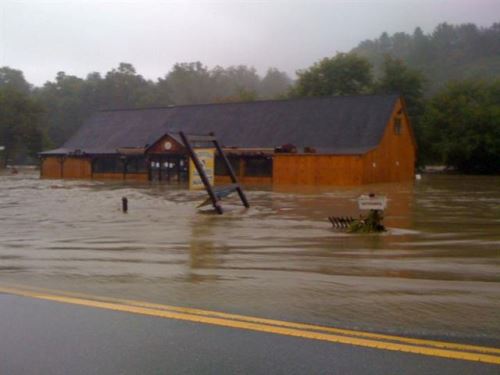
Vermont legislators agreed in May to offer up to $8.67 million in refunds and discounts to businesses that laid off workers in the wake of 2011’s disastrous floods.
Their unemployment insurance charges — the money that feeds the trust fund from which unemployment benefits are paid — presumably had gone up because they’re based partly on employers’ history of layoffs: the more layoffs, the bigger the bill. But on top of other flood-related repairs, the insurance hike hindered their recovery, employers argued. Lawmakers agreed to cut them some slack.
But only 75 employers, among the untold eligible businesses hailing from every county in the state, applied for the unemployment insurance relief. Instead of giving breaks for a “worst-case” scenario of 11,247 layoffs, the state forgave at least partial charges on just 299. Employer benefits were capped at eight weeks. On their July 1 unemployment insurance bills, 54 businesses accepted $264,178.53 in refunds.
“Really, that’s all? Wow,” said Steve Moyer, CFO of Woodstock Farmers’ Market. The retail business benefited from the program almost two years after temporarily laying off all of its 50 employees. Even after a partial refund and with a discount on its current unemployment insurance charges, Moyer estimates the market’s costs will increase by $90,000 over the course of three years.
“We got hit very hard with that cost,” he said. Had more relief been offered, he wonders if his business would have taken such a hit.
Moyer’s reaction embodies the conundrum policymakers wrestled with when they struck a deal in May to create the state’s Unemployment Insurance Disaster Relief program. Some legislators were reluctant to give employers any relief, while others wanted to offer more.

“We never claimed to make any of these people whole, to really compensate them everything they deserved,” said Sen. Dick McCormack (D-Windsor). “And if it turns out that there is more money available than we thought, and it seems that is the case, then it seems to me the first people on line ought to be the businesses that were aggrieved in the first place.”
Many businesses that received refunds likely will continue to reap related discounts another year still. Their total savings — and therefore the ultimate cost to the unemployment insurance trust fund — is impossible to calculate given the unpredictability of future job markets and the complexity of the unemployment insurance system, according to officials from the Vermont Department of Labor.
But Labor Commissioner Annie Noonan expects lawmakers will want to review the program when they reconvene in January. They’ll find the program reached a fraction of its potential cost and impact, as they consider whether and how to reshape the program in the event of future disasters.
Rep. Bill Botzow (D-Bennington), chair of the House Commerce Committee, advises a tempered approach to considering change.
“I’m glad they were helped,” he said of the 54 businesses enrolled. Going forward, he will assess what latitude the state has with its unemployment insurance trust fund, and then consider the best actions to take. “I think that’s the next step and we all ought to do our best, and patiently work our way through it,” he said.
Vermont’s first Unemployment Insurance Disaster Relief program
Moyer estimates the Woodstock Farmers’ Market’s unemployment insurance bill has increased by about $30,000 over the past 12 months.
A charge that used to equal 1.3 percent of the market’s payroll jumped to 6.4 percent after Tropical Storm Irene, when the business closed for 11 weeks, laying off 50 employees. That’s because businesses are charged for unemployment insurance based on their history of layoffs. The rationale is for employers to contribute to the trust fund about the same amount that any of their laid off employees might take out of it in the form of unemployment benefits.
The market had no choice but to lay off, Moyer said. The store had to be gutted, the drywall torn out, the whole place rewired and repaired, and the parking lot torn up, hauled away and replaced, he said.
“I think the best thing you can do for the workers is get them back to full employment, which we spent every ounce of our effort doing,” Moyer said. “Not only to get the business reopened, but to get them back on full paychecks.”
And they did. With help from a Vermont Economic Development Authority loan, private loans and $250,000 of Moyer’s and owner Patrick Crowl’s own money, the Woodstock Farmers’ Market reopened after 11 weeks. “Which was really remarkable when you consider the extent of the damage,” Moyer said. All but one employee returned to work when the market reopened.
Those 11-week layoffs, however, came back for another bite at the company’s finances the following July. Seasonal businesses that regularly implement layoffs are used to big bills for their contribution to the unemployment insurance trust fund. Places like the Woodstock Farmers’ Market, on the other hand, which previously had been charged for the lowest possible “experience rating,” got a costly surprise.
Several businesses took issue with the price hike, feeling they had been penalized for the impact of a natural disaster beyond their control. They brought that issue to legislators, who in turn carried it to their colleagues at the statehouse.
After much negotiation and trepidation about tapping into the fragile unemployment trust fund, which had been bailed out by a $77.7 million federal loan in 2010, the disaster relief program was born. Businesses affected by all three federally declared natural disasters in 2011 would be forgiven for up to eight weeks of layoffs they rolled out after the floods. And going forward, up to four weeks of forgiveness would be available to businesses whose layoffs could be attributed to future disasters.
The retroactive eight-week relief was a compromise among some who thought it should be longer, others who feared any new pressures on the trust fund were ill advised, and still others who thought that any aid should be directed to the laid off employees rather than the businesses that laid them off. The money to cover the disaster relief program wasn’t so much set aside as it was agreed upon as the limit to which the trust fund could be tapped without compromising its progress toward solvency. The federal loan has since been paid off.

While the committees worked out the details, the Department of Labor had no way of assessing which layoffs could be blamed on what disasters, much less how many businesses would come forward to apply for relief. They based “worst-case scenarios” on the possibility — remote though it was — that all unemployment claims paid out in affected counties during the 12 weeks following each disaster stemmed from layoffs related to the floods. Forgiving up to six weeks worth of layoffs could take a $5.9 million chunk out of the trust fund, they estimated. Forgiving up to three months worth would run about $14.4 million.
Lawmakers agreed to settle on eight weeks of retroactive relief for 2011. They put four weeks on the table for the future.
“From a department standpoint, we were very supportive of the concept,” Noonan said. She added that no prior administration had ever looked at adopting such a program, although it’s common in other states.
Relativity: Increase or savings?
The Woodstock Farmers’ Market jumped at the chance for a refund.
Moyer said they had paid their 2012 unemployment insurance bill at a 6.4 percent experience rating for its 11-week layoff. With eight weeks forgiven, the labor department manually went back to the market’s records and revised the company’s 2011 rating to 4.0 percent — as if the layoffs had lasted three weeks instead of 11.
Similar retroactive, manual adjustments were made for 53 other qualifying businesses out of all 75 that applied. The 21 other businesses, the labor department found, already had experience ratings so high that eight weeks of credit would not bring down their bills. In all, almost $265,000 was refunded to 54 businesses.
Woodstock Farmers’ Market got about $12,000 back, Moyer said. The refund meant that, retroactively, the company was only charged for the last three weeks of the layoff, “but that still had the effect of raising it (the company’s experience rating) from 1.3 percent to 4 percent for 2011,” he said. An increase of 2.7 percent charged against a nearly million-dollar payroll adds up fast.
The refunds aren’t the end of the story, however.
They were calculated by changing the experience rating, which stays with a company for three years: Every year when the rating is recalculated before July bills, the new rate is based on the layoff experience of the past three calendar years. Ratings from 2011, therefore, will stay with employers through 2014 and fall off on the 2015 bill.
That means the higher experience rating of 4 percent from 2011 still plagues the Woodstock Farmers’ Market, just like higher ratings stick to other businesses in similar situations. So, even after the adjustment, Moyer estimates the increase will require the market to pay nearly $90,000 more for unemployment insurance over three years than it would have if Tropical Storm Irene had not flooded them out.
And though it’s not as apparent as a refund of $12,000 on an annual bill, the Woodstock Farmers’ Market will save money for an equal amount of time. The employer’s 2011 experience rating of 4.0 percent was higher than it previously had been at 1.3 percent, but it’s also lower than the 6.4 percent it would have been were it not for the disaster relief program.
If it happens again
Only one type of federally declared disaster triggers the relief program, and none of Vermont’s abundance of disasters since 2011 qualifies. In the event that one should strike that would qualify employers for unemployment insurance disaster relief, the very fact that the program now exists would change its implementation.
Sponsoring legislators and labor department officials had hoped to roll out the relief program earlier in 2013, but the enabling legislation wasn’t passed until the “bitter end” of the legislative session, Noonan said.
Labor department staff was left with only about three weeks to notify employers of their eligibility. Moyer said the deadline loomed just 10 days from when he received the first notice by mail. Subsequent reminder calls and emails from staff left him with nothing but good to say about their diligence.
It’s possible, but unknowable, if more businesses could have taken advantage of the program. “As long as every business that was eligible was made aware, then the numbers are what they are,” said Sen. Tim Ashe (D/P-Chittenden), dismissing any criticism about timing.

“The Legislature passed a bill in one session,” Ashe said. “We won over some converts who were either conservative or not initially supportive. … I can see why people might be frustrated, but I think it’s an accomplishment.”
But aside from potentially more time for notification, Ashe points out a different effect of the fact that the program is now established for future use.
“None of these businesses had any expectation that a program like this would exist at the time they laid off employees, or decided to keep them,” Ashe said. “One of the dangers you run is, if it’s a permanent program, the next time there’s a flood, people will perhaps make decisions based on this program being there to hold them harmless.” That knowledge could make the difference between an employer choosing to issue layoffs or putting employees to work on cleanup, as Ashe said some did in 2011.
On the flip side, it potentially could change the calculus between a layoff and a closure, Moyer pointed out. He said he didn’t know if the Woodstock Farmers’ Market could withstand another disaster without every dollar of assistance that got it through Irene. He even finds the four-week provision going forward a “disappointment,” wishing it were longer.
Noonan said she expects that, when the Legislature reconvenes in January, lawmakers will review the program’s first implementation. “They may make decisions about moving that number (four weeks) again,” she said. “But I think all in all, the Commerce Committee did their due diligence to be careful with the trust fund.”
Sen. Peter Galbraith (D-Windham) supported the program’s creation. He said he doubts a situation would arise again that merits its implementation, but he feels comfortable with keeping the four-week provision in place. It represents fairness to all employers, not just consideration for those whose bills went up after layoffs, he said.

That point is made by several lawmakers, and it’s tied to the structure of Vermont’s unemployment insurance system. Experience ratings are based on a statistical “array” calculated not only by employers’ own layoff histories, but also by other layoffs around them. In other words, businesses are ranked in comparison to each other, not just on their own merits. The manual adjustments to lower 54 experience ratings this summer, therefore, could have the effect of raising others.
“When you do this, you are transferring the burden from employers who laid off to those who didn’t,” Galbraith said.
Galbraith also takes a more philosophical view. Totally negating experience ratings that change after natural disasters, he said, defeats the purpose of insurance. It’s not intended only to cover a business that issues layoffs due to market forces or poor business decisions. “It’s about unforeseen things and natural disasters, too. It’s all part of it,” he said.
The challenge for policymakers, then, is to determine how much different parties should bear for the cost of things going wrong.

