

Editor’s note: Landscape Confidential is a regular column by Audrey Clark, a curatorial assistant at the Pringle Herbarium at the University of Vermont.
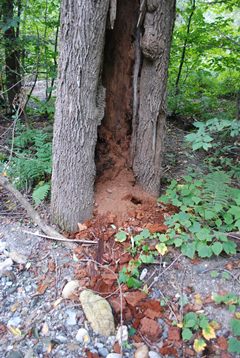
The standing snag is pocked with holes, riddled with zigzag channels, peppered with rough-hewn oval gouges. The remaining flakes of bark come away in your hand, revealing a caked layer of sawdust and white, cobweb-thin filaments inside the curve of bark. Sweep away the sawdust on the trunk and you reveal more holes and channels. At the base of the trunk is a pile of sawdust and rotten woodchips.
Though it looks deader than dead, this tree is teeming with life: the wood feeds beetles, which feed woodpeckers. Fungal filaments thread through the wood, sucking out what nutrients are left. Carpenter ants make their home in the heartwood, carving channels and dropping sawdust by their back door.
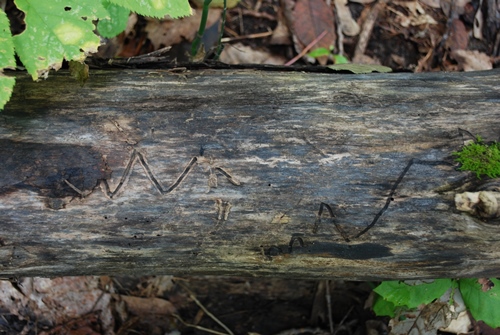
The holes and zigzag tracks belong to bark beetles, which lay their eggs under the bark of dying trees. These beetles choose dying and stressed trees because they still contain the nutrients of living trees, but are unable to defend themselves quite so well. Often you can find three kinds of chambers just under the bark of a tree: mating, laying and growing.
A mating chamber is often fairly small, oblong, and difficult to distinguish from the corridors branching from it. It is where the male and female beetles do the deed before they part ways, him to mate again and her to lay eggs. The branching corridors are gnawed by the female beetle who lays her eggs in little alcoves evenly spaced along the main hallway.
After a period of time, the larvae hatch and gnaw their own channels under the bark, sometimes zigzagging back and forth, eating and growing. They eat the cambium, the living part of the tree from which new wood is formed. These channels get noticeably bigger toward the end, making it clear how much the larvae grow as they eat the nutrient-rich wood. As the larvae munch along, they leave behind a trail of frass, or insect feces, that is essentially sawdust.
The larvae then chew their way through the bark and enter a stage of life called pupation, often dropping to the forest floor and burrowing under leaves for the winter. In spring, the pupae hatch into full-grown beetles — though perhaps only a few millimeters long — and fly off to seek mates, ready to start the cycle over again.
Each wood-boring beetle species enacts a variation on this general pattern. Some lay one egg per alcove, while others lay masses. Some bore mainly through the bark while others bore mainly through the wood. Some chew tiny exit holes in the wood, while other holes are asymmetrical or large enough to stick a pencil into. It is possible to use these signs to identify the family, if not the species, of many wood-boring beetles (see Charley Eiseman’s “Tracks and Sign of Insects and Other Invertebrates” for a more detailed treatment).
Carpenter ants also leave sawdust behind, though in this case it is undigested. In early summer a female ant finds a decent-looking dead tree and begins her colony there. She excavates a small egg chamber and lays eggs. These hatch into larvae and then, like the beetles, pupate for a period of time. Finally, mature ants emerge.
These ants, all sterile females, become the workers of the colony. These workers use their mandibles to chew apart the wood, carving irregular channels into the heartwood of the tree. Workers carry each piece of sawdust out of the nest one at a time, often leaving a pile at the base of the snag.
After the colony reaches a certain size, male and female individuals are born. These winged individuals, called alates, are capable of reproduction. They leave their home colony to fly off and mate with alates from other colonies.
Shortly after mating, the males die. The females, if they survive predation, seek dead and dying trees in which to begin their own colonies. Those that succeed become queens. According to Gilbert Waldbauer, author of “The Birder’s Bug Book,” carpenter ants can reach up to half an inch in length, making them good eating for a bird.
Woodpeckers enjoy the tasty, protein-rich morsels of beetle larvae and carpenter ants they find in dead and dying trees. Pileated, hairy and downy woodpeckers hammer gouges into the wood, seeking these as well as other wood-boring insects. They’ll hunt for insects in both soft and hard, living wood, hammering with remarkable power and rapidity. Once a woodpecker has a promising hole, she’ll poke her long, barbed tongue into it, feeling for and catching hold of insect prey. Woodpeckers are able to hammer so hard on trees because their tongue wraps all the way around their brain and cushions it.
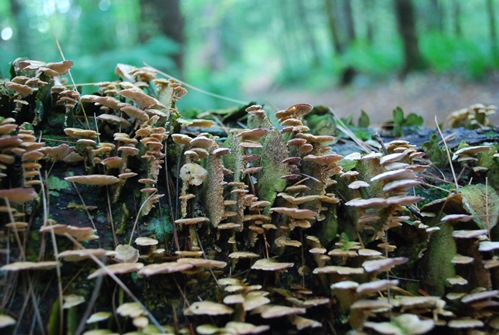
Fungi also take advantage of dead and dying trees, threading their hair-thin filaments through the softening wood or just under the bark. In fact, most of a fungus’ body might be inside a tree, while the smaller fruiting body, the part we commonly call a mushroom, spreads its fan on the outside of the tree, ready to release spores on the wind.
Turkey tail, a common fungus in Vermont, grow like this on rotting wood. Its fan-like, cream-colored fruiting body is striped with rusty brown, reminiscent of turkey feathers. According to naturalist Tom Wessels in his book Reading the Forested Landscape: a Natural History of New England, the presence of these fungi on wood tells us the tree died more than three years ago.
Sometimes, shelf fungi on wood tell us more than just how long ago the tree died. A fallen log near Mud Pond, in Colchester, hosts a layer of fungi on the trunk that spread their fans perpendicular to the trunk. The tree must have fallen and then a second layer of fungi grew on the first, this time parallel to the tree trunk. The fans always grow horizontally, so that if a tree tilts or falls, you can tell its former position.
A dying tree, a scraggly snag, a fallen log, and a cut stump are more than vestiges of living trees. From the insects to the birds and fungi, these symbols of death are still living, still fueling life in the forest.

