

BURLINGTON — Collaboration between medical professionals, service providers, educators and responsible families is the future of health care, proponents of reform said at a forum Thursday.
Health care reform advocates at the “Interprofessional Development Summit” at the University of Vermont discussed the need for Vermont to develop a state-led model of collaborative health care.
The challenge, they said, is that the current system is too specialized and prescriptive. Instead, it ought to be interdisciplinary and preventive.
Health care must rely on a holistic and interdisciplinary model that focuses on the long-term goal of general “well-being,” said Bud Meyers, director of the James M. Jeffords Center at UVM.
The purpose of the event, titled “People Helping People: Interprofessional Workforce Development Forum,” was to introduce professionals across the broad spectrum of health care often divided by distinct work cultures.
“You need them all,” Meyers said. “Family problems don’t come in the cute little boxes.”
The closest model to what Meyers is advocating for is Vermont’s Blueprint for Health, a program launched in 2003 by former Gov. Jim Douglas designed to bring a diverse range of organizations together to find health care solutions.
But even this well-intentioned model has problems, Meyers said. Cultural barriers prohibit collaboration, he said. This means that physicians, service providers and teachers all operate in isolation, from their clothing to the hours they work, he said.
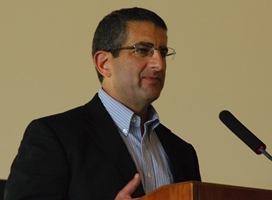
Craig Jones, director for the Vermont Blueprint for Health, said health care ought to be an industry that shares information. New technology would allow all disciplines to work together to treat patents.
Another challenge is funding for an interdisciplinary program, Meyers said. Money is “silo-ed” to specific organizations designed to perform a single task instead of a “team” that treats people in collaboration.
However, Jones said a new payment model for collaborative health care is not far-fetched, and might allow Vermont to be the laboratory for the task.
He said that under the Affordable Care Act (ACA), President Barack Obama’s 2010 overhaul of health care, states are allowed to design new payment models.
He said Vermont could lead the country in designing a payment model that would encourage various actors in the health care industry to work together by offering them financial incentives for their teamwork.
“The limitation isn’t funding, it’s us,” Jones said. “It’s what is our willingness to challenge the silos.”
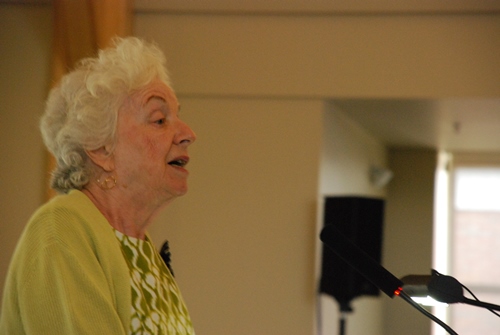
Former Gov. Madeleine Kunin came to the event to call for political action that will require creative solutions to a complex issue.
“This could start right here at the University of Vermont,” she said. “I ask you to speak out, go to Montpelier.”
Some community partners have been experimenting with collaborative treatment models and they say it’s working.
Kimberly Cookson of Elmore said the traditional pediatric care facilities were not able to treat her daughter, McKayla, now 14, who was born with a life-limiting metabolic condition that causes frequent seizures.
She decided to contact a family medical home, Hagan, Rinehart & Connolly Pediatricians, PLLC. At the home, physicians work with her family to discuss a holistic solution to meet her daughter’s need, Cookson said.
She said the family center operates like a “hub of information” that is centralized in its location but broad in its treatment.
Dr. Jill S. Rinehart said medical homes operate by “negotiating” with families. This means working with the family to come up with a solution specific to the patient’s needs, such as their child’s attendance in school or participation in other activities and programs.
Some issues cannot be treated by a simple doctor’s visit, Rinehart said.
“They don’t just take that into my office, they take that into the community,” she said.

